
Blog
How to Build a Second-Source Case After the Missile Multiyears
Two missile multiyears worth up to $45 billion combined go to one prime. For suppliers, the useful question is whether the part's users want a second source and what it takes to qualify.
Two of the largest munitions awards of the year landed within a week of each other. On September 25, the Pentagon awarded Raytheon a five-year AMRAAM contract with two option years, valued at up to $20.7 billion. On October 1, RTX announced a five-year SM-6 contract, also with two option years, valued at up to $24.4 billion.
Both are ceilings. Reuters reported that Congress has not yet funded the full deals and called the AMRAAM award provisional, and neither announcement says how many missiles they buy. The demand behind them is real, though. CBO's September 15 report on the cost of combat operations against Iran said the expenditure of missile defense interceptors "will leave the United States with a reduced inventory of interceptors for several years."
None of this money goes directly to a startup. It goes to the prime. The question for a component, materials or manufacturing company is what higher production rates do to the parts underneath the missile, and whether you can become a qualified source for one of them.
Start with the buyer's problem
Founders who see an opening like this usually lead with their technology, such as a faster process or a cheaper part. That pitch skips the two questions that decide whether anyone funds a second source.
An industrial-base program we spoke with recently put them plainly. Do the companies that use this part actually want a second source? And would a second qualified source reduce a meaningful supply-chain risk?
Those questions track the law behind DPA Title III, which requires findings that the item is essential to national defense and that U.S. industry cannot reasonably be expected to provide it in time without help. Neither finding turns on a better process.
Learn the qualification path before you pitch
A new source becomes a supplier when the part's owner approves it, which usually comes well after the part is shown to work. For most missile components, that owner is the prime or a sub-tier supplier, and the government may have its own source approval requirements on top.
Before you spend money on a pitch, find out:
Who owns the part today and who buys it.
How that owner approves a new source: approved supplier list, first article inspection, lot acceptance testing and any government approval.
How long qualification usually takes and who pays for the test articles.
Qualification for energetics and flight hardware usually takes years. If your runway cannot carry that, a teaming or licensing arrangement with an existing qualified supplier may be the better first step.
Document the risk you remove
Funders and primes respond to specific risk. Name it: a single domestic source, a foreign-sourced input, a lead time that limits the production rate, a capacity ceiling at current suppliers.
Then ask the buyer for evidence you can use. A letter of interest that names the part, the specification or test basis and the qualification path is realistic. A purchase commitment usually is not, because no prime will commit before your data exists.
You found the gap. Here is how to fund it.
With buyer interest and a documented risk, you have the raw material for an industrial-base project. For most companies the most direct door is Cornerstone.
Cornerstone is an Army-run other transaction consortium, managed by DEVCOM Chemical Biological Center and Army Contracting Command-Rock Island. The Office of the Assistant Secretary of War for Industrial Base Policy uses it to fund projects under the Industrial Base Analysis and Sustainment program, and the WIRE team inside that office decides what gets funded. Its standing call, Strengthening America's Manufacturing and Defense Industrial Base (SAMDIB), accepts white papers on a rolling basis across priority sectors that include kinetic capabilities, energy storage, castings and forgings, critical minerals, microelectronics and manufacturing capabilities. Membership is free, and a successful prototype can lead to a follow-on production OT without a new competition.
A few things decide whether the paper goes anywhere:
One capacity argument with numbers. Fund this project and U.S. capacity for this part goes from X to Y, or the import share falls by Z points, by a specific date. If you cannot write that sentence, the project is not ready.
A production deliverable. The program funds lines, equipment, qualification infrastructure and workforce. A study as the main deliverable will not carry it.
Demand evidence. Reference the buyer letters in the narrative. They are what turn a capacity claim into a credible one.
Speed and cost share. A running line in about two years reads far better than a long research arc, and cost share is weighed in the evaluation.
DPA Title III, the other industrial-base authority, tends to fit larger capacity investments. A prime may also fund supplier development when its own rate depends on it.
The Army is asking the same questions in public. Its Energetics Center of Excellence RFI (W519TC-26-R-0019) seeks concepts that reduce "foreign, sole-source, or other critical supply-chain dependencies" and names "long qualification timelines" as a constraint. Responses are due November 2 at 4:00 p.m. Central. Facilities must be at Blue Grass Army Depot and concepts should not rely on recurring government funding, so it suits teams that can co-invest.
Our Cornerstone SAMDIB guide explains how to join and submit.
A short checklist
Before you pitch a second source, you should be able to answer:
Which part, and who owns it today?
What is the qualification path, how long does it take and who pays?
What specific risk does a second source remove?
Which buyer has said, in writing, that it would consider qualifying you?
Can you write the capacity sentence for a Cornerstone white paper?
If the fourth or fifth answer is blank, keep doing customer discovery before you write the paper.
Sources
Defense News, "Pentagon awards Raytheon up to $20.7 billion to nearly double AMRAAM production," Sept. 29, 2026: https://www.defensenews.com/pentagon/2026/09/29/pentagon-awards-raytheon-up-to-207-billion-to-nearly-double-amraam-production/
RTX, "RTX's Raytheon awarded $24.4 billion multi-year contract for SM-6 interceptors," Oct. 1, 2026: https://www.rtx.com/news/news-center/2026/10/01/rtxs-raytheon-awarded-24-4-billion-multi-year-contract-for-sm-6-interceptors
Defense News, SM-6 award and appropriations status, Oct. 1, 2026: https://www.defensenews.com/industry/techwatch/2026/10/01/us-navy-awards-rtxs-raytheon-244b-for-sm-6-missiles-amid-stockpile-concerns/
Congressional Budget Office, "Estimating the Cost of Combat Operations Against Iran," Sept. 15, 2026: https://www.cbo.gov/publication/62756
SAM.gov, RFI W519TC-26-R-0019, Energetics Center of Excellence, posted Oct. 1, 2026, due Nov. 2, 2026: https://sam.gov/opp/513aee5332ab4f1083396f8b658e7978/view
Cornerstone OTA, SAMDIB (CIR CS-24-1801), SAM.gov special notice: https://sam.gov/opp/ff8191fa55494095858f6d95630bdb34/view
Cornerstone consortium: https://cornerstone.army.mil
Industrial Base Policy, WIRE and IBAS: https://www.businessdefense.gov/ibr/wire/ibas.html
50 U.S.C. 4533 (DPA Title III determinations): https://www.law.cornell.edu/uscode/text/50/4533
DPA Title III overview: https://www.businessdefense.gov/ibr/mceip/dpai/dpat3/docs/DPA-TitleIII-Overview.pdf
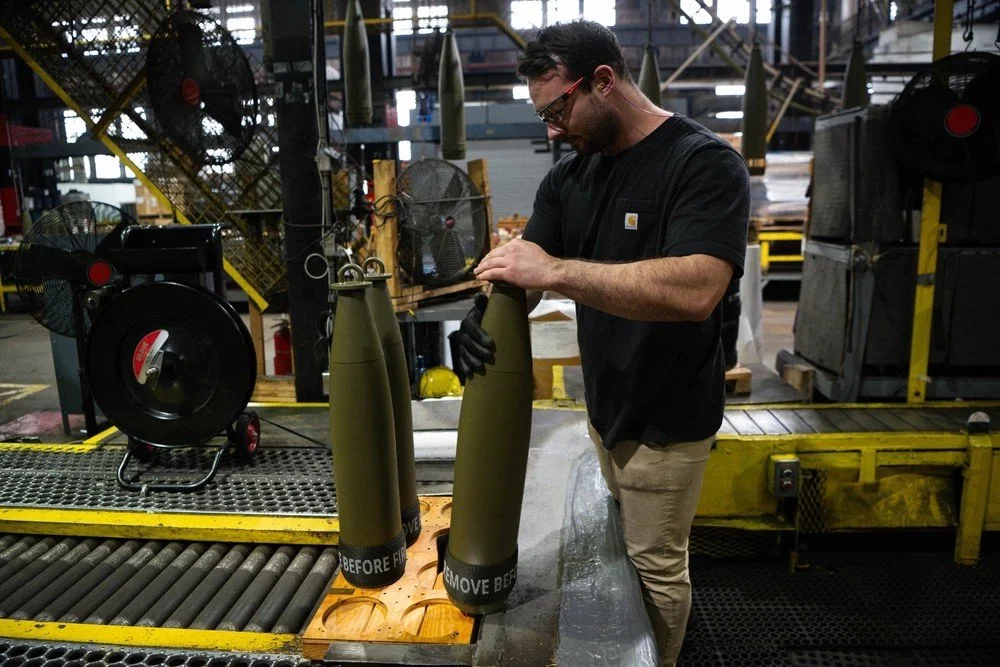
Photo: U.S. Army photo by Henry Villarama, Joint Munitions Command, March 26, 2024. The image shows artillery shell production at Scranton Army Ammunition Plant, not AMRAAM or SM-6. The appearance of U.S. Department of War visual information does not imply or constitute DoW endorsement.

The Pentagon Is Buying 60,000 Drones. Here Are Three Ways Deep-Tech Founders Get In.
The Pentagon’s roughly $1.1 billion Drone Dominance Program is creating a few scaled drone champions and pushing them onto a domestic supply chain. That opens doors for far more than drone makers.
The Department of War's Drone Dominance Program has finished its second competitive round. The program named its top performers in September and plans to order about 60,000 drones from them, with final quantities set at contract award.
The program is worth understanding even if you have never built a drone. It is a roughly $1.1 billion, four-phase buy designed to create a few scaled U.S. drone companies. It is also deliberately pushing those companies toward a domestic and allied supply chain. That combination creates openings for component, materials, payload and autonomy companies.
How the program works
Drone Dominance is sponsored by the Office of the Secretary of War and executed by the Test Resource Management Center, with the Defense Innovation Unit overseeing industry engagement. Awards are prototype Other Transaction agreements under 10 U.S.C. 4022. NSWC Crane awards them, and they are managed through the NSTXL consortium portal. The most recent call says NSTXL membership is not required to respond but is required before award.
Each phase centers on a Gauntlet. Vendors deliver drones, military operators fly them against realistic missions, and the government orders from the top performers. Gauntlet 2 ran at Fort Carson from August 16 to September 5, 2026. DefenseScoop reported 1,858 sorties across 23 platform types from 19 companies. The top performers were:
Deep Strike: Perennial Autonomy, Hyperscale, Neros, Skycutter and Swarm Defense Technologies
Close Quarters Battle: Neros, ORQA US, XTEND Reality, Vector and ModalAI
The program's March 2026 industry day slides laid out the plan. They put Phase III around February 2027, with about $350 million. The stated goal is three to five "champion" companies that are "profitable, scaled, and selling to DoD at low cost."
Door 1: Build the drone
Gauntlet 3 is expected about six months after Gauntlet 2. If you build small UAS, treat February 2027 as your planning date and watch dronedominance.mil and the NSTXL portal for the next request for solutions.
Flight performance is only part of the score. The latest call evaluates four things:
performance in degraded RF and GNSS environments
structured feedback from military operators
compliance with the program's supply chain framework
production capability, assessed through surveys, interviews and site visits
Gauntlet 2 vendors had to deliver 120 drones, with a mix of live, safe-armed, trainer and dummy payloads, before the event even started. A company that cannot show volume production and a compliant bill of materials will struggle, however good its aircraft is.
Door 2: Supply the winners
This is the widest door, and most founders overlook it.
The program publishes a supply chain framework that tightens each phase. The Phase 2 floor requires motors, battery packs, flight controllers and ground control stations assembled outside covered countries. The Phase 3 minimum, around February 2027, adds battery cells from non-covered countries that comply with Section 842 of the FY2026 NDAA, and requires motor makers to have a DFARS-compliant magnet sourcing plan. The Phase 3 preferred level adds non-covered-country magnet production and winding, with disclosed rare earth feedstock origin. By the Phase 4 minimum, magnet production and rare earth feedstock must both be non-covered. The call also states that vendors exceeding the minimums score higher, so the demand for compliant parts shows up before each floor takes effect.
The top performers now have to deliver at volume while their sourcing rules tighten. That is a direct demand signal for companies that make:
magnets and motor components
battery cells and packs
flight controllers, radios and GNSS modules
cameras and sensors
the manufacturing equipment and processes that make any of these cheaper at scale
This is a supplier route, not a direct government opportunity. Your customer is the drone company. The pitch is a qualified, compliant part that lets them meet the next phase floor at their price target.
For materials and component companies, the same demand also strengthens the case for industrial-base funding. A letter of intent from a Drone Dominance vendor is exactly the kind of demand evidence those programs look for.
Door 3: Make the drone more capable
Gauntlet 2 vendors had to partner with at least one lethality provider, and five payload vendors took part. The Phase 2.5 bomber-drone call lists areas of particular interest:
advanced target engagement, such as pixel locking and automated target recognition
autonomous behaviors, such as GPS-denied navigation and mission continuation after link loss
open data feeds and interfaces
Payload, autonomy, EW-resilience and software companies usually enter by teaming with a platform vendor before the next Gauntlet. The team is scored together, so the time to form it is well before the call opens.
What to do this month
Decide which door fits your company. Most deep-tech companies belong in Door 2 or 3.
Read the supply chain framework and the most recent request for solutions on dronedominance.mil. The Phase 2.5 call closed August 5, so use it as a preview of what Gauntlet 3 will ask for.
If you are a supplier, map your part against the Phase 3 and Phase 4 requirements and identify which top performers need it.
If you are a platform company, build the production and supply chain evidence now. Four months is not long to prove volume.
Register on the NSTXL portal so you can see program correspondence.
Figures come from Department of War materials and the reporting cited below. Order quantities are planned, not obligated, and are finalized at contract award.
Photo: A small unmanned aircraft system is prepared for launch during the Air Force's Game of Drones 26-2 at Edwards Air Force Base, California. This is not a Drone Dominance Gauntlet event. U.S. Air Force photo by Brandon Hernandez, 412th Test Wing, via DVIDS. The appearance of U.S. Department of War visual information does not imply or constitute DoW endorsement.
Sources
Drone Dominance Program official site: https://dronedominance.mil/
Department of War, "Drone Dominance Program Receives First Order, Gauntlet II Gets Underway": https://www.war.gov/News/News-Stories/Article/Article/4520698/drone-dominance-program-receives-first-order-gauntlet-ii-gets-underway/
Drone Dominance Industry Day program overview, March 26, 2026: https://dronedominance.mil/assets/industry-day-slides/DDP_Program_Overview.pdf
S2MARTS Drone Dominance Phase 2.5 Mission C Request for Solutions: https://dronedominance.mil/assets/S2MARTS%20Drone%20Dominance%20G2%20RFS%20-%20Phase%202.5%20Mission%20C.pdf
DefenseScoop, "Pentagon unveils top performers in latest 'Gauntlet' for Drone Dominance Program," September 18, 2026: https://defensescoop.com/2026/09/18/drone-dominance-program-gauntlet-2-results/
Soldier Systems Daily, "Drone Dominance Program Announces Gauntlet II Results," September 25, 2026: https://soldiersystems.net/2026/09/25/drone-dominance-program-announces-gauntlet-ii-results/
S2MARTS Drone Dominance Gauntlet II Request for Solutions (Final): https://dronedominance.mil/assets/S2MARTS%20Drone%20Dominance%20G2%20RFS%20-%20Final.pdf
DVIDS, "AMCOM Safety supports Gauntlet 2 drone evaluation at Fort Carson," September 11, 2026: https://www.dvidshub.net/news/574452/amcom-safety-supports-gauntlet-2-drone-evaluation-fort-carson
Drone Dominance Program Supply Chain Framework: https://dronedominance.mil/assets/misc/DDP%20Supply%20Chain%20Framework.pdf
Inside Unmanned Systems, "Inside the Drone Dominance Supply Chain: What Every U.S. Drone Company Must Source and by When": https://insideunmannedsystems.com/inside-the-drone-dominance-supply-chain-what-every-u-s-drone-company-must-source-and-by-when/
The Navy Wants Help Getting People to Adopt New Technology. That Opens a Door for Non-Defense Startups.
NAWCAD says technology adoption fails when workforce adoption comes second. Its new challenge is open to small businesses and nontraditional companies, and it fits far more of them than a typical Navy topic.
The prototype challenge the Naval Air Warfare Center Aircraft Division (NAWCAD) posted on September 25 is about people more than hardware. NAWCAD wants better ways to help its workforce adopt new technology.
What NAWCAD is asking for
NAWCAD delivers research, development, test, evaluation and sustainment for naval aviation. Its challenge, the Workforce Innovation and Capability Integration Challenge, describes what happens when an organization tries to adopt new technologies, processes and structures quickly. According to NAWCAD, the workforce faces "simultaneous capability, identity, cultural, and operational shocks," and the problem is that "the pace of change exceeds the pace of support."
The conclusion is stated plainly: "technology adoption fails when workforce adoption is treated as secondary." NAWCAD wants "practical, evidence-based ways to close the gap between the pace of change and the pace of support, so that new technologies and processes are adopted as quickly as they are introduced."
The critical focus areas are interdisciplinary collaboration, systems thinking and "learning as a part of daily performance." The listing is tagged Collaboration Tools. NAWCAD says it wants to work with "nontraditional defense contractors, nonprofit research institutions, and small businesses" to "develop and prototype novel methods."
NAWCAD already works on this problem itself. In August it described a new standardized training and certification process that it says expands the Navy's in-house fiber optic repair capability by 400 percent. The challenge asks outside organizations to help it do that kind of work faster and more broadly.
Who fits
This is my reading, not NAWCAD's list. The challenge fits companies whose product or method measurably shortens the time between "we bought a new tool" and "people use it well." That includes:
learning and training platforms, including adaptive learning and microlearning
XR, simulation and digital twins used for training
AI assistants and performance-support tools that guide people inside a task
collaboration, knowledge-management and expertise-finding software
digital adoption and change-management platforms
nonprofit research groups working on organizational behavior and learning science
A company can fit without any defense history if it has evidence that its approach changes adoption outcomes.
How the process works
The challenge is posted on the GoColosseum Marketplace, run by One Nation Innovation (ONI), a 501(c)(3) nonprofit. ONI describes the marketplace as free. In July 2025, Army Contracting Command-Rock Island posted a notice saying it had awarded ONI an OT-based marketplace award, with a period of performance of June 4, 2025 to June 3, 2030. The notice describes the marketplace as "a single location for the Government to issue challenges and make awards utilizing OTA, Commercial Solution Openings (CSO) and other acquisition authorities." Federal award data shows OT actions to ONI funded by NAWCAD and several other DoW offices.
In at least one recent challenge on the platform, selected respondents became ONIX consortium members and performed under ONI's Other Transaction Agreement. If that holds here, your agreement would be with ONI. Ask for ONI's member terms on IP, data rights, fees and payment timing before you commit significant effort.
The challenge closes October 15. HigherGov lists the close time as 1:00 p.m. ET, which is noon Central. Confirm the time on the live listing after you register. The listing does not publish an award amount.
How to build a strong response
Anchor on one realistic scenario. NAWCAD's workforce includes engineers, scientists, testers and maintainers. Pick one adoption problem, such as engineers moving to a new digital engineering tool or technicians learning a new repair and certification process. Show how your method works there.
Name the metric before the method. Evaluators need to see what gets better. Time to proficiency, error rates, rework, usage and certification pass rates are all measurable.
Bring evidence. NAWCAD asks for evidence-based approaches. Results from a commercial deployment, a pilot or published research carry weight, even if they come from outside defense.
Keep the prototype small and measurable. A bounded pilot with one team, a baseline and a comparison is easier to approve than an enterprise transformation.
Show how it scales. Explain how the approach would move from one team to the rest of the command, and what NAWCAD staff would need to run it themselves.
Checklist
Register your organization on GoColosseum.
Request ONI's member terms.
Choose one NAWCAD scenario and one adoption metric.
Assemble your strongest evidence.
Draft a small prototype plan with a measurement approach.
Submit before October 15.
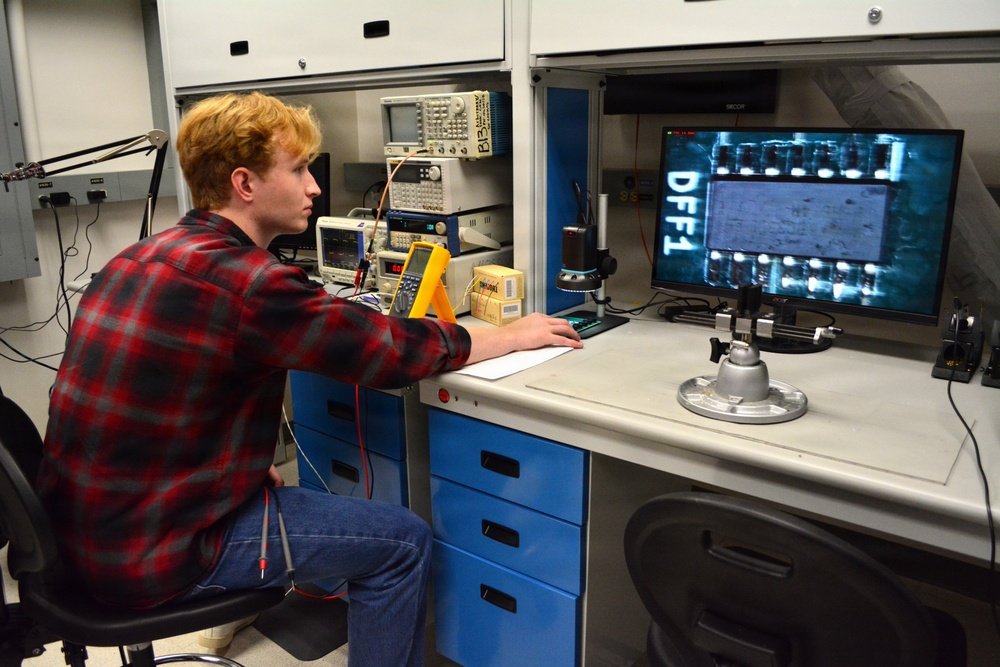
Photo: U.S. Navy photo by Jacob Moore, Naval Air Warfare Center Aircraft Division, via DVIDS. The appearance of U.S. Department of War visual information does not imply or constitute DoW endorsement.
Sources
GoColosseum, NAWCAD Workforce Innovation and Capability Integration Challenge: https://marketplace.gocolosseum.org/public/challenges/5d92b4a3-b78c-41db-a0f2-50892a2e2eb7
HigherGov mirror of the challenge text and dates, posted 2026-09-25, due 2026-10-15 13:00 ET: https://www.highergov.com/contract-opportunity/nawcad-workforce-innovation-and-capability-integ-5d92b4a3-b78c-41db-a0f2-50892a2e2eb7-o-d8fff
SAM.gov, ACC-RI Special Notice, "Open National Innovation Exchange - Open opportunities," posted 2025-07-21: https://sam.gov/opp/ab096d6b8c1c4c409aed6961c326c12b/view
One Nation Innovation: https://onenationinnovation.org/
HigherGov, One Nation Innovation awardee profile (FPDS OT actions): https://www.highergov.com/awardee/one-nation-innovation-265266797/
DVIDS, "Navy bringing fiber optic repair in-house to expand fleet capability by 400 percent," NAWCAD, 2026-08-05: https://www.dvidshub.net/news/571633/navy-bringing-fiber-optic-repair-house-expand-fleet-capability-400-percent
“Capability in 24 Months or Less”: How Deep-Tech Founders Can Build a Minimum Viable Capability
A Pentagon official says his office delivers capability in 24 months or less, or it's a science project. How can deep tech meet that clock? Build a minimum viable capability.
"We deliver capability in 24 months or less. If you don't fit in my construct, that's a science project."
Mike Dodd, Assistant Secretary of Defense for Critical Technologies, said that to Federal News Network in an interview published September 25, 2026. For deep-tech founders, it raises a hard question: how do you deliver capability in 24 months when the breakthrough behind it needs five years or more?
Some context on the quote. Dodd oversees three of R&E's six critical technology areas: contested logistics, quantum and battlefield information dominance, and scaled directed energy. The interview ran as sponsored content, and the 24-month rule is his description of how his office works, not a department-wide policy. The tension it exposes is familiar to most deep-tech founders: the customer wants something useful in two years, and the technology is rarely finished that fast.
The answer I would give founders borrows a phrase the Pentagon already uses.
The Pentagon's own term
On February 21, 2024, then-Deputy Secretary of Defense Kathleen Hicks announced that CJADC2, the department's effort to connect sensors and command systems across the services, had reached a "minimum viable capability." She said it was "real and ready now." CDAO chief Craig Martell described the approach as figuring out how to "get something in front of the warfighter quickly, but do it in such a way that we can sustain it and make it grow."
That CJADC2 capability was software, data and networks. The idea transfers well to deep tech with one adjustment. Here is how I define a deep-tech minimum viable capability (MVC). This is my extension of the term, not an official DoD definition.
A deep-tech MVC is the smallest improvement in capability a warfighter can use within about 24 months, built from what already works, with the breakthrough saved for a later block.
Four tests for a deep-tech MVC
1. It is in users' hands. A lab demonstration does not count. Operators should be able to use it in the field, even if only one unit has it.
2. It improves a capability the unit already measures. Range, detection time, equipment downtime, navigation accuracy or cost per engagement. Describe the gain in the user's terms, not your technology's specifications.
3. It is built from what is mature today. Freeze the design on the parts that already work. Put the breakthrough on the Block 1 roadmap instead of the critical path.
4. It has a next owner. Name the service, program office or unit that would keep it and fund what comes next. Without that, a fast prototype still dies after the demo.
Four ways to build one
Narrow the mission. Pick one mission where today's performance already beats what is fielded. The Army's Rapid Capabilities and Critical Technologies Office awarded Epirus $66.1 million in December 2022 for four high-power microwave prototypes to counter drone swarms. The first prototype was delivered within about a year. It was derived from Epirus's existing Leonidas system, which is why it could move that fast.
Ride platforms that are already flying. If your technology has a software or model layer, run it on hardware the services already operate. In August 2024, SandboxAQ's AQNav magnetic navigation system was flight-tested as the primary navigation method on an Air Force C-17.
Use exercises as early evidence. Scheduled exercises put prototypes in front of operators in real conditions. Vector Atomic's optical clocks ran continuously at sea for more than 20 days during RIMPAC 2022. This is evidence, not qualification. It builds user confidence long before a program would.
Run two lanes with two pitches. Keep the long-horizon science in research programs such as SBIR Phase I where topics exist, NSF, DARPA and the service labs. Pitch the MVC separately to the offices that buy near-term capability. Mixing them in one pitch makes the near-term offer look like a science project.
Put the MVC in the contract
A deep-tech MVC is easier to fund when the first agreement says what "done" means. Under 10 U.S.C. 4022(f), a prototype other transaction that was competitively awarded and "successfully completed" can lead to a follow-on production award without a new competition. The statute leaves success to the agreement, so write objective, testable criteria for a first 18 to 24 month increment. That opens a path to production but does not guarantee the money.
What the MVC does not do
Certification still sets its own clock. Airworthiness, safety, nuclear, medical and export approvals cannot be rushed, so the MVC has to be designed around them.
Years of research do not compress into months either. Every example above sits on years of earlier development, and the 24-month clock starts when the program starts.
A customer is still required. The next owner in test four is what separates a capability from a demo.
Where to start
Write one page that answers four questions. What would your MVC be? What capability does it improve, and by how much? Which parts of your technology does it use, and which parts wait for Block 1? Who keeps it after the prototype?
If the answers are clear, you have something to bring to the users and program offices behind the problem. For the offices Dodd oversees, R&E's current entry point is the critical technology area contact form on cto.mil. A consolidated industry "front door" portal is planned but not live.
If the answers are not clear yet, that is useful too. It tells you which lane your next dollar belongs in.
Sources
DefenseScoop, "What's next for the new CJADC2 minimum viable capability," February 26, 2024
C4ISRNet, "Pentagon achieves 'minimum viable' version of CJADC2, Hicks says," February 21, 2024
Office of the Under Secretary of War for Research and Engineering, Critical Technology Areas
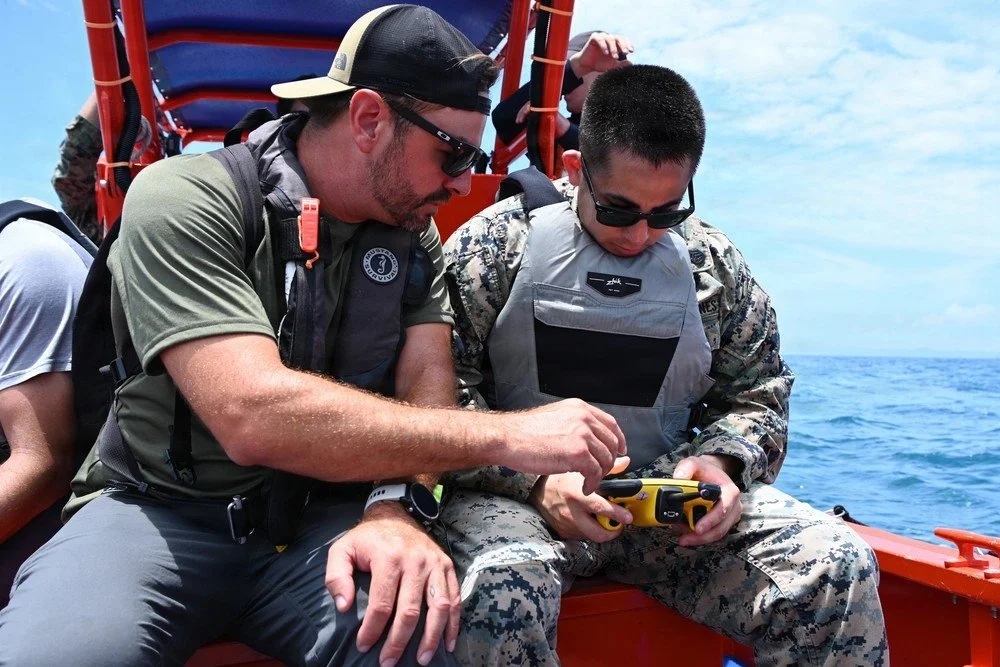
Photo: Ryan Faber, a Naval Surface Warfare Center Carderock civilian, shows U.S. Marine Corps Staff Sgt. Joseph Banuelos, 3rd Marine Logistics Group, how to operate the remote control for an unmanned foam raiding craft during RAMFORCE, an initiative hosted by the Office of the Under Secretary of Defense for Research and Engineering, at Valiant Shield 26, White Beach, Okinawa, Japan, June 29, 2026. U.S. Marine Corps photo by Cpl. Rachel Mason, via DVIDS. The appearance of U.S. Department of War visual information does not imply or constitute DoW endorsement.
Open Topics Are Shrinking. Here Is How to Keep Funding Moving When You Have Demand.
The customer now shows up before the topic does. Founders who keep talking to new users, and who know the routes beyond the next open topic, can keep funding moving.
For years, a broad open topic let a founder bring almost any dual-use technology to the Air Force and let the government decide whether it fit. That door is narrowing. More of the money now starts with a customer who has already defined the problem.
What changed
When AFWERX and SpaceWERX reopened SBIR and STTR solicitations after reauthorization this spring, they organized them around seven focus areas and a cohort-based model that groups related technologies against specific capability gaps. AFWERX describes its specific topics as having "clearly-defined requirements and a known Air Force customer built into the topic solicitation." The current DoW SBIR/STTR Release 6 window runs through October 21.
The practical effect is simple. The customer shows up before the topic does. If you wait for a solicitation to meet your first user, you are starting after the people who helped shape it.
Talk to new users before there is a topic
The companies that keep funding moving treat user conversations as continuous work, not a pre-proposal step. Two reasons.
First, one champion isn't a pipeline. Government advocates rotate, retire and move to new jobs. A single relationship can disappear in a PCS cycle.
Second, different users open different money. An operational unit, a program office, a lab and a sustainment organization each use different funding and different contracting routes.
In every conversation, try to leave knowing:
What problem this person owns, and how they measure it today.
Who else feels the same problem, in their organization or another one.
Whether money exists this fiscal year or next, and what kind.
Which contracting routes their office actually uses.
What evidence they would need to see before acting.
When you already have demand
A user who wants your technology is the asset. The question is which route turns that interest into a contract. Here are the main ones, and what each needs.
A sponsored topic. Specific topics come from government customers. If your user has a real gap, ask whether they would sponsor a topic in a future release. It takes time, but it points a solicitation at the problem you solve.
TACFI and STRATFI. For companies with a current or recent Phase II, AFWERX matches SBIR funds with government or private dollars. TACFI provides $375,000 to $2 million with 1:1 cost share. STRATFI provides $3 million to $15 million in SBIR funds matched by $6 million to $45 million. Both need a government customer committed enough to put up money.
A public example: in 2020, the Texas Military Department secured $7.5 million from the National Guard Bureau, plus $6 million from AFRL and the Rapid Sustainment Office, to back an additive manufacturing startup through STRATFI, with the SBIR program matching those funds. The relationship began a year earlier, when an Air National Guard metals technician met the Phase I company during a customer discovery session.
SBIR Phase III. If the new work derives from, extends or completes earlier SBIR work, an agency can award a Phase III without a new competition. Phase III uses non-SBIR money, so the customer still has to find the funds.
Commercial Solutions Openings and OT consortia. These let a program office fund a prototype outside the SBIR calendar. They work best when the user can point the contracting office to an existing opening or consortium.
APFIT. For production-ready technology, APFIT provides $10 million to $50 million in procurement funding per project. Only a government organization can submit, on behalf of an eligible small business or nontraditional contractor. Companies can't apply directly.
The common requirement
Every route above needs a government person willing to act for you: sponsor a topic, commit matching funds, find Phase III money or submit a nomination. That is why the user conversations matter more now than the proposal writing.
Checklist
List every government user you have spoken with in the last 90 days, and mark the ones who own a problem and a budget.
Add at least two new users outside your current champion's organization.
For each interested user, identify the money (type and fiscal year) and the contracting route their office uses.
Match your stage to the route: Phase II for TACFI or STRATFI, prior SBIR work for Phase III, production readiness for APFIT.
Decide what evidence you need to produce before the user can act.
Have demand? Let's talk
If you have a government user who wants what you've built and you're not sure which route fits, send me a message. I'm glad to talk it through.
Sources
DVIDS, "AFWERX, SpaceWERX open new SBIR/STTR solicitations following reauthorization," Apr. 29, 2026
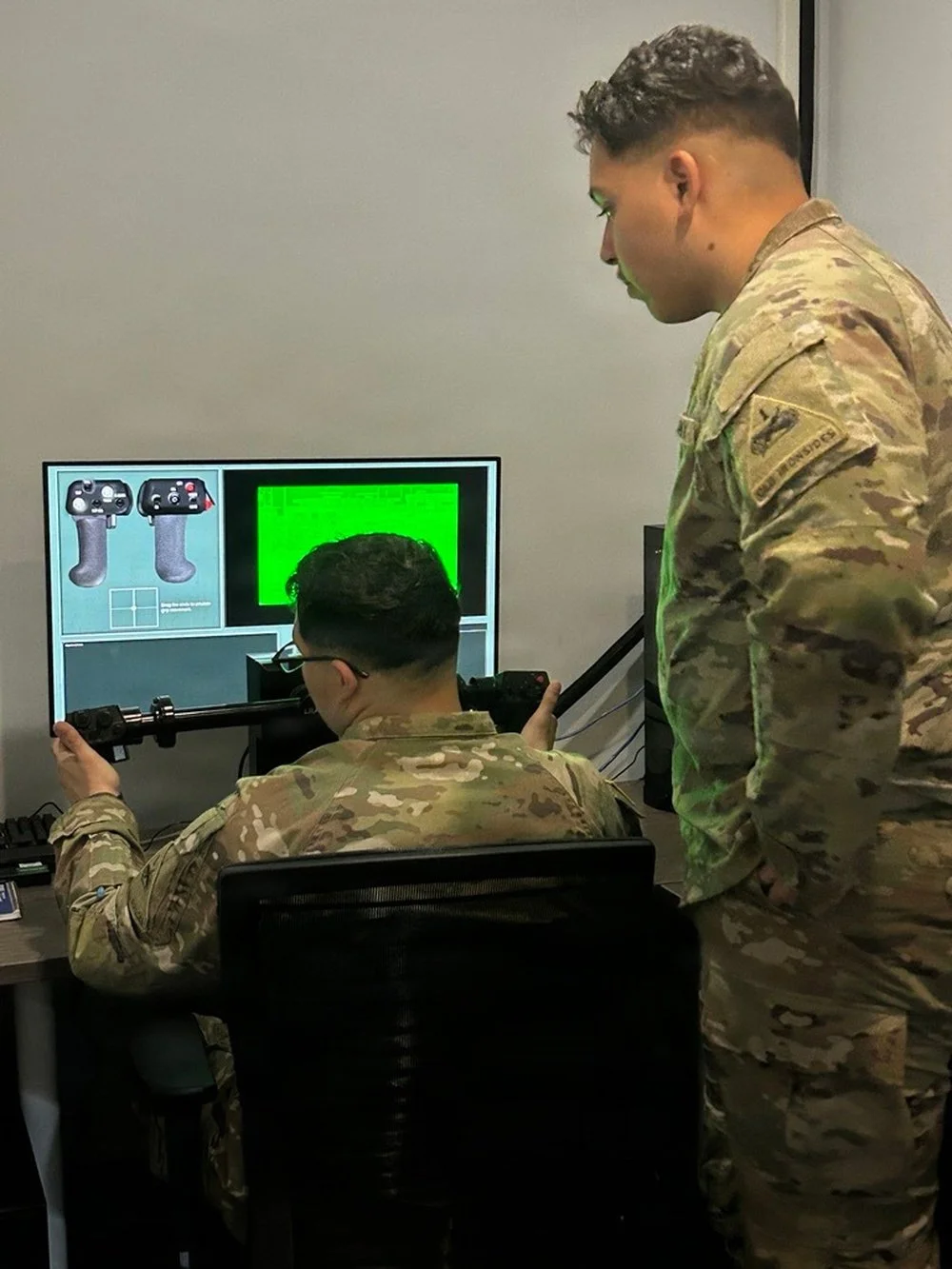
Featured photo: Soldiers familiarize themselves with legacy LRAS3 hand grips before evaluating FALCONS sensor prototypes during a Soldier Touch Point, February 2026. U.S. Army photo by M. Scott Bortot, via DVIDS. The appearance of U.S. Department of War visual information does not imply or constitute DoW endorsement.