
Innovation Funding Database
Choose Your Area of Innovation:
Advanced Materials & Manufacturing
Aerospace & Spacetech
Agtech & Foodtech
Artificial Intelligence & Machines Learning
Biotech
Cleantech & Climatetech
Cybersecurity
Defensetech & Dual-Use Tech
eXtended Reality
Healthtech
Medtech
Other Tech
Quantum & Photonics
Robotics & Autonomous Systems
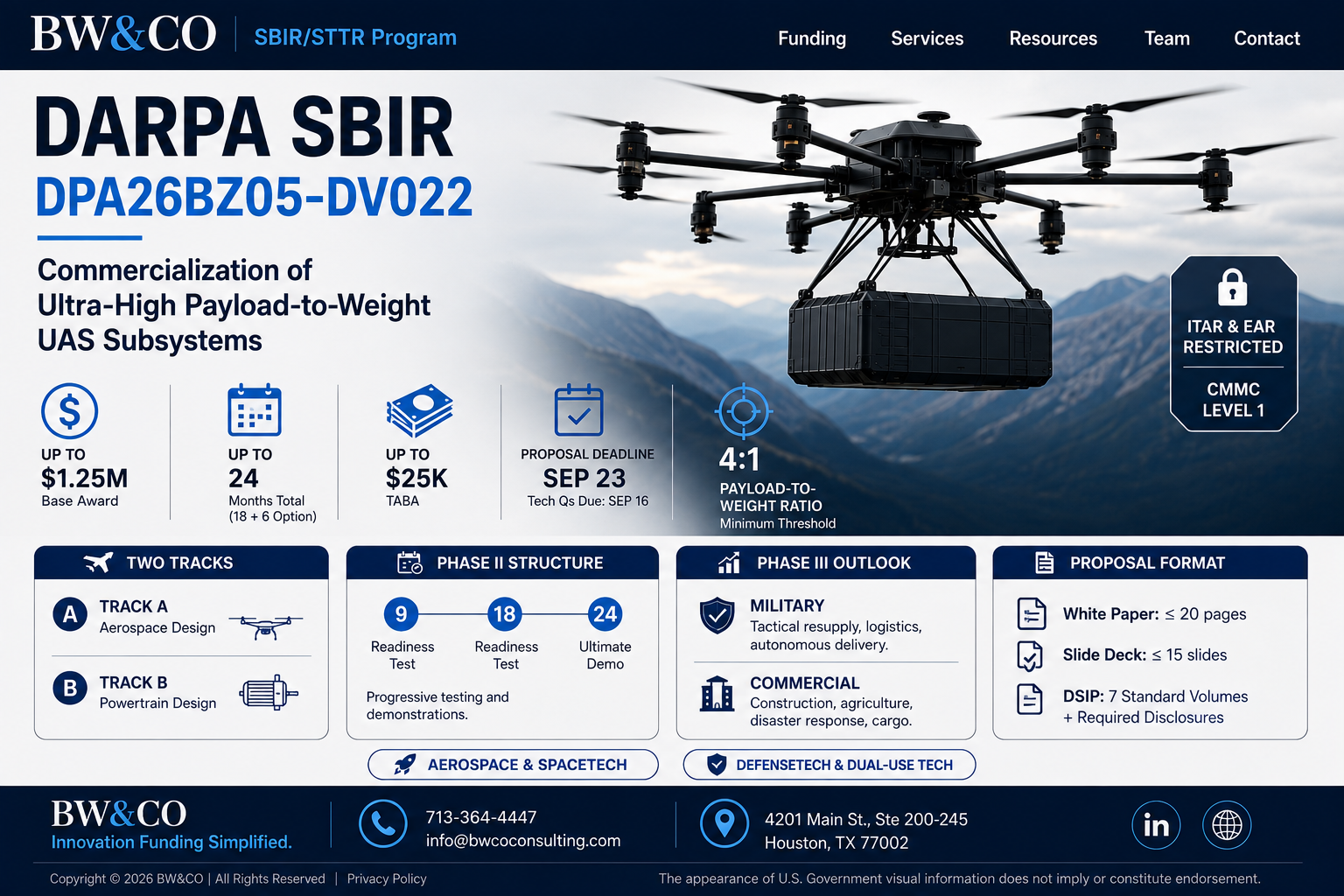
DARPA SBIR DPA26BZ05-DV022: Commercialization of Ultra-High Payload-to-Weight UAS Subsystems
Deadline: September 23rd, 2026
Funding Award Size: $1.5m
Description: Everything startups need to know about DPA26BZ05-DV022, DARPA's SBIR topic for commercializing ultra-high payload-to-weight UAS subsystems. Funding, deadlines, and requirements. Proposals due September 23.
Below is a brief summary. Please check the full solicitation before applying (link in resources section).
Quick Answer
DPA26BZ05-DV022 is a DARPA Direct to Phase II SBIR topic seeking to commercialize UAS subsystems that break the 4 to 1 payload-to-weight ratio, building directly on results from the DARPA Lift Challenge. The award is worth up to 1,250,000 dollars over an 18 month base period, with an optional 250,000 dollar, 6 month extension, for a total period of performance up to 24 months. Proposals are due September 23. The topic is ITAR and EAR restricted and carries a CMMC Level 1 requirement.
What This Topic Is Looking For
Most multirotor UAS today max out around a 1 to 1 payload-to-weight ratio. The DARPA Lift Challenge proved that a 4 to 1 ratio is achievable through aggressive weight minimization, advanced materials, and novel propulsion. This topic exists to take that proof of concept and turn it into a manufacturable, certifiable, commercially viable product.
Proposers choose one of two tracks and may only submit one proposal per track.
Track A, Revolutionary Aerodynamic Design, focuses on ultra-lightweight structures and novel airframe or rotor configurations, plus the commercialization subcomponents needed for a real product: communications, autonomy, safety systems, and transportability, along with starting the certification process.
Track B, Revolutionary Powertrain Design, focuses on transitioning a high-efficiency, high-power-density propulsion system away from hand-built prototypes and into a mass-produced, certified module that any UAS integrator could drop into their platform.
Both tracks are structured around the same demonstration philosophy: prove the design works, then prove it can be manufactured repeatably at scale, then prove it survives real operational stress, and finally deliver a complete technical data package with an active certification roadmap.
DP2 Feasibility and Phase II Structure
This is a Direct to Phase II topic only, so proposers need a working proof of concept already in hand. That means empirical data, flight logs, or prototype test results proving the baseline concept meets or exceeds the 4 to 1 payload-to-weight threshold, along with first order analysis that complements the empirical data. DARPA specifically calls out participation in the DARPA Lift Challenge as an ideal way to satisfy this requirement, though similar rigorous testing environments are also acceptable.
Phase II runs up to 24 months with Readiness Tests at Month 9 and Month 18, followed by an Ultimate Program Demonstration at Month 24. Each track escalates in difficulty at each checkpoint.
For Track A, the Month 9 test requires producing three identical structural components using scalable manufacturing and proving less than 10 percent variance in failure load across them at a 4 to 1 ratio. The Month 18 test requires integrating the airframe into a full UAS weighing no more than 1,320 pounds, complete with communications, autonomy, and safety systems, then flying an untethered hover demonstration at a 4 to 1 payload ratio for at least 5 continuous minutes. The Month 24 demonstration requires a complete technical data package and formal initiation of certification under standards like AS9100 for manufacturing and FAA airworthiness or military flight release for operational use.
For Track B, the Month 9 test requires producing three identical, mass-production-ready powertrain units and proving less than 5 percent performance variance across them on a dynamometer. The Month 18 test requires an accelerated life-cycle and environmental stress test following MIL-STD-810 procedures, plus a continuous operation test simulating a real heavy-lift mission profile without thermal failure or degradation. The Month 24 demonstration requires a final analysis package and a technical data package tailored for mass production, mapped against FAA airworthiness standards and relevant MIL-STDs.
Phase III Outlook
Phase III is oriented toward transition within the military and further commercialization. Military applications include tactical resupply, autonomous ammunition or ration delivery in contested logistics environments, and rapid casualty evacuation. Commercial applications include delivery of heavy construction materials to high-rise sites, automated disaster response logistics, heavy-duty agricultural spraying, and commercial cargo transport.
Funding and Timeline
Base award amount: up to 1,250,000 dollars for an 18 month period of performance.
Option amount: up to 250,000 dollars for an additional 6 months, bringing the total period of performance to 24 months.
TABA: up to 25,000 dollars per Phase II project, reviewed at time of award.
Proposal deadline: September 23. Technical questions must be submitted by September 16, since DARPA does not answer questions submitted within 7 calendar days of the closing date.
Proposal Format
This topic uses the white paper and slide deck Technical Volume format. The white paper cannot exceed 20 pages and needs to cover goals and impact, proof of concept feasibility documentation, a technical plan with milestones no more than a month apart, management and capabilities, and a transition and commercialization plan. The slide deck cannot exceed 15 slides and covers the same ground in pitch format, including cost, schedule, and DARPA's required quad chart templates.
All proposals go through DSIP and require the standard seven volumes: cover sheet, technical volume, cost volume, Company Commercialization Report, supporting documents, Fraud Waste and Abuse training, and the Disclosures of Foreign Affiliations webform, which must be completed as a webform and will not be accepted as a PDF upload.
Frequently Asked Questions
What is the deadline for DPA26BZ05-DV022? September 23. Technical questions must be submitted by September 16.
Is this a Phase I or Phase II award? Phase II only. Proposers must already have proof-of-concept data proving a 4 to 1 payload-to-weight ratio, since this topic accepts Direct to Phase II proposals exclusively.
Do I have to have competed in the DARPA Lift Challenge to qualify? No, but DARPA specifically calls Lift Challenge data ideal for meeting the proof-of-concept requirement. Data from other similarly rigorous testing environments is also acceptable.
Can a company propose to both Track A and Track B? A proposing team may submit one proposal per track, so a company could pursue both an aerodynamic design proposal and a separate powertrain proposal, but not more than one proposal per track, and no firm can be selected for more than one Phase II award on this topic overall.
What is the weight limit for the integrated UAS in Track A? No more than 1,320 pounds, which anticipates FAA Part 108 requirements for larger drone operations.
Is this topic export controlled? Yes. It is restricted under ITAR and may also fall under EAR. Any planned use of foreign nationals must be disclosed, including country of origin, visa status, and specific tasks.
Can venture capital or private equity backed companies apply? Yes. DARPA topics under this BAA explicitly accept proposals from companies more than 50 percent owned by venture capital operating companies, hedge funds, or private equity firms, provided the company registers with the SBA Company Registry Database and submits the required VC certification.
DARPA SBIR DPA26BZ05-DV021: Open Architecture Platform for Underwater Vehicles for Rapid Adaptation, Collaborative Sensing, Navigation, and Autonomy
Deadline: September 23rd, 2026
Funding Award Size: $1.8m
Description: Everything startups need to know about DPA26BZ05-DV021, DARPA's Open Architecture Platform SBIR topic for modular autonomous underwater vehicles. Funding, deadlines, and requirements. Proposals due September 23.
Below is a brief summary. Please check the full solicitation before applying (link in resources section).
Quick Answer
DPA26BZ05-DV021 is a DARPA Direct to Phase II SBIR topic seeking a modular, open-architecture autonomous underwater vehicle platform that supports rapid payload swaps, fleet-scale deployment, and multi-vehicle collaboration. The award is worth up to 1,800,000 dollars over a 24 month period of performance, with no option period. Proposals are due September 23. This topic carries a CMMC Level 1 requirement.
What This Topic Is Looking For
DARPA wants to move away from proprietary, single-purpose underwater vehicles and toward an open ecosystem where hardware and software can be reconfigured without specialized tooling. Open architecture here means both physical modularity for hardware reconfiguration and adherence to open software standards so sensors, communications, navigation, and autonomy stacks can plug in interchangeably.
The platform needs to be two-person portable and support operations for up to 24 hours, while maintaining strict control across the water column, including fixed-depth stationkeeping, since vehicle stability directly determines whether the data collected is usable. DARPA describes an end-to-end mission lifecycle approach built around several capability areas: a modular, flooded-hull architecture that allows upgrades or repairs in hours or days without specialized tooling, software hooks that support task allocation across heterogeneous vehicles without burdening the end user, a seamless multimodal mesh communications network linking acoustic, RF, cellular, and satellite channels, an integrated software ecosystem connecting mission planning, command and control, and centralized data analytics, scalable hardware integration with software-optimized, customizable propulsion tailored to specific hydrodynamic profiles, and signature management to minimize acoustic and hydrodynamic wake.
DP2 Feasibility and Phase II Structure
This is a Direct to Phase II topic, so no Phase I award will be made. To qualify, proposers need to demonstrate feasibility across three domains: vehicle dynamics and hydrodynamic modeling data covering propulsion performance and signature characteristics, acoustic characterization and localization data covering individual platforms or multi-vehicle formations, and analytical or algorithmic proof supporting stable formation control under degraded communications or platform performance.
Phase II runs 24 months and is aimed at developing and demonstrating a functional, in-water prototype. Performers validate rapid reconfiguration by swapping payload housings and integrating new sensor packages within a target timeframe and without specialized tools, conduct at-sea testing of the multimodal communications mesh, and demonstrate dynamic, multi-vehicle collaborative sensing and autonomous navigation in a simulated operational environment.
Fixed milestones run from a Month 2 delivery of hardware and software interface standards through a Month 22 demonstration of a heterogeneous AUV fleet performing dynamic retasking, deconfliction, collaborative sensing, and automated data offloading, and a Month 24 finalized Phase III transition plan.
Phase III Outlook
Phase III is oriented toward scaling the platform for fleet-wide deployment and integration into broader defense and commercial enterprise architectures. The goal is to transition the system into a commercially viable product capable of rapid payload integration for advanced undersea systems programs, accelerating both experimentation and operational transition for end users across defense, commercial, and scientific maritime missions.
Funding and Timeline
Award amount: up to 1,800,000 dollars for the base period of performance.
Period of performance: 24 months, with no option period.
TABA: up to 25,000 dollars per Phase II project, reviewed at time of award.
Proposal deadline: September 23. Technical questions must be submitted by September 16, since DARPA does not answer questions submitted within 7 calendar days of the closing date.
Proposal Format
This topic uses the white paper and slide deck Technical Volume format. The white paper cannot exceed 20 pages and needs to cover goals and impact, Phase I equivalent feasibility across the three required domains, a technical plan with milestones no more than a month apart, management and capabilities, and a transition and commercialization plan. The slide deck cannot exceed 15 slides and covers the same ground in pitch format, including cost, schedule, and DARPA's required quad chart templates.
All proposals go through DSIP and require the standard seven volumes: cover sheet, technical volume, cost volume, Company Commercialization Report, supporting documents, Fraud Waste and Abuse training, and the Disclosures of Foreign Affiliations webform, which must be completed as a webform and will not be accepted as a PDF upload.
Frequently Asked Questions
What is the deadline for DPA26BZ05-DV021? September 23. Technical questions must be submitted by September 16.
Is this a Phase I or Phase II award? Phase II only. This topic is soliciting Direct to Phase II proposals exclusively. Proposers must document feasibility across vehicle dynamics, acoustic characterization, and formation stability through prior work.
What does two-person portable mean for this topic? The platform needs to be light and compact enough that two people can carry and deploy it without additional lifting equipment, while still supporting up to 24 hours of continuous operation.
How is fleet collaboration demonstrated in Phase II? Through at-sea testing of a multimodal mesh communications network and a simulated operational demonstration of dynamic retasking, deconfliction, and collaborative sensing across a heterogeneous fleet of vehicles.
Is this topic export controlled? The topic sheet does not include an ITAR or EAR restriction paragraph the way several other Release 5 DARPA topics do, and it carries a CMMC Level 1 requirement, but companies should still confirm export control status for their specific technical approach before proposing.
Can venture capital or private equity backed companies apply? Yes. DARPA topics under this BAA explicitly accept proposals from companies more than 50 percent owned by venture capital operating companies, hedge funds, or private equity firms, provided the company registers with the SBA Company Registry Database and submits the required VC certification.
What kind of company fits this topic best? Teams with underwater vehicle engineering experience, particularly in hydrodynamics, acoustic signature management, multi-vehicle autonomy, and mesh communications, who can show prior modeling or testing data rather than starting from a blank sheet.
DARPA SBIR DPA26BZ05-DV020: Universal Cell Culture Platform for Rapid Establishment of Species-Agnostic Cell Lines and Autonomous Culture Operations
Deadline: September 23rd, 2026
Funding Award Size: $2m
Description: Everything startups need to know about DPA26BZ05-DV020, DARPA's Universal Cell Culture Platform SBIR topic for species-agnostic cell lines and automated culture optimization. Funding, deadlines, and requirements. Proposals due September 23.
Below is a brief summary. Please check the full solicitation before applying (link in resources section).
Quick Answer
DPA26BZ05-DV020 is a DARPA Direct to Phase II SBIR topic seeking a universal cell culture platform that can rapidly establish viable cell lines from non-model species and automate the culture optimization process that normally takes years. The award is worth up to 2,000,000 dollars over an 18 month period of performance, with no option period. Proposals are due September 23. This topic carries a lower CMMC Level 1 requirement and no ITAR restriction is listed.
What This Topic Is Looking For
Cell culture protocols today exist almost exclusively for well-characterized model organisms like human, mouse, and rat. For most other species, especially ones of interest for defense, biosecurity, agriculture, and public health, there is no established culture baseline, and building one from scratch normally takes years of manual, trial-and-error optimization that does not transfer well between labs. DARPA wants a platform that breaks this bottleneck, in part because it currently blocks gene-drive research in non-model invasive species.
Proposers must address two required components and are encouraged to address a third optional one.
Component 1 asks for species-agnostic biological methods, meaning universal or rapidly tunable media and substrate formulations, generalizable approaches to primary cell isolation, immortalization, or induced pluripotent stem cell reprogramming, and a structured, design-of-experiments framework for converging on viable culture conditions for a species that has never been cultured before.
Component 2 asks for autonomous, closed-loop culture automation, meaning independent environmental control per vessel or well so many optimization experiments can run in parallel, automated feeding, passaging, imaging, and sampling, and a closed-loop system where automated imaging and analysis feed directly into the next round of experimental conditions.
Component 3, which is optional but favorably reviewed, asks for the cellular substrate and workflows needed to characterize gene-drive and genetic biocontrol technologies in non-model species, strictly limited to in vitro and cellular work. No environmental release and no creation of a gene-drive-competent whole organism is permitted under this effort, and proposers addressing this component must explicitly address biosafety, biosecurity, and institutional oversight.
A proposer may only submit one proposal to this topic.
DP2 Feasibility and Phase II Structure
This is a Direct to Phase II topic, so no Phase I award will be made. Feasibility must already be demonstrated through prior work. For Component 1, that means showing established or maintained cell lines, or successful iPSC derivation, from at least two non-model species, ideally spanning more than one taxonomic class. For Component 2, that means showing prior operation of automated or closed-loop culture functionality with supporting performance data. For Component 3, if addressed, that means showing prior genome editing or construct delivery in a non-model cell line with documented biosafety practices.
Phase II is an 18 month effort aimed at advancing the platform from TRL 3 to 4 up to TRL 6 by program end. Performers stand up and validate the integrated platform against a reference species, then launch optimization campaigns on at least four new, non-model species not used in the feasibility demonstration, at least one of which must be vertebrate.
DARPA has set specific program metrics performers are expected to meet or exceed: less than 90 days to a validated cell line for a previously uncharacterized species, greater than 85 percent cross-run reproducibility with demonstrated cross-operator success, coverage of more than 4 species spanning more than 2 taxonomic classes, and genomic stability across more than 20 passages, equivalent to at least 5 generations. If Component 3 is addressed, performers also need to demonstrate in vitro construct delivery and gene-drive characterization with a functioning safeguard or containment mechanism.
Fixed milestones run from a Month 2 requirements analysis and biosafety baseline through a Month 17 capability demonstration across the required species set and a Month 18 final report.
Phase III Outlook
On the defense side, DARPA points to biosecurity and genetic biocontrol countermeasures, protecting force health from disease vectors, defending against invasive or pest species threatening installations and agriculture, and resilient, expeditionary biomanufacturing. Commercially, the platform applies to public health vector control, agricultural pest management, cellular agriculture and cultivated foods, biopharmaceutical and vaccine host line development, regenerative medicine, species conservation and biobanking, veterinary biotechnology, and contract research bioprocess development.
Funding and Timeline
Award amount: up to 2,000,000 dollars for the base period of performance.
Period of performance: 18 months, with no option period.
TABA: up to 25,000 dollars per Phase II project, reviewed at time of award.
Proposal deadline: September 23. Technical questions must be submitted by September 16, since DARPA does not answer questions submitted within 7 calendar days of the closing date.
Proposal Format
This topic uses the white paper and slide deck Technical Volume format. The white paper cannot exceed 20 pages and needs to cover goals and impact, Phase I equivalent feasibility, a technical plan with milestones no more than a month apart, management and capabilities including any biosafety and IBC oversight arrangements, and a transition and commercialization plan. The slide deck cannot exceed 15 slides and covers the same ground in pitch format, including cost, schedule, and DARPA's required quad chart templates.
All proposals go through DSIP and require the standard seven volumes: cover sheet, technical volume, cost volume, Company Commercialization Report, supporting documents, Fraud Waste and Abuse training, and the Disclosures of Foreign Affiliations webform, which must be completed as a webform and will not be accepted as a PDF upload.
Frequently Asked Questions
What is the deadline for DPA26BZ05-DV020? September 23. Technical questions must be submitted by September 16.
Is this a Phase I or Phase II award? Phase II only. No Phase I award will be made under this topic. Proposers must document feasibility equivalent to Phase I through prior work.
Are both required components mandatory? Yes. Component 1, species-agnostic culture methods, and Component 2, closed-loop automation, must both be addressed. Component 3, gene-drive enablement, is optional but favorably reviewed if included.
Does this topic allow whole-organism gene-drive work? No. Any Component 3 work is strictly limited to in vitro and cellular research. No environmental release and no creation of a gene-drive-competent whole organism is contemplated or permitted under this effort.
How many species does Phase II need to demonstrate? At least four new, non-model species not used in the original feasibility demonstration, with at least one of them vertebrate, and preference given to proposals covering a greater number of vertebrate or long-life-cycle species.
Can only one proposal be submitted per company? Yes. A proposer may submit only one proposal to this topic.
Is this topic export controlled? The topic sheet does not list ITAR or EAR restrictions the way several other Release 5 DARPA topics do, and it carries a lower CMMC Level 1 requirement, but companies should still confirm export control status for their specific technical approach before proposing.
Can venture capital or private equity backed companies apply? Yes. DARPA topics under this BAA explicitly accept proposals from companies more than 50 percent owned by venture capital operating companies, hedge funds, or private equity firms, provided the company registers with the SBA Company Registry Database and submits the required VC certification.
DARPA SBIR DPA26BZ05-DV019: Semantically-Aware ISR
Deadline: September 23rd, 2026
Funding Award Size: $2m
Description: Everything startups need to know about DPA26BZ05-DV019, DARPA's Semantically-Aware ISR SBIR topic for low-bandwidth semantic ISR communications. Funding, deadlines, and requirements. Proposals due September 23.
Below is a brief summary. Please check the full solicitation before applying (link in resources section).
Quick Answer
DPA26BZ05-DV019 is a DARPA Direct to Phase II SBIR topic seeking a mission-aware semantic communications system that can shrink the amount of ISR video data transmitted from small drones by roughly 90 to 99 percent while still preserving the information an operator actually needs. The award is worth up to 1,500,000 dollars over an 18 month base period, with an optional 500,000 dollar, 6 month extension. Proposals are due September 23. The topic is ITAR and EAR restricted, and no Phase I award will be made under this topic.
What This Topic Is Looking For
Small unmanned aircraft carrying electro-optical and infrared sensors generate far more video data than tactical communications links can carry, especially once those links are jammed, degraded, or squeezed down to single-digit kilobits per second. DARPA wants a system that solves this by reasoning about what actually matters in a scene rather than just compressing video harder.
The core requirement is an onboard, real-time, low-power processing layer that understands what the operator is actually looking for, even when that request is vague or context-dependent, tracks behavior and change across multiple frames rather than relying on fixed object categories, and transmits only compact semantic packets containing the regions, events, and context the operator needs to act.
Specific Phase II capabilities include mission-intent grounding that turns natural language operator requests into executable mission logic without retraining mid-flight, open-world spatiotemporal reasoning that can flag mission-relevant behavior even when the objects involved are unknown or camouflaged, multimodal fusion that combines EO video with at least one other sensor or metadata stream, and a traceability requirement so an operator can audit why any given piece of information was transmitted or suppressed. On the hardware side, the system needs to run at 5 watts of incremental power during interim testing with a final target of 2 watts, on embedded hardware such as NVIDIA Jetson Orin Nano, Hailo-8L, Coral Edge TPU, AMD Kintex FPGAs, or ARM Cortex-M microcontrollers.
DARPA is explicit about what it does not want: conventional video compression without mission reasoning, fixed-taxonomy object detection or tracking, large vision-language models that cannot run onboard, anything requiring cloud processing or constant high-bandwidth reachback, and anything requiring replacement of existing flight controllers, radios, or ground stations. The topic also explicitly excludes weapon-release, lethal engagement, and named-person identification capabilities.
DP2 Feasibility and Phase II Structure
This topic accepts Direct to Phase II proposals only. There is no Phase I award, and proposers need to show Phase I equivalent feasibility was already achieved outside the SBIR program, with a technical readiness level of 4 or above at the start of Phase II for the perception, reasoning, and semantic encoding subsystems.
To document that feasibility, proposers need a prior prototype that ingests EO video and produces measurable data reduction against full-frame video, including at least one case where the reasoning depended on behavior or context rather than a single frame's object class. They also need preliminary measurements showing a credible path to at least 90 percent data reduction, documented edge deployment of at least one critical processing block with measured power and latency, a comparison against baselines like H.264, H.265, or AV1 compression and standard object detection pipelines, and a path-to-platform analysis naming at least two specific Group 1 or Group 2 small UAS targets or surrogates.
Phase II runs 18 months with a possible 6 month option to extend into multi-UAS semantic coordination, satellite or high-altitude downlink emulation, ruggedized packaging, and government-supported field demonstration. Performers integrate with two representative platform classes, Group 1 short-range systems like the RQ-11B Raven or RQ-20 Puma, and Group 2 longer-endurance systems like ScanEagle, though government-furnished platforms are not required and surrogates or recorded video are acceptable.
Fixed milestones run from a Month 1 system requirements review through a Month 18 capstone demonstration achieving at least 90 percent data reduction across both platform classes, with option period milestones at Month 21 for multi-UAS coordination and Month 24 for an operationally realistic capstone and productization package.
Phase III Outlook
DARPA expects Phase III funding to come from private industry or non-SBIR government sources, with the product taking the form of a small hardware-software module, embedded SDK, or sensor pipeline plugin. Defense applications include small UAS ISR, route reconnaissance, perimeter security, convoy overwatch, maritime surveillance, and sensor-to-shooter support under degraded or contested communications. Commercial applications include wildfire monitoring, search and rescue, law enforcement overwatch, infrastructure inspection, border and port security, offshore energy monitoring, precision agriculture, wildlife monitoring, and disaster assessment, along with a satellite or high-altitude platform variant for remote sensing downlink reduction.
Funding and Timeline
Base award amount: up to 1,500,000 dollars for an 18 month period of performance.
Option amount: up to 500,000 dollars for an additional 6 months.
TABA: up to 25,000 dollars per Phase II project, reviewed at time of award.
Proposal deadline: September 23. Technical questions must be submitted by September 16, since DARPA does not answer questions submitted within 7 calendar days of the closing date.
Proposal Format
This topic uses the white paper and slide deck Technical Volume format. The white paper cannot exceed 20 pages and needs to cover goals and impact, Phase I equivalent feasibility, a technical plan with milestones no more than a month apart, management and capabilities, and a transition and commercialization plan. The slide deck cannot exceed 15 slides and needs to cover the same ground in a more visual, pitch-style format, including cost, schedule, and quad chart summaries using DARPA's templates.
All proposals go through DSIP and require the standard seven volumes: cover sheet, technical volume, cost volume, Company Commercialization Report, supporting documents, Fraud Waste and Abuse training, and the Disclosures of Foreign Affiliations webform, which must be completed as a webform and will not be accepted as a PDF upload.
Frequently Asked Questions
What is the deadline for DPA26BZ05-DV019? September 23. Technical questions must be submitted by September 16.
Is this a Phase I or Phase II award? Phase II only. This topic explicitly states Phase I proposals will not be accepted or reviewed. Proposers must document Phase I equivalent feasibility achieved outside the SBIR program.
What data reduction target does this topic actually require? A threshold of 90 percent, or 10x, reduction versus full-frame video baselines by the end of Phase II, with an objective of 95 to 99 percent reduction in mission-suitable scenes.
Does this topic allow lethal or targeting applications? No. Weapon-release, lethal engagement, and named-person identification are explicitly excluded from this topic's scope.
What kind of company fits this topic best? Teams with strength in embedded AI, computer vision, and signal processing who can show a working prototype already deployed on low-power edge hardware, ideally with prior UAS or ISR sensor integration experience.
Is this topic export controlled? Yes. It is restricted under ITAR and may also fall under EAR. Any planned use of foreign nationals must be disclosed, including country of origin, visa status, and specific tasks.
Can venture capital or private equity backed companies apply? Yes. DARPA topics under this BAA explicitly accept proposals from companies more than 50 percent owned by venture capital operating companies, hedge funds, or private equity firms, provided the company registers with the SBA Company Registry Database and submits the required VC certification.
DARPA SBIR DPA26BZ05-DV018: Hoboken - SBIR XL
Deadline: September 23rd, 2026
Funding Award Size: $3m
Description: Everything startups need to know about DPA26BZ05-DV018, DARPA's Hoboken SBIR XL topic for underwater 3D concrete printing subsystems. Funding, deadlines, and requirements. Proposals due September 23.
Below is a brief summary. Please check the full solicitation before applying (link in resources section).
Quick Answer
DPA26BZ05-DV018, known as Hoboken, is a DARPA Direct to Phase II SBIR topic seeking critical subsystems for an underwater 3D concrete printing system that uses local seafloor sediment and seawater instead of traditional imported materials. The award is worth up to 3,000,000 dollars over an 18 month period of performance, with no option period. Proposals are due September 23. The topic is ITAR and EAR restricted, and this is a Direct to Phase II topic only, meaning no separate Phase I award will be made.
What This Topic Is Looking For
DARPA wants to move underwater concrete construction away from slow, expensive, cast-in-place methods and toward rapid, flexible 3D printing that harvests sediment straight from the seafloor. Building on the DARPA Trenton program, which already proved that low-binder concrete mixes using native sediment and seawater can achieve self-supporting strength, Hoboken funds the next layer of hardware and software needed to make that idea field-ready.
The topic is structured around four tracks, and performers can propose to one or more:
Track 1 asks for a fully submersible 3D concrete printer that can operate at shallow to medium depths near shore and print a self-supporting structure such as an arch, wall, slab, or pile, with basic remote deployment and retrieval.
Track 2 asks for a modular transportation system that can pump wet sediment, dry sediment, and low-binder concrete mixes through the harvest-to-print pipeline, including in-line dewatering.
Track 3 asks for an in-line, marinized mixing system near the print nozzle that can handle variable sediment and binder ratios, monitor mix quality in real time, and adjust based on sensor feedback.
Track 4 asks for a structured, data-driven approach to sediment-based concrete formulation, including building a machine-readable database of sediment properties and mix performance, and developing a beta AI tool that predicts strength and printability and recommends optimized mixes.
Every proposed subsystem needs to fit inside a 3,000,000 dollar budget per performer, use seawater in the concrete mix, and be designed for future interoperability since DARPA plans a follow-on program focused on full system integration.
DP2 Feasibility and Phase II Structure
Because this is a Direct to Phase II topic, there is no separate Phase I award. Proposers to Tracks 1 through 3 need to show prior work demonstrating understanding of low-binder seafloor sediment concrete. Proposers to Track 4 need to show prior work with low-binder, non-traditional concrete mixes. DARPA points to its own Trenton program as the baseline proof that this approach is feasible.
The 18 month Phase II period runs through four stages: feasibility and requirements analysis, system design and detailed design review, component fabrication and subsystem testing, and prototype demonstration with transition planning. Every proposal must include an Integration Readiness Plan and performers will participate in cross-team Technical Interchange Meetings, since DARPA is planning a future Strategic Breakthrough Phase II focused on integrating everyone's subsystems together. The prototype demonstration has to tie to a real-world use case such as port damage repair, new port construction, seawall construction, underwater cable or pipe protection, blowout protection for oil and gas, or artificial reef construction and repair.
Fixed milestones run from a Month 2 requirements analysis through a Month 17 near-shore underwater prototype demonstration and a Month 18 final report.
Phase III Outlook
Phase III applications split cleanly between military and commercial. On the defense side, DARPA points to expeditionary port damage repair, underwater infrastructure, and underwater asset protection. Commercially, the technology applies to offshore platform construction, custom mooring, shoreline protection, environmental restoration, hydroelectric infrastructure, and even underwater data centers. The long-term vision is full system integration combining sediment harvesting, formulation, transport, mixing, and printing into one autonomous, deep-water capable construction system.
Funding and Timeline
Award amount: up to 3,000,000 dollars for the base period of performance.
Period of performance: 18 months, with no option period.
TABA: DARPA offers Technical and Business Assistance up to 25,000 dollars per Phase II project, reviewed at time of award.
Proposal deadline: September 23. Technical questions must be submitted by September 16, since DARPA does not answer questions submitted within 7 calendar days of the closing date.
Proposal Format
DARPA DP2 proposals for this topic use the standard Technical Volume format rather than the white paper and slide deck format, since Hoboken's table entry lists page limits rather than slide limits in the underlying BAA structure. Proposers should confirm the exact Volume 2 format required for this topic against the DSIP posting before drafting, since DARPA enforces page limits strictly and will not consider pages beyond the stated limit.
All proposals go through DSIP and require the standard seven volumes: cover sheet, technical volume, cost volume, Company Commercialization Report, supporting documents, Fraud Waste and Abuse training, and the Disclosures of Foreign Affiliations webform, which must be completed as a webform and will not be accepted as a PDF upload.
Frequently Asked Questions
What is the deadline for DPA26BZ05-DV018? September 23. Technical questions must be submitted by September 16.
Is this a Phase I or Phase II award? Phase II only. This is a Direct to Phase II topic, so no separate Phase I award will be made. Proposers must show feasibility was already established outside the SBIR program, largely by pointing to the DARPA Trenton program results.
Can a company propose to more than one track? The topic describes four distinct tracks and expects each performer to focus on one or more, but the proposal should clearly identify which track or tracks are being addressed and size the budget accordingly within the 3,000,000 dollar per performer limit.
Does DARPA expect a fully integrated system in Phase II? No. Full system integration is explicitly deferred to a future program. Phase II is about developing and demonstrating individual subsystems and proving they are ready for future integration.
Is this topic export controlled? Yes. It is restricted under ITAR and may also fall under EAR. Any planned use of foreign nationals must be disclosed, including country of origin, visa status, and specific tasks.
Can venture capital or private equity backed companies apply? Yes. DARPA topics under this BAA explicitly accept proposals from companies more than 50 percent owned by venture capital operating companies, hedge funds, or private equity firms, provided the company registers with the SBA Company Registry Database and submits the required VC certification.
What real-world application does the prototype need to support? At least one of the following: port damage repair, new port construction, seawall construction, underwater cable or pipe protection, blowout protection for oil and gas, or artificial reef construction and repair.
Navy STTR DON26TZ05-NV024: Lightweight, Modular Fuel Cell Systems for Unmanned Aircraft Systems
Deadline: September 23rd, 2026
Funding Award Size: $315k
Description: Everything startups need to know about DON26TZ05-NV024, the Navy STTR topic for lightweight modular hydrogen fuel cell systems for unmanned aircraft. Funding, deadlines, and requirements. Proposals due September 23.
Below is a brief summary. Please check the full solicitation before applying (link in resources section).
Quick Answer
DON26TZ05-NV024 is a Navy STTR topic seeking a rugged, modular hydrogen fuel cell system to extend the range, endurance, and payload capacity of Navy and Marine Corps unmanned aircraft. It falls under NAVAIR and the Contested Logistics Technologies critical technology area. Phase I awards go up to 315,000 dollars across a six month base and six month option. Proposals are due September 23.
What This Topic Is Looking For
The Navy and Marine Corps want to extend UAS performance using hydrogen fuel cells in place of or alongside conventional propulsion and power systems. Proton exchange membrane, or PEM, fuel cells are the most established option for this application, but the topic is open to any fuel cell chemistry that can meet the required performance, reliability, and design metrics. Fuels other than gaseous hydrogen will also be considered if they offer a logistics advantage.
The core ask is modularity. The Navy wants a stack and balance-of-plant design that scales from an initial 1 kilowatt configuration up to 20 kilowatts, with an eye toward eventually exceeding 100 kilowatts.
Key performance targets include a full system power-to-weight ratio of 500 watts per kilogram, including thermal management hardware, overall efficiency of 50 percent or better at half of maximum power output, more than 200 full on and off cycles, a service lifetime over 1,000 hours with minimal maintenance, startup and shutdown in under 10 minutes, and operation up to 15,000 feet altitude. The system also needs to start and run at full power and at idle across MIL-STD-810H hot and cold environmental conditions, meet shock and vibration standards, and include an advanced monitoring and control system that autonomously optimizes performance and reports health diagnostics.
Extra credit goes to designs with minimal thermal and audible signature, and to designs that can survive the high g-forces associated with tube-launched systems.
Phase I, II, and III Expectations
Phase I calls for a comprehensive design concept substantiated with real engineering data, such as CAD drawings, i-V polarization curves, or modeling and simulation results. Proposers need to demonstrate modularity specifically through two configurations: a 1 kilowatt system weighing no more than 5 pounds, and a 10 kilowatt system weighing no more than 40 pounds. The proposal also needs to define the control schemes and algorithms for monitoring and autonomously managing the fuel cell in both configurations, and show compatibility with UAS integration. The government will supply UAS requirement specs, including integration interfaces, dimensions, electrical connectors, voltage requirements, and communication protocols such as CAN bus, to support this part of the design.
Phase II is about building and proving the prototype. That includes fabricating and demonstrating the fuel cell system, bench testing it against a government supplied UAS power profile to validate operational, environmental, and lifetime performance, implementing and testing the control system for optimization and diagnostics, and collaborating with a government selected UAS manufacturer to integrate and demonstrate the system on an actual platform.
Phase III is focused on turning the prototype into a manufacturable product, including developing a robust manufacturing process, demonstrating Low-Rate Initial Production capability, continuing the UAS manufacturer collaboration, and demonstrating the integrated system across operational exercises and scenarios.
Commercially, the Navy specifically flags this as a potential drop-in upgrade for commercial UAS vendors already exploring fuel cells, along with applications in forklifts and stationary or mobile backup power systems that could benefit from the reliability and lifetime improvements developed under this effort.
Funding and Timeline
Phase I Base: up to 200,000 dollars for six months of work.
Phase I Option: up to 115,000 dollars for an additional six months.
Combined Phase I maximum: 315,000 dollars, not including TABA.
TABA: up to 6,500 dollars additional if requested.
Phase II maximum: up to 2,000,000 dollars including TABA, though the actual amount depends on the awarding command's available funding.
Proposal deadline: September 23. Submission is only accepted through the DoW SBIR/STTR Innovation Portal, DSIP, and must be certified by a Corporate Official before the BAA closes.
STTR Requirements
Because this is an STTR topic, the proposing small business must partner with a qualifying research institution. The small business must perform at least 40 percent of the work and the research institution at least 30 percent, measured across both base and option costs. Navy laboratories do not satisfy this requirement on their own, though they can be added alongside a qualifying university, FFRDC, or nonprofit research institution.
Frequently Asked Questions
What is the deadline for DON26TZ05-NV024? September 23. Proposals must be certified in DSIP before that date.
Does the fuel cell have to use hydrogen? Gaseous hydrogen is the expected fuel, but the Navy will consider other fuel cell types and other fuels if they offer a logistical benefit over hydrogen.
What weight and power targets does Phase I need to hit? Two specific configurations: a 1 kilowatt system at no more than 5 pounds, and a 10 kilowatt system at no more than 40 pounds, both demonstrating the same modular architecture.
Will the government provide any UAS specifications to work from? Yes. The government will supply integration interfaces, dimensions, electrical connector details, voltage requirements, and communication protocols such as CAN bus to support UAS compatibility.
Is a research partner required? Yes. This is an STTR topic, so a formal partnership with a qualifying research institution performing at least 30 percent of the work is mandatory.
Does this technology have commercial applications outside defense? Yes. The Navy specifically points to commercial UAS vendors as a drop-in adoption path, along with forklifts and backup power systems that could benefit from the reliability and lifetime gains targeted in this effort.
Is this topic export controlled? The topic description does not list ITAR or EAR restrictions the way the other two Release 5 topics do, but companies should still confirm export control status for their specific technical approach before proposing.
Navy STTR DON26TZ05-NV023: Detection and Classification of Low Probability of Intercept Radar Waveforms Using FPGA with Cognitive Techniques
Deadline: September 23rd, 2026
Funding Award Size: $315k
Description: Everything startups need to know about DON26TZ05-NV023, the Navy STTR topic for FPGA based detection and classification of low probability of intercept radar. Funding, deadlines, and requirements. Proposals due September 23.
Below is a brief summary. Please check the full solicitation before applying (link in resources section).
Quick Answer
DON26TZ05-NV023 is a Navy STTR topic seeking an FPGA based electronic warfare capability that detects and classifies Low Probability of Intercept radar waveforms in near real time. It falls under NAVAIR and the Quantum and Battlefield Information Dominance critical technology area. Phase I awards go up to 315,000 dollars across a six month base and six month option. Proposals are due September 23. The topic is ITAR and EAR restricted.
What This Topic Is Looking For
Digital Radio Frequency Memory systems, known as DRFMs, are used to characterize and jam adversarial radar signals. This topic focuses specifically on the detection and classification piece of that problem, using the Field-Programmable Gate Array inside a Radio Frequency System-on-Chip, or RFSoC, device.
Low probability of intercept signals are hard to catch because they run low power, high duty cycle, and wideband, which demands long integration times and sensitive receivers. The topic scopes the work around signal processing and FPGA implementation rather than the RF hardware itself. Acceptable approaches include traditional methods like adaptive matched filtering with FFT frequency detection, filter banks, autocorrelation, and Wigner-Ville or cyclostationary processing, as well as more advanced cognitive techniques such as convolutional neural networks and LSTM based deep learning. The FPGA is specifically valuable here because hardware emulation of these algorithms allows real time or near real time performance.
The Navy's Airborne Threat Simulation Organization at NAWCWD Point Mugu will make real LPI waveform data available to train, validate, and benchmark whatever approach is proposed, and can also provide ground truth data for measuring performance. The target evaluation hardware is an AMD, formerly Xilinx, RFSoC kit. Because real time hyperparameter tuning on the FPGA is not practical, any neural network or cognitive model has to be designed and trained on a high compute PC or Linux platform first, then transitioned to hardware. Non deep learning algorithms can be developed directly in HDL and simulated in tools like ModelSim.
Phase I, II, and III Expectations
Phase I is about building the model and proving feasibility. Deliverables include a large training and validation database, which the topic notes can be built using tools like MATLAB, identification of candidate algorithms, and a feasibility demonstration before anything moves to actual RFSoC hardware.
Phase II moves into hardware implementation. That means additional HDL development, testbenches to track performance as the model transitions from MATLAB and ModelSim into Xilinx Vivado, and deployment onto the actual RFSoC. Initial testing happens on a laboratory benchtop using LPI waveforms transmitted by RF instrumentation such as Keysight equipment. Further validation happens at NAWCWD Point Mugu facilities, including over the air testing in an anechoic chamber. If additional funding becomes available later, the detector could be integrated onto a target platform such as the GQM-163A for live, virtual, and constructive training realism, though that would require added systems engineering support.
Phase III focuses on finalizing hardware and firmware for integration into an operational target platform, ruggedizing the design, running comprehensive operational test and evaluation across live, virtual, and constructive scenarios, and building a transition and manufacturing plan for fleet deployment.
Beyond the military application, this technology has broad commercial relevance anywhere weak or complex signals need to be detected in a crowded spectrum. The topic specifically calls out cognitive radio and cell tower connectivity in low signal environments, automotive radar for ADAS and autonomous vehicles, spectrum monitoring for regulators and private companies, and scientific applications in radio astronomy and atmospheric sensing.
Funding and Timeline
Phase I Base: up to 200,000 dollars for six months of work.
Phase I Option: up to 115,000 dollars for an additional six months.
Combined Phase I maximum: 315,000 dollars, not including TABA.
TABA: up to 6,500 dollars additional if requested.
Phase II maximum: up to 2,000,000 dollars including TABA, though the actual amount depends on the awarding command's available funding.
Proposal deadline: September 23. Submission is only accepted through the DoW SBIR/STTR Innovation Portal, DSIP, and must be certified by a Corporate Official before the BAA closes.
STTR Requirements
Because this is an STTR topic, the proposing small business must partner with a qualifying research institution. The small business must perform at least 40 percent of the work and the research institution at least 30 percent, measured across both base and option costs. Navy laboratories do not satisfy this requirement on their own, though they can be added alongside a qualifying university, FFRDC, or nonprofit research institution.
Frequently Asked Questions
What is the deadline for DON26TZ05-NV023? September 23. Proposals must be certified in DSIP before that date.
What kind of company or team fits this topic best? Teams with strength in FPGA and RFSoC development, digital signal processing, and ideally experience with cognitive or deep learning techniques applied to RF signals, paired with a research institution that can support algorithm development.
Does the Navy provide test data? Yes. The Airborne Threat Simulation Organization at NAWCWD Point Mugu will provide access to real LPI waveform data for training, testing, and validating whatever algorithm or model is proposed.
What hardware platform is this built for? An AMD, formerly Xilinx, RFSoC evaluation kit, which is representative of the DRFM RFSoC hardware used in test and evaluation threat simulation systems.
Is a research partner required? Yes. This is an STTR topic, so a formal partnership with a qualifying research institution performing at least 30 percent of the work is mandatory.
Is this topic export controlled? Yes. It is restricted under ITAR and may also fall under EAR. Any planned use of foreign nationals must be disclosed, including country of origin, visa status, and specific tasks.
Does this technology have non-defense applications? Yes. The topic specifically names cognitive radio, cell phone connectivity improvements, automotive radar for autonomous vehicles, spectrum monitoring, and radio astronomy as commercial and scientific applications.
Navy STTR DON26TZ05-NV022: Compact Efficient High Energy Pulsed Laser
Deadline: September 23rd, 2026
Funding Award Size: $315k
Description: Everything startups need to know about DON26TZ05-NV022, the Navy STTR topic for a compact high energy tunable pulsed laser. Funding, deadlines, and requirements. Proposals due September 23.
Below is a brief summary. Please check the full solicitation before applying (link in resources section).
Quick Answer
DON26TZ05-NV022 is a Navy STTR topic seeking a compact, high energy, tunable repetition rate pulsed laser system for airborne material ablation and penetration. It falls under NAVAIR and the Scaled Directed Energy critical technology area. Phase I awards go up to 315,000 dollars across a six month base and six month option. Proposals are due September 23. The topic is ITAR and EAR restricted.
What This Topic Is Looking For
The Navy wants a robust, turn-key, long-pulse laser built for airborne platforms, with two parameters ranked above everything else: pulse energy and repetition rate tunability.
Target specifications include pulse energy of 10 joules or greater, repetition rate tunable up to 40 kilohertz, the ability to fire single on-demand pulses, pulse duration above 5 nanoseconds, and thermal management capable of sustaining high repetition rate at full power for at least 10 seconds. That last requirement is called out specifically as longer than any commercially available system can currently handle.
On packaging, the target envelope is roughly 80 inches long by 24 inches wide by 24 inches high, with a clear path to that size even if the Phase I design does not hit it outright. The system also needs to be operable by non-laser specialists for routine functions like startup, shutdown, and changing repetition rate, and it needs to require minimal maintenance. If flashlamp pumping is used, the lamps must be swappable without a laser engineer on hand.
Commercial off-the-shelf components are allowed, but achieving these numbers is expected to require genuinely novel laser engineering. Coherent beam combining is explicitly accepted as a path to reach the required pulse energy. If a proposer cannot hit every parameter, the topic instructions say to state what is achievable and expect evaluation on that basis, rather than being disqualified outright.
Phase I, II, and III Expectations
Phase I is a design and feasibility phase. Deliverables include a detailed system design, full component specification, cost analysis, and supporting modeling or engineering calculations that produce clear performance targets for pulse duration, spectral profile, pulse energy, and timing diagram. Proposers also need a proof of concept or breadboard demo for any high risk elements critical to Phase II success, along with a Statement of Work, development timeline, and personnel plan.
Phase II is where the prototype gets built and validated against the Phase I design, with continuous iteration toward the tunable repetition rate and multi-joule pulse energy goals. Key milestones include demonstrating the laser meeting core objectives, measuring penetration rates on material samples, and assessing far field beam quality. The deliverable is a compact prototype, or one with a clear path to compact, that a non-expert can operate without manually adjusting optics.
Phase III is expected to produce a ruggedized, commercially available laser system starting around TRL 3 to 4, with Navy follow-on funding possible to push toward TRL 6. Beyond military use, the Navy specifically flags high energy physics, machining, plasma science, and solar power or power beaming as likely commercial and scientific applications.
Funding and Timeline
Phase I Base: up to 200,000 dollars for six months of work.
Phase I Option: up to 115,000 dollars for an additional six months.
Combined Phase I maximum: 315,000 dollars, not including TABA.
TABA: up to 6,500 dollars additional if requested.
Phase II maximum: up to 2,000,000 dollars including TABA, though the actual amount depends on the awarding command's available funding.
Proposal deadline: September 23. Submission is only accepted through the DoW SBIR/STTR Innovation Portal, DSIP, and must be certified by a Corporate Official before the BAA closes.
STTR Requirements
Because this is an STTR topic, the proposing small business must partner with a qualifying research institution. The small business must perform at least 40 percent of the work and the research institution at least 30 percent, measured across both base and option costs. Navy laboratories do not satisfy this requirement on their own, though they can be added alongside a qualifying university, FFRDC, or nonprofit research institution.
Frequently Asked Questions
What is the deadline for DON26TZ05-NV022? September 23. Proposals must be certified in DSIP before that date.
What is the highest priority requirement in this topic? Pulse energy and repetition rate tunability rank above every other parameter, including pulse duration and center frequency, which the topic describes as flexible.
Does the laser need to hit every listed specification? Not necessarily. If full performance across all parameters is not feasible, proposers are instructed to state what can be achieved, and evaluation will be scored on that basis.
Is a research partner required? Yes. This is an STTR topic, so a formal partnership with a qualifying research institution performing at least 30 percent of the work is mandatory.
Is this topic export controlled? Yes. It is restricted under ITAR and may also fall under EAR. Any planned use of foreign nationals must be disclosed, including country of origin, visa status, and specific tasks.
How much can a company request for Phase I? Up to 315,000 dollars combined across the base and option, plus up to 6,500 dollars in TABA if requested.
What does the Phase I deliverable actually look like? A detailed system design with cost analysis and modeling, plus a proof of concept or breadboard demo for the highest risk elements, not a finished prototype. The prototype comes in Phase II.
DON26BZ05-NV080 — Submarine Cabinet Sound Dampening Alternative
Deadline: September 23rd, 2026
Funding Award Size: $315k
Description: SSP SBIR topic DON26BZ05-NV080 funds a 40-year structureborne noise mitigation material for submarine cabinets. Phase I up to $315,000. Deadline September 23, 2026.
Below is a brief summary. Please check the full solicitation before applying (link in resources section).
Quick Answer
DON26BZ05-NV080 is a Navy Phase I SBIR topic sponsored by Strategic Systems Programs (SSP). It funds development of a structureborne noise mitigation material to replace lead septum foam in electronic cabinets aboard COLUMBIA/Dreadnought-class submarines, targeting a service life exceeding forty years and faster replacement than the current material. Maximum Phase I award across Base and Option is $315,000. Proposals are due September 23, 2026.
Executive Summary
Electronic cabinets and consoles on submarines rely on lead septum foam for structureborne noise mitigation, applied to inner enclosure walls before electronics and cabling go in. The problem is practical and costly: on complex electronics assemblies, this foam is difficult or impossible to remove and replace without pulling the entire electronics and cabling package first, and reassembling cable harnesses risks electrical faults, which then requires complete system retesting. For a platform like COLUMBIA/Dreadnought designed to serve for decades, that maintenance burden compounds badly over the ship's life.
SSP wants a replacement material with performance equal to or better than the current lead septum foam, but critically, with a service life exceeding forty years to match the COLUMBIA/Dreadnought platform's own end-of-life horizon, and a meaningfully faster attachment and replacement method than the current baseline. The material also has to pass the Structureborne Noise MIL-SPEC testing criteria under MIL-STD-740-2, and be reproducible in sheet sizes matching the existing baseline product to support Navy production needs.
This will be installed specifically in Strategic Systems Programs Fire Control, NAV, and TEMPALT equipment cabinets aboard COLUMBIA/Dreadnought SSBNs, so companies should understand this is a submarine-specific, SSP-owned program rather than a general surface fleet effort, which is also reflected in the different point of contact for this topic compared to the rest of this release.
Phase I is a comparative concept study: identify or develop candidate materials, evaluate them against the baseline across noise mitigation, sound absorption, shelf life, density, interface requirements, removal and replacement time, low-smoke properties, and size, and deliver a trade study comparing multiple design options directly against the baseline 53711-3203197 lead septum product, working with SP23 to understand the government's actual performance priorities.
Work is expected to become classified in Phase II, and the contractor must be able to obtain and maintain a secret facility clearance and personnel clearances. Phase III and dual-use potential extend to Virginia-class and other underwater platforms using similar structureborne noise mitigation materials, plus SSP's own NAV and TEMPALT common cabinets across other programs.
Funding
Phase I Base: up to $200,000
Phase I Option: up to $115,000
Maximum Phase I total (Base plus Option): $315,000
Award types: Firm Fixed Price, Basic Ordering Agreement, or Prototype Other Transaction
Phase I period: exactly 6 months Base, exactly 6 months Option
Phase II maximum: up to $2,000,000
Discretionary TABA available: up to $6,500 in Phase I, in addition to the award amount
Timeline
Proposal deadline: September 23, 2026
Submission portal: DoW SBIR/STTR Innovation Portal (DSIP)
Notifications sent approximately one week after BAA close
Phase I payments: 50% at 15 days, 35% at 90 days, 15% at 180 days, for both Base and Option
Key Requirements
Technical Volume limited to 10 pages
Minimum two-thirds of Phase I work performed by the proposing small business, in both Base and Option
No cost sharing accepted
CMMC Level 2 (Self) projected requirement
Material must exceed 40-year service life and pass MIL-STD-740-2 testing
ITAR-restricted, with mandatory foreign national disclosures
Must be able to obtain a secret facility clearance and personnel clearances for classified Phase II work
Point of Contact
Scott Steward, Strategic Systems Programs (SSP)
ssp.sbir@ssp.navy.mil
Frequently Asked Questions
What material is this trying to replace?
Lead septum foam, the current baseline structureborne noise mitigation material, referenced in the topic as part number 53711-3203197.
Why is a 40-year service life required?
To match the expected end-of-life horizon of the COLUMBIA/Dreadnought submarine platforms these cabinets will be installed on.
What testing standard must the material meet?
MIL-STD-740-2, the Structureborne Noise MIL-SPEC criteria.
Which specific systems will use this material?
Strategic Systems Programs Fire Control, NAV, and TEMPALT equipment cabinets aboard COLUMBIA/Dreadnought SSBNs.
Who is the point of contact for this topic?
Scott Steward at Strategic Systems Programs, a different SYSCOM point of contact than the NAVAIR topics elsewhere in this release.
Does this require a security clearance?
Yes. Work is expected to become classified in Phase II, and the contractor must be able to obtain and maintain a secret facility clearance and personnel security clearances.
Is there an application for this beyond COLUMBIA/Dreadnought?
Yes. SSP notes potential use on Virginia-class and other underwater platforms, plus other SSP NAV and TEMPALT common cabinet programs.
How much funding is available in Phase I?
Up to $200,000 for the Base and up to $115,000 for the Option, for a combined maximum of $315,000.
What is the proposal deadline?
September 23, 2026, submitted through the DoW SBIR/STTR Innovation Portal (DSIP).
DON26BZ05-NV078 — Tech Data Interactive Electronic Technical Manuals Convertor
Deadline: September 23rd, 2026
Funding Award Size: $315k
Description: NAVAIR SBIR topic DON26BZ05-NV078 funds an automated technical manual to IETM/XML convertor with AR display. Phase I up to $315,000. Deadline September 23, 2026.
Below is a brief summary. Please check the full solicitation before applying (link in resources section).
Quick Answer
DON26BZ05-NV078 is a Navy Phase I SBIR topic sponsored by NAVAIR. It funds a tool that automatically converts existing Navy technical manuals, regardless of original format, into standardized XML for Interactive Electronic Technical Manuals (IETMs), with NLP-driven search and AR/XR-based step-by-step display for maintainers. Maximum Phase I award across Base and Option is $315,000. Proposals are due September 23, 2026.
Executive Summary
The Navy is standardizing its technical manual format to make IETMs easier to create, manage, and publish, but a large volume of existing manuals hasn't been converted yet, and those manuals exist in inconsistent legacy formats that are hard for automated tools to parse and hard for users to navigate. NAVAIR wants a tool that automates that conversion, regardless of the manual's original specification, while correctly preserving distribution markings and DFARS markings from the source document.
The format range this tool needs to handle is specific: PDFs, MIL-STD-3001-1, MIL-DTL-81310, S1000D v3.0, and S1000D v4.0. The converted output has to be viewable in the Navy's designated IETMs viewer, and it needs to feed into a COTS or GOTS tool that generates step-by-step instructions, ultimately displayed to a technician through an XR headset or tablet in an AR environment during actual maintenance or troubleshooting.
Phase I is analysis and pipeline design: study existing legacy formats, work with Navy stakeholders to define target format compliance such as S1000D or MIL-STD-3001 XML, select one product to build a content library around, and develop extraction algorithms for text, tables, images, and diagrams, plus a plan for integrating NLP-driven search so users can query specific tasks within the converted content.
Phase II sets a concrete accuracy bar worth pricing carefully: at least 95 percent conversion accuracy, with error correction bringing the residual error rate down to 1 percent or less. Phase III raises that bar again, targeting roughly 99 percent accuracy for information retrieval, matching current industry standards for AI chatbot tools, and includes a live test event pairing a maintainer using the new tool against a maintainer using today's typical laptop-based technical manual workflow.
This topic is ITAR-restricted, though it does not carry the standard classification notice seen elsewhere in this release. Commercial potential extends to any industry relying on standardized technical documentation, including aerospace, automotive, and energy, where the same query-based search and AR-integrated instruction delivery could reduce downtime and improve technician productivity.
Funding
Phase I Base: up to $200,000
Phase I Option: up to $115,000
Maximum Phase I total (Base plus Option): $315,000
Award types: Firm Fixed Price, Basic Ordering Agreement, or Prototype Other Transaction
Phase I period: exactly 6 months Base, exactly 6 months Option
Phase II maximum: up to $2,000,000
Discretionary TABA available: up to $6,500 in Phase I, in addition to the award amount
Timeline
Proposal deadline: September 23, 2026
Submission portal: DoW SBIR/STTR Innovation Portal (DSIP)
Notifications sent approximately one week after BAA close
Phase I payments: 50% at 15 days, 35% at 90 days, 15% at 180 days, for both Base and Option
Key Requirements
Technical Volume limited to 10 pages
Minimum two-thirds of Phase I work performed by the proposing small business, in both Base and Option
No cost sharing accepted
CMMC Level 2 (Self) projected requirement
ITAR-restricted, with mandatory foreign national disclosures
Phase II conversion accuracy must reach at least 95 percent, with error correction to 1 percent or less residual error
Point of Contact
Kristi DePriest, Naval Air Systems Command (NAVAIR)
navair-sbir@us.navy.mil
Frequently Asked Questions
What legacy formats must this tool be able to parse?
PDFs, MIL-STD-3001-1, MIL-DTL-81310, S1000D v3.0, and S1000D v4.0.
What accuracy standard does Phase II require?
At least 95 percent conversion accuracy, with an error detection and correction mechanism reducing the residual error rate to 1 percent or less.
How is the converted content ultimately displayed to a maintainer?
Through an XR headset or tablet, in an Augmented Reality environment, with step-by-step instructions generated by a COTS or GOTS tool.
What accuracy target does Phase III use?
Approximately 99 percent accuracy for information retrieval, matching current industry benchmarks for AI chatbot tools.
Does this preserve the original document's security markings?
Yes. The transformed output must contain distribution markings and DFARS markings matching the original inputted technical manual.
Is there a commercial application for this technology?
Yes. NAVAIR points to aerospace, automotive, and energy industries that rely on standardized technical documentation and could benefit from the same query-based search and AR integration.
How much funding is available in Phase I?
Up to $200,000 for the Base and up to $115,000 for the Option, for a combined maximum of $315,000.
What is the proposal deadline?
September 23, 2026, submitted through the DoW SBIR/STTR Innovation Portal (DSIP).
DON26BZ05-NV077 — Multi-Core Parallel Processing for Sensor Fusion Architecture
Deadline: September 23rd, 2026
Funding Award Size: $315k
Description: NAVAIR SBIR topic DON26BZ05-NV077 funds a parallel processing sensor fusion architecture for tactical aircraft. Phase I up to $315,000. Deadline September 23, 2026.
Below is a brief summary. Please check the full solicitation before applying (link in resources section).
Quick Answer
DON26BZ05-NV077 is a Navy Phase I SBIR topic sponsored by NAVAIR. It funds a modular, platform-agnostic sensor fusion architecture using multi-core parallel processing, designed to eliminate track loss and reduce latency in fighter aircraft sensor fusion without falling back on today's data-prioritization filters. Maximum Phase I award across Base and Option is $315,000. Proposals are due September 23, 2026.
Executive Summary
Fusing data from multiple sensors, both homogeneous and heterogeneous, improves target tracking and situational awareness, but current fusion architectures are largely serial, which creates latency and forces a tough tradeoff: to keep up, systems apply a prioritization ranking that processes higher-value tracks while dropping others. That tradeoff risks track loss and incomplete situational awareness for operators, especially in high-workload environments. NAVAIR wants a parallel processing architecture that eliminates that tradeoff entirely rather than optimizing around it.
The architecture needs to decompose fusion tasks (spatial alignment, temporal correlation, attribute fusion) into sub-tasks that run concurrently across multiple processing cores, without losing track integrity to serial bottlenecks or aggressive filtering. Size, weight, and power constraints are specific and non-negotiable: the processing unit needs to fit 5th-generation or later tactical aircraft, typically 0.5 to 1.0 cubic feet at 28VDC power. The design also needs to scale to handle a growing mix of data sources including AESA radar, Distributed Aperture Systems, and Electro-Optical Targeting Systems.
Phase I is architecture and modeling work: define a scalable fusion framework, build a discrete-event simulation to assess throughput, latency, and track correlation accuracy against current serial benchmarks, and map fusion sub-tasks to physical CPU, GPU, or FPGA cores within tactical SWaP constraints. If the Option is exercised, it culminates in a Preliminary Design Document with finalized architectural constraints and a hardware-software roadmap into Phase II.
Phase II has a specific, checkable performance target: approximately a 50 percent reduction in end-to-end track latency compared to Phase I benchmarks, validated through Hardware-in-the-Loop integration on a multi-core System-on-Chip that meets a 28VDC, 80-pound weight envelope, and a real sensor data demonstration. The deliverable is a TRL 6 prototype with a full Test and Evaluation report and transition plan.
Work is expected to become classified in Phase II, requiring a secret facility clearance and personnel clearances. Phase III dual-use applications are broad and specific: search and rescue, home and private security, autonomous driving and robotics, and smart grid and energy management, anywhere multi-sensor fusion under real-time constraints matters.
Funding
Phase I Base: up to $200,000
Phase I Option: up to $115,000
Maximum Phase I total (Base plus Option): $315,000
Award types: Firm Fixed Price, Basic Ordering Agreement, or Prototype Other Transaction
Phase I period: exactly 6 months Base, exactly 6 months Option
Phase II maximum: up to $2,000,000
Discretionary TABA available: up to $6,500 in Phase I, in addition to the award amount
Timeline
Proposal deadline: September 23, 2026
Submission portal: DoW SBIR/STTR Innovation Portal (DSIP)
Notifications sent approximately one week after BAA close
Phase I payments: 50% at 15 days, 35% at 90 days, 15% at 180 days, for both Base and Option
Key Requirements
Technical Volume limited to 10 pages
Minimum two-thirds of Phase I work performed by the proposing small business, in both Base and Option
No cost sharing accepted
CMMC Level 2 (Self) projected requirement
Processing unit must fit 5th-generation tactical aircraft SWaP constraints, 0.5-1.0 cubic feet at 28VDC
Must be able to obtain a secret facility clearance and personnel clearances for classified Phase II work
Point of Contact
Kristi DePriest, Naval Air Systems Command (NAVAIR)
navair-sbir@us.navy.mil
Frequently Asked Questions
What problem does current sensor fusion architecture have?
It's largely serial, creating latency, and to compensate, systems apply prioritization filters that process higher-value tracks while dropping others, risking incomplete tracks and reduced situational awareness.
What specific performance improvement does Phase II target?
Approximately a 50 percent reduction in end-to-end track latency compared to Phase I benchmarks.
What are the size, weight, and power constraints?
The processing unit must fit within 0.5 to 1.0 cubic feet and operate at 28VDC power, compatible with 5th-generation or later tactical aircraft platforms.
What sensor types must the architecture scale to support?
AESA Radar, Distributed Aperture Systems (DAS), and Electro-Optical Targeting Systems (EOTS), among others.
Does this require a security clearance?
Yes. Work is expected to become classified in Phase II, and the contractor must be able to obtain and maintain a secret facility clearance and personnel security clearances.
What TRL does Phase II need to reach?
TRL 6, delivered as a prototype with a comprehensive Test and Evaluation report and transition plan.
Is there a commercial application for this technology?
Yes. NAVAIR points to search and rescue, home and private security, autonomous driving and robotics, and smart grid and energy management as dual-use applications.
How much funding is available in Phase I?
Up to $200,000 for the Base and up to $115,000 for the Option, for a combined maximum of $315,000.
What is the proposal deadline?
September 23, 2026, submitted through the DoW SBIR/STTR Innovation Portal (DSIP).
DON26BZ05-NV076 — Open, Layered, Yielding Modular Platform for Unified Systems (OLYMPUS)
Deadline: September 23rd, 2026
Funding Award Size: $315k
Description: NAVAIR SBIR topic DON26BZ05-NV076 funds OLYMPUS, a modular open architecture platform for below-deck ship systems. Phase I up to $315,000. Deadline September 23, 2026.
Below is a brief summary. Please check the full solicitation before applying (link in resources section).
Quick Answer
DON26BZ05-NV076 is a Navy Phase I SBIR topic sponsored by NAVAIR. It funds OLYMPUS, a modular, open architecture system for below-deck ship infrastructure under PMA-213's larger Zeus system-of-systems effort, aimed at fusing data, streamlining decision-making, and cutting long-term hardware and sustainment costs across the fleet. Maximum Phase I award across Base and Option is $315,000. Proposals are due September 23, 2026.
Executive Summary
The Navy's current shipboard systems portfolio developed piecemeal over time, and that history now creates a real cost and readiness problem: multiple disparate systems doing similar jobs, a bloated logistics tail, redundant documentation and training, and a lack of commonality that makes it hard to integrate new capabilities like AI or digital engineering without touching every system individually. PMA-213 is addressing this at the portfolio level through Zeus, a modular, open system-of-systems architecture. This topic funds OLYMPUS, the sub-project focused specifically on below-deck ship infrastructure within that larger Zeus framework.
OLYMPUS is meant to improve situational awareness, decision-making, and fleet-wide interoperability through data fusion, real-time analytics, and secure communication networks, using AI, machine learning, and digital engineering. The cost argument is concrete and worth noting for pricing conversations: NAVAIR's own example is standardizing hardware so the Navy buys 25 identical computers to serve five systems, rather than five different computer types for five systems. This will apply across CVNs, L-Class ships, and DDGs.
Government ownership of the majority of data rights for this portfolio is explicitly part of the story here. That ownership is what allows the resulting technology to be fielded gradually through Engineering Change Proposals as part of routine sustainment and technology refresh, rather than through a disruptive one-time system replacement. Companies proposing on this topic should understand that data rights posture going in, since it shapes how their solution gets transitioned.
Phase I is a feasibility study: scope definition, high-level system design and architecture for the modular framework and data fusion capabilities, proof-of-concept demonstrations for critical components, a comprehensive risk assessment, and a feasibility report with a Phase II roadmap. Phase II builds and tests a prototype integrating sensors, processing units, interfaces, and communication networks, with both lab and field testing.
This topic is ITAR-restricted. It does not carry the standard classification notice seen in several other NAVAIR topics in this release, though the platform touches sensitive shipboard systems. Phase III and dual-use potential extend to infrastructure monitoring, industrial operations, transportation systems, and emergency response, anywhere that needs integrated sensing, real-time data fusion, and resilient communications.
Funding
Phase I Base: up to $200,000
Phase I Option: up to $115,000
Maximum Phase I total (Base plus Option): $315,000
Award types: Firm Fixed Price, Basic Ordering Agreement, or Prototype Other Transaction
Phase I period: exactly 6 months Base, exactly 6 months Option
Phase II maximum: up to $2,000,000
Discretionary TABA available: up to $6,500 in Phase I, in addition to the award amount
Timeline
Proposal deadline: September 23, 2026
Submission portal: DoW SBIR/STTR Innovation Portal (DSIP)
Notifications sent approximately one week after BAA close
Phase I payments: 50% at 15 days, 35% at 90 days, 15% at 180 days, for both Base and Option
Key Requirements
Technical Volume limited to 10 pages
Minimum two-thirds of Phase I work performed by the proposing small business, in both Base and Option
No cost sharing accepted
CMMC Level 2 (Self) projected requirement
ITAR-restricted, with mandatory foreign national disclosures
Solution must fit within the government-owned data rights and ECP-based transition model
Point of Contact
Kristi DePriest, Naval Air Systems Command (NAVAIR)
navair-sbir@us.navy.mil
Frequently Asked Questions
What is Zeus and how does OLYMPUS relate to it?
Zeus is PMA-213's broader portfolio-wide modular, open architecture system-of-systems effort. OLYMPUS is the sub-project within Zeus specifically focused on below-deck ship infrastructure.
What problem is this solving?
Decades of piecemeal system development have created a fragmented, costly logistics tail with redundant documentation, training, and hardware across systems that do similar jobs, limiting the Navy's ability to integrate new AI and digital engineering capabilities.
What is the cost-savings example NAVAIR gives?
Standardizing hardware procurement so 25 identical computers serve five systems, instead of five different computer types for five separate systems.
Why does government data rights ownership matter for this topic?
Because government ownership of the majority of data rights allows the resulting OLYMPUS technology to be fielded gradually through Engineering Change Proposals during routine sustainment, rather than requiring a disruptive full system replacement.
Which platforms will this affect?
Air-capable fleet platforms including CVNs, L-Class ships, and DDGs.
Does this topic require a security clearance?
The topic is ITAR-restricted, but it does not carry the explicit classification notice seen in several other NAVAIR topics in this release.
Is there a commercial application for this technology?
Yes. NAVAIR points to infrastructure monitoring, industrial operations, transportation systems, and emergency response as sectors needing the same integrated sensing and resilient communication approach.
How much funding is available in Phase I?
Up to $200,000 for the Base and up to $115,000 for the Option, for a combined maximum of $315,000.
What is the proposal deadline?
September 23, 2026, submitted through the DoW SBIR/STTR Innovation Portal (DSIP).
DON26BZ05-NV075 — High Performance Electrolytic Coating Touch-Up Repairs for Aluminum
Deadline: September 23rd, 2026
Funding Award Size: $315k
Description: NAVAIR SBIR topic DON26BZ05-NV075 funds a portable electrolytic conversion coating touch-up tool for aluminum aircraft parts. Phase I up to $315,000. Deadline September 23, 2026.
Below is a brief summary. Please check the full solicitation before applying (link in resources section).
Quick Answer
DON26BZ05-NV075 is a Navy Phase I SBIR topic sponsored by NAVAIR. It funds a portable touch-up applicator for electrolytic conversion coating repairs, bridging the performance gap between weaker chromate touch-up pens and depot-only anodizing, to give fleet-level maintainers a stronger corrosion protection repair option for aluminum aircraft components. Maximum Phase I award across Base and Option is $315,000. Proposals are due September 23, 2026.
Executive Summary
Aerospace aluminum corrosion protection relies mainly on two coatings: anodizing, which gives superior salt-water protection but is complex and generally restricted to depot or OEM facilities, and chromate conversion coating, which is easy to apply with simple touch-up pens but offers weaker protection. When an anodized part needs a field repair, maintainers often fall back on chromate touch-up pens, which creates a weak point that's more vulnerable to corrosion than the surrounding anodized surface.
NAVAIR has already validated a third option in internal research: electrolytic conversion coating, where applying a small electrical current, several hundred milliamps per square foot, during the conversion process meaningfully improves corrosion resistance over standard chromate. The catch is that the equipment for this process currently only exists in depot chemical processing shops. This topic funds making that same electrolytic process portable enough for fleet-level touch-up use.
The requirements list reads like a checklist for a genuinely field-deployable tool: no chemical spills, environmental release, or operator exposure, simple and low-training operation, minimal hazardous waste generation, coating performance meeting or exceeding MIL-DTL-81706, no damage to the underlying aluminum through pitting or fatigue, compatibility across 2000, 6000, and 7000 series aluminum alloys, and no use of hexavalent chromium. That last point is notable given ongoing regulatory pressure on hexavalent chromium in coatings generally.
Phase I is design and feasibility: concept a portable applicator, prove it can deposit effective coatings including in tight spaces like fastener holes, and run initial corrosion and paint adhesion studies. Phase II builds and delivers a working prototype to NAVAIR, refines portability and material compatibility, and tests against MIL-DTL-81706 and MIL-PRF-8625, while the company is expected to pursue additional outside funding for fatigue testing.
Notably, this topic does not carry an ITAR restriction or classification notice, making it more accessible to companies without cleared facilities. Phase III and commercial potential are substantial, since anodizing and chromate touch-up repairs are routine maintenance across airliners, helicopters, corporate jets, and general aviation, all facing the same durability gap this technology addresses.
Funding
Phase I Base: up to $200,000
Phase I Option: up to $115,000
Maximum Phase I total (Base plus Option): $315,000
Award types: Firm Fixed Price, Basic Ordering Agreement, or Prototype Other Transaction
Phase I period: exactly 6 months Base, exactly 6 months Option
Phase II maximum: up to $2,000,000
Discretionary TABA available: up to $6,500 in Phase I, in addition to the award amount
Timeline
Proposal deadline: September 23, 2026
Submission portal: DoW SBIR/STTR Innovation Portal (DSIP)
Notifications sent approximately one week after BAA close
Phase I payments: 50% at 15 days, 35% at 90 days, 15% at 180 days, for both Base and Option
Key Requirements
Technical Volume limited to 10 pages
Minimum two-thirds of Phase I work performed by the proposing small business, in both Base and Option
No cost sharing accepted
CMMC Level 2 (Self) projected requirement
Must meet MIL-DTL-81706 corrosion performance without using hexavalent chromium
No security clearance requirement stated in the topic description
Point of Contact
Kristi DePriest, Naval Air Systems Command (NAVAIR)
navair-sbir@us.navy.mil
Frequently Asked Questions
Why not just use existing chromate touch-up pens?
Chromate touch-up pens are easy to use but offer weaker corrosion protection than anodizing, and repairing an anodized part with chromate creates a point of weakness more susceptible to corrosion.
What has NAVAIR already validated about electrolytic conversion coating?
Internal studies show applying a small electrical current, several hundred milliamps per square foot, during the coating process significantly improves corrosion resistance compared to standard chromate conversion.
Why is hexavalent chromium specifically excluded?
The process must not use hexavalent chromium, reflecting the coating industry's broader move away from that chemistry due to environmental and safety concerns.
Which aluminum alloys must this work on?
Primarily 2000, 6000, and 7000 series, though the application method must perform equally well across all aluminum alloys.
Does this topic require a security clearance?
No. The topic description does not include an ITAR restriction or classification notice.
Is there a commercial market for this technology?
Yes. NAVAIR notes commercial airliners, helicopters, corporate jets, and general aviation aircraft all rely on the same anodizing and chromate touch-up repair processes and face the same durability gap.
How much funding is available in Phase I?
Up to $200,000 for the Base and up to $115,000 for the Option, for a combined maximum of $315,000.
What is the proposal deadline?
September 23, 2026, submitted through the DoW SBIR/STTR Innovation Portal (DSIP).
DON26BZ05-NV074 — Automated Post-Mission De-Brief and Re-Planning for Collaborative Combat Aircraft (CCA) Missions
Deadline: September 23rd, 2026
Funding Award Size: $315k
Description: NAVAIR SBIR topic DON26BZ05-NV074 funds automated post-mission debrief and re-planning tools for Collaborative Combat Aircraft. Phase I up to $315,000. Deadline September 23, 2026.
Below is a brief summary. Please check the full solicitation before applying (link in resources section).
Quick Answer
DON26BZ05-NV074 is a Navy Phase I SBIR topic sponsored by NAVAIR. It funds automated analytics and decision-support tools that speed up post-mission debriefs and generate rapid re-planning recommendations for Collaborative Combat Aircraft (CCA) missions in contested environments. Maximum Phase I award across Base and Option is $315,000. Proposals are due September 23, 2026.
Executive Summary
Multi-day CCA missions need fast turnaround between engagements, but current post-mission analysis is resource-intensive and too slow to feed timely, actionable insight into the next mission's planning. NAVAIR wants to automate that debrief-to-replan cycle using advanced analytics, diagnostics, and algorithms, so operators get explainable, traceable recommendations instead of waiting on manual analysis.
The topic organizes the problem into three areas. Blue Force Optimization refines CCA operational parameters, autonomy behaviors, task allocation, and tactics based on mission outcomes, and must identify expected benefits, survivability implications, and confidence in the projected result. Red Force Modeling improves planning through analysis of adversary tactics and behaviors, and critically, must flag uncertainty and offer alternative threat interpretations when the evidence doesn't support a single high-confidence conclusion, rather than forcing a false level of certainty. Autonomous Re-Planning uses machine learning and optimization to generate and compare follow-on mission plans, recommending multiple feasible courses of action with confidence levels and traceable rationale for operator review.
That last point matters: NAVAIR wants recommendations an operator can actually interrogate and approve, not a black-box output. The topic also poses open research questions worth addressing directly in a proposal, including what data points matter most for post-mission analysis, how to enable rapid iterative plan updates, and how to select and adapt algorithms in real time based on available data.
Phase I is a strategy and literature-grounded effort: select suitable AI/ML approaches supported by a review of existing research. Phase II implements the chosen approach in a Navy-approved simulation environment and demonstrates it across multi-day mission simulations, with documentation for operational use and integration with existing CCA systems.
This topic is ITAR-restricted, and work is expected to become classified in Phase II, requiring a secret facility clearance and personnel clearances. Phase III looks toward integrating this into operational CCA and autonomy frameworks, and the topic notes that industry already using AI-driven decision support could adapt similar frameworks for commercial systems.
Funding
Phase I Base: up to $200,000
Phase I Option: up to $115,000
Maximum Phase I total (Base plus Option): $315,000
Award types: Firm Fixed Price, Basic Ordering Agreement, or Prototype Other Transaction
Phase I period: exactly 6 months Base, exactly 6 months Option
Phase II maximum: up to $2,000,000
Discretionary TABA available: up to $6,500 in Phase I, in addition to the award amount
Timeline
Proposal deadline: September 23, 2026
Submission portal: DoW SBIR/STTR Innovation Portal (DSIP)
Notifications sent approximately one week after BAA close
Phase I payments: 50% at 15 days, 35% at 90 days, 15% at 180 days, for both Base and Option
Key Requirements
Technical Volume limited to 10 pages
Minimum two-thirds of Phase I work performed by the proposing small business, in both Base and Option
No cost sharing accepted
CMMC Level 2 (Self) projected requirement
ITAR-restricted, with mandatory foreign national disclosures
Must be able to obtain a secret facility clearance and personnel clearances for classified Phase II work
Point of Contact
Kristi DePriest, Naval Air Systems Command (NAVAIR)
navair-sbir@us.navy.mil
Frequently Asked Questions
What are the three main focus areas of this topic?
Blue Force Optimization (refining CCA tactics and operations based on outcomes), Red Force Modeling (analyzing adversary behavior and flagging uncertainty), and Autonomous Re-Planning (generating and comparing follow-on mission plans).
Does the system need to give a single definitive answer for adversary behavior?
No. NAVAIR specifically wants the system to identify uncertainty in Red Force assessments and provide alternative threat interpretations when the evidence doesn't support one high-confidence conclusion.
How are recommendations meant to be reviewed?
With traceable rationale supporting operator review and approval, not as an opaque automated decision.
What environment is Phase II tested in?
A Navy-approved simulation environment, demonstrated across multi-day mission simulations.
Does this require a security clearance?
Yes. Work is expected to become classified in Phase II, and the contractor must be able to obtain and maintain a secret facility clearance and personnel security clearances.
Is there a commercial application for this technology?
Yes. NAVAIR notes industry already using AI-driven decision support frameworks could adapt similar approaches for commercial and civilian systems.
How much funding is available in Phase I?
Up to $200,000 for the Base and up to $115,000 for the Option, for a combined maximum of $315,000.
What is the proposal deadline?
September 23, 2026, submitted through the DoW SBIR/STTR Innovation Portal (DSIP).
DON26BZ05-NV073 — Portable Digital Metrology System for Measurement of Defects on Optically Transparent Canopies and Windscreens
Deadline: September 23rd, 2026
Funding Award Size: $315k
Description: NAVAIR SBIR topic DON26BZ05-NV073 funds a portable metrology tool for measuring canopy and windscreen defects on-aircraft. Phase I up to $315,000. Deadline September 23, 2026.
Below is a brief summary. Please check the full solicitation before applying (link in resources section).
Quick Answer
DON26BZ05-NV073 is a Navy Phase I SBIR topic sponsored by NAVAIR. It funds a portable digital metrology tool that lets squadron-level maintenance personnel accurately measure scratches, pits, and cracks on aircraft canopies and windscreens directly on the aircraft, replacing a difficult-to-use optical micrometer. Maximum Phase I award across Base and Option is $315,000. Proposals are due September 23, 2026.
Executive Summary
Scratches and pits on aircraft canopy and windscreen acrylic cause both optical distortion and structural weakness, and whether a damaged transparency can be repaired or must be scrapped depends entirely on accurate measurement of the defect's dimensions. The problem is that the only current portable measurement method, an optical micrometer, is user-dependent, not ergonomic, requires extensive training, and is genuinely difficult to use on a transparent surface, especially on-aircraft or outdoors, often forcing removal of the canopy or windshield just to measure it.
This is a comparatively narrow, well-scoped engineering problem relative to other topics in this release. NAVAIR gives a concrete example of the kind of defect the tool needs to characterize: a scratch with roughly 1 inch length, under 0.125 inch width, and about 0.1 inch depth. The tool needs to work directly on the aircraft, in the field, in the hands of squadron maintainers who are not measurement specialists.
Phase I is a concept and demonstration effort: define a measurement concept and portable tool, then perform analysis or testing showing it can meet the description's requirements. Phase II moves into a real facility, with prototype testing and demonstration performed at the canopy shop at Fleet Readiness Center Southwest, North Island.
Notably, this topic carries no ITAR restriction notice and no classification or security clearance requirement in the description, unlike most of the other topics in this release, which may make it more accessible to companies without an existing cleared facility.
Phase III testing will evaluate practical adoption factors: total training time to reach full competency, precision and accuracy compared to existing tools, clarity of the measurement documentation given to the end user, and how well the tool works across multiple aircraft platforms and transparency materials. The commercial angle is direct and specific: commercial airline MRO and automotive glass inspection are both called out as dual-use markets facing the same optical transparency measurement problem.
Funding
Phase I Base: up to $200,000
Phase I Option: up to $115,000
Maximum Phase I total (Base plus Option): $315,000
Award types: Firm Fixed Price, Basic Ordering Agreement, or Prototype Other Transaction
Phase I period: exactly 6 months Base, exactly 6 months Option
Phase II maximum: up to $2,000,000
Discretionary TABA available: up to $6,500 in Phase I, in addition to the award amount
Timeline
Proposal deadline: September 23, 2026
Submission portal: DoW SBIR/STTR Innovation Portal (DSIP)
Notifications sent approximately one week after BAA close
Phase I payments: 50% at 15 days, 35% at 90 days, 15% at 180 days, for both Base and Option
Key Requirements
Technical Volume limited to 10 pages
Minimum two-thirds of Phase I work performed by the proposing small business, in both Base and Option
No cost sharing accepted
CMMC Level 2 (Self) projected requirement
Phase II demonstration must occur at Fleet Readiness Center Southwest, North Island
No security clearance requirement stated in the topic description
Point of Contact
Kristi DePriest, Naval Air Systems Command (NAVAIR)
navair-sbir@us.navy.mil
Frequently Asked Questions
What problem does the current optical micrometer have?
It is user-dependent, not ergonomic, requires extensive training, and is difficult to use on transparent materials on-aircraft or outdoors, often requiring canopy or windshield removal just to take a measurement.
What size defect does the tool need to measure?
NAVAIR gives an example scratch of about 1 inch length, under 0.125 inch width, and roughly 0.1 inch depth, on optically transparent materials.
Where does the Phase II demonstration happen?
At the canopy shop at Fleet Readiness Center Southwest, North Island.
Does this topic require a security clearance?
No. Unlike most other topics in this release, this description does not include an ITAR restriction or classification requirement.
What will Phase III testing evaluate?
Training time to reach full competency, measurement precision and accuracy versus existing tools, clarity of output documentation, and applicability across multiple aircraft platforms and transparency materials.
Is there a commercial market for this technology?
Yes. NAVAIR specifically points to commercial airline MRO and automotive glass inspection as dual-use applications.
How much funding is available in Phase I?
Up to $200,000 for the Base and up to $115,000 for the Option, for a combined maximum of $315,000.
What is the proposal deadline?
September 23, 2026, submitted through the DoW SBIR/STTR Innovation Portal (DSIP).
DON26BZ05-NV072 — Digitally Enhanced Weapon System Technical Data
Deadline: September 23rd, 2026
Funding Award Size: $315k
Description: NAVAIR SBIR topic DON26BZ05-NV072 funds rapid digitally enhanced technical data delivered within 24 hours. Phase I up to $315,000. Deadline September 23, 2026.
Below is a brief summary. Please check the full solicitation before applying (link in resources section).
Quick Answer
DON26BZ05-NV072 is a Navy Phase I SBIR topic sponsored by NAVAIR. It funds a solution that can produce and deploy digitally enhanced, interactive weapon system technical data, including video and animations, within 24 hours of an emergent fleet issue being identified. Maximum Phase I award across Base and Option is $315,000. Proposals are due September 23, 2026.
Executive Summary
When a critical fleet issue emerges, current practice can take weeks or months to get clear, actionable maintenance instructions into the hands of operators, largely because technical data is still captured as static text and images that don't convey the complexity of the systems being repaired. NAVAIR wants a rapid, "just in time" alternative: a solution that turns SME knowledge into visual and interactive animations, and delivers that enhanced content within 24 hours of capture, for both unclassified and classified content.
This isn't a slow, polished production pipeline. It's built for speed under pressure, with a "Red Flag" capability specifically for completing and delivering digital media applications within 24 hours. Output has to integrate with the Navy's existing All Weapon Information System (AWIS) Repository and be accessible on laptops and tablets already used by fleet maintainers, so this needs to slot into existing infrastructure rather than requiring new hardware.
Phase II adds real technical rigor: the interactive animations and videos must align with MIL-STD-3001 Parts 1 through 4, covering general digital data preparation, principles of operation content, testing and troubleshooting procedures, and maintenance information with illustrated parts breakdown. This is a meaningful compliance lift, since it means the rapid content pipeline still has to produce output that maps cleanly onto a formal military technical documentation standard, not just a video that looks good.
This topic is not marked ITAR-restricted in the description, but work is expected to become classified in Phase II, and the contractor needs a secret facility clearance, personnel clearances, and CAC-enabled access to work with classified technical data. Phase I also requires demonstrating CMMC 2.0 certification capability and CUI handling protocols.
Phase III and commercial potential lean on the same digital engineering and technical data management trends already reshaping commercial aviation MRO, industrial equipment servicing, and logistics, where reduced downtime and improved data accessibility carry direct cost benefits.
Funding
Phase I Base: up to $200,000
Phase I Option: up to $115,000
Maximum Phase I total (Base plus Option): $315,000
Award types: Firm Fixed Price, Basic Ordering Agreement, or Prototype Other Transaction
Phase I period: exactly 6 months Base, exactly 6 months Option
Phase II maximum: up to $2,000,000
Discretionary TABA available: up to $6,500 in Phase I, in addition to the award amount
Timeline
Proposal deadline: September 23, 2026
Submission portal: DoW SBIR/STTR Innovation Portal (DSIP)
Notifications sent approximately one week after BAA close
Phase I payments: 50% at 15 days, 35% at 90 days, 15% at 180 days, for both Base and Option
Key Requirements
Technical Volume limited to 10 pages
Minimum two-thirds of Phase I work performed by the proposing small business, in both Base and Option
No cost sharing accepted
CMMC Level 2 (Self) projected requirement, with CMMC 2.0 certification capability demonstrated in Phase I
Phase II output must comply with MIL-STD-3001 Parts 1 through 4
Must be able to obtain a secret facility clearance, personnel clearances, and CAC access for classified Phase II work
Point of Contact
Kristi DePriest, Naval Air Systems Command (NAVAIR)
navair-sbir@us.navy.mil
Frequently Asked Questions
How fast does the solution need to deliver enhanced technical data?
Within 24 hours from the time of capture, for both unclassified and classified emergent critical discrepancies.
What repository must the output integrate with?
The Navy's All Weapon Information System (AWIS) Repository, accessible on laptops and tablets already used by fleet maintainers.
What standard must Phase II output comply with?
MIL-STD-3001 Parts 1 through 4, covering general data preparation, principles of operation, testing and troubleshooting procedures, and maintenance information with illustrated parts breakdown.
Does this topic require a security clearance?
Yes. Work is expected to become classified in Phase II, requiring a secret facility clearance, personnel security clearances, and CAC-enabled access.
Is this topic ITAR-restricted?
The topic description does not include the standard ITAR restriction notice found in several other topics in this release, but classified work is still expected in Phase II.
Is there a commercial application for this technology?
Yes. NAVAIR points to commercial aviation maintenance, industrial equipment servicing, and logistics as sectors that could adopt the same rapid digital technical data approach.
How much funding is available in Phase I?
Up to $200,000 for the Base and up to $115,000 for the Option, for a combined maximum of $315,000.
What is the proposal deadline?
September 23, 2026, submitted through the DoW SBIR/STTR Innovation Portal (DSIP).
DON26BZ05-NV071 — Dynamically Generated, Articulated 3-Dimensional Training Content
Deadline: September 23rd, 2026
Funding Award Size: $315k
Description: NAVAIR SBIR topic DON26BZ05-NV071 funds a no-code toolkit converting Navy data into 3D AR/MR training content. Phase I up to $315,000. Deadline September 23, 2026.
Below is a brief summary. Please check the full solicitation before applying (link in resources section).
Quick Answer
DON26BZ05-NV071 is a Navy Phase I SBIR topic sponsored by NAVAIR. It funds a low-code/no-code toolkit that converts Navy data sources into photorealistic, articulated 3D assets for AR/MR training and Live-Virtual-Constructive environments, using AI-driven generation to cut content creation time from months to days. Maximum Phase I award across Base and Option is $315,000. Proposals are due September 23, 2026.
Executive Summary
Building interactive 3D training content today takes months of specialized modeling and coded scripting, which slows curriculum updates and limits how much realistic, scenario-based training the Navy can actually deploy. NAVAIR wants to close that gap using recent breakthroughs like neural radiance fields, 3D Gaussian Splatting, and generative AI diffusion models, which allow near-instant scene creation from minimal source material such as smartphone photos, video, or CAD files.
The critical design requirement is accessibility: this has to be a low-code or no-code platform that lets Subject Matter Experts, not programmers, verify content outputs, embed adaptive training cues, and export directly to existing simulators and LVC systems. NAVAIR specifically calls out dynamic articulation (parts that move and respond to user actions), multi-user networking, SME oversight, and standards-compliant export as the real transition hurdles, more so than the underlying content generation technology itself.
Key technical elements include AI-assisted generation of 3D assets and animations, natural language processing to convert textual data like maintenance records or after-action reports into scenario logic, low-code/no-code authoring interfaces, and export compatibility with Unity, Unreal, and Navy-deployed headsets or mobile devices.
Phase I builds an end-to-end pipeline prototype: ingest operational or training data, output usable AR/MR scenarios, and validate core technical components like data parsing and no-code editing, while tracking ROI metrics such as time to generate, test, and integrate content. Phase II expands to multiple asset classes with automated kinematics and collision physics, connects to adaptive tutoring models and multi-user systems, and targets an IL-4/IL-5-accredited or higher solution.
The commercial case here is well-argued in the topic itself: any industry with complex, hands-on procedural training and frequent updates, including commercial aerospace, advanced manufacturing, energy, and medical technology, faces this same content bottleneck. NAVAIR envisions this leading to a tiered SaaS commercialization model, distinguishing it from game engines that require specialized developers or no-code tools that only produce static visuals.
Funding
Phase I Base: up to $200,000
Phase I Option: up to $115,000
Maximum Phase I total (Base plus Option): $315,000
Award types: Firm Fixed Price, Basic Ordering Agreement, or Prototype Other Transaction
Phase I period: exactly 6 months Base, exactly 6 months Option
Phase II maximum: up to $2,000,000
Discretionary TABA available: up to $6,500 in Phase I, in addition to the award amount
Timeline
Proposal deadline: September 23, 2026
Submission portal: DoW SBIR/STTR Innovation Portal (DSIP)
Notifications sent approximately one week after BAA close
Phase I payments: 50% at 15 days, 35% at 90 days, 15% at 180 days, for both Base and Option
Key Requirements
Technical Volume limited to 10 pages
Minimum two-thirds of Phase I work performed by the proposing small business, in both Base and Option
No cost sharing accepted
CMMC Level 2 (Self) projected requirement
Must be usable by Subject Matter Experts without software development skills
Phase II targets IL-4/IL-5 accreditation or higher
Point of Contact
Kristi DePriest, Naval Air Systems Command (NAVAIR)
navair-sbir@us.navy.mil
Frequently Asked Questions
What kind of source material can generate the 3D training content?
Minimal inputs such as smartphone photos, video, CAD models, or schematics, converted using techniques like neural radiance fields, 3D Gaussian Splatting, and generative AI diffusion.
Does this require programming skills to use?
No. The platform must be low-code or no-code, letting Subject Matter Experts create, verify, and customize training content without software development skills.
What makes this different from existing 3D modeling tools?
Existing tools often lack dynamic articulation, physics, and logic for hands-on procedural practice, and typically require specialized developers rather than SME-driven, no-code workflows.
What export compatibility is required?
Common AR/MR engines including Unity and Unreal, plus Navy-deployed headsets and mobile devices, with compatibility for existing LVC systems.
What accreditation level does Phase II target?
IL-4/IL-5 accreditation or higher.
Is there a commercial market for this technology?
Yes. NAVAIR points to commercial aerospace, advanced manufacturing, energy, and medical technology as industries facing the same procedural training content bottleneck.
How much funding is available in Phase I?
Up to $200,000 for the Base and up to $115,000 for the Option, for a combined maximum of $315,000.
What is the proposal deadline?
September 23, 2026, submitted through the DoW SBIR/STTR Innovation Portal (DSIP).
DON26BZ05-NV070 — Multi-Frequency Coverage Unit with Broad Band Interference and Designed Canceller
Deadline: September 23rd, 2026
Funding Award Size: $315k
Description: NAVAIR SBIR topic DON26BZ05-NV070 funds an interference canceller preserving CNI connectivity during self and co-site jamming. Phase I up to $315,000. Deadline September 23, 2026.
Below is a brief summary. Please check the full solicitation before applying (link in resources section).
Quick Answer
DON26BZ05-NV070 is a Navy Phase I SBIR topic sponsored by NAVAIR. It funds an interference canceller for CNI (Communications, Navigation, Identification) systems, designed to preserve aircraft-to-aircraft and aircraft-to-ground connectivity during self and co-site interference, including MIDS/JTRS-type frequency-hopping systems. Maximum Phase I award across Base and Option is $315,000. Proposals are due September 23, 2026.
Executive Summary
Modern CNI systems use rapid frequency hopping to reduce vulnerability to narrowband jamming, but that agility doesn't fully solve the problem of self-interference or co-site interference between systems sharing an airframe or operating near each other. NAVAIR wants a canceller unit that keeps a TDMA-based, frequency-hopping secure data link connected to other aircraft and ground CNI systems at distances of at least 120 nautical miles, even while under self or co-site interference, and the unit needs to handle high transmit power in UHF along with a mix of UHF signal plus interference on receive.
Phase I sets a lower bar than the ultimate goal: demonstrate the canceller concept in a lab environment, showing CNI communication and connectivity out to 70 nautical miles during self or co-site interference. This is explicitly proof-of-concept work, not a fielded unit. Phase II raises the bar substantially, requiring chamber testing against actual interference emitters and demonstrating connectivity at greater ranges, while also imposing a firm physical form factor: less than 6 by 6 by 12 inches, under 30 pounds, and a maximum power draw of 150W at 28VDC.
This is a compact hardware engineering problem as much as a signal processing one. Companies proposing here should have existing RF interference cancellation expertise, since the government is asking for real chamber-validated performance against live jamming, not just simulated results.
Work is expected to become classified in Phase II, and the contractor must be able to obtain and maintain a secret facility clearance and personnel clearances. Phase III looks toward integration with a later-specified aircraft platform and validated operation against MIDS/JTRS jamming scenarios. NAVAIR notes real commercial crossover potential: any commercial airline facing communication interference between aircraft or from ground signals could benefit from the same canceller technology.
Funding
Phase I Base: up to $200,000
Phase I Option: up to $115,000
Maximum Phase I total (Base plus Option): $315,000
Award types: Firm Fixed Price, Basic Ordering Agreement, or Prototype Other Transaction
Phase I period: exactly 6 months Base, exactly 6 months Option
Phase II maximum: up to $2,000,000
Discretionary TABA available: up to $6,500 in Phase I, in addition to the award amount
Timeline
Proposal deadline: September 23, 2026
Submission portal: DoW SBIR/STTR Innovation Portal (DSIP)
Notifications sent approximately one week after BAA close
Phase I payments: 50% at 15 days, 35% at 90 days, 15% at 180 days, for both Base and Option
Key Requirements
Technical Volume limited to 10 pages
Minimum two-thirds of Phase I work performed by the proposing small business, in both Base and Option
No cost sharing accepted
CMMC Level 2 (Self) projected requirement
Phase II unit must be under 6x6x12 inches, under 30 pounds, 150W maximum at 28VDC
Must be able to obtain a secret facility clearance and personnel clearances for classified Phase II work
Point of Contact
Kristi DePriest, Naval Air Systems Command (NAVAIR)
navair-sbir@us.navy.mil
Frequently Asked Questions
What is a CNI system?
Communications, Navigation, and Identification systems, in this case a TDMA-based, frequency-hopping secure data link similar to MIDS/JTRS.
What distance must the canceller preserve connectivity at?
The ultimate target is 120 nautical miles, though Phase I only requires demonstrating 70 nautical miles in a lab environment.
What are the physical constraints on the Phase II unit?
Less than 6 by 6 by 12 inches, under 30 pounds, and a maximum power draw of 150W at 28VDC.
How is Phase II tested differently than Phase I?
Phase I uses lab-based proof of concept. Phase II requires chamber testing against actual interference emitters, not simulated interference.
Does this require a security clearance?
Yes. Work is expected to become classified in Phase II, and the contractor must be able to obtain and maintain a secret facility clearance and personnel security clearances.
Is there a commercial application for this technology?
Yes. NAVAIR notes commercial and private airlines facing aircraft-to-aircraft or ground-based communication interference could benefit from the same canceller approach.
How much funding is available in Phase I?
Up to $200,000 for the Base and up to $115,000 for the Option, for a combined maximum of $315,000.
What is the proposal deadline?
September 23, 2026, submitted through the DoW SBIR/STTR Innovation Portal (DSIP).
DON26BZ05-NV069 — Wearable Real-Time Command-and-Control Interface for Enhanced Naval Situational Awareness
Deadline: September 23rd, 2026
Funding Award Size: $315k
Description: NAVAIR SBIR topic DON26BZ05-NV069 funds a wearable Mixed Reality command-and-control interface for JADC2 and REPLICATOR integration. Phase I up to $315,000. Deadline September 23, 2026.
Below is a brief summary. Please check the full solicitation before applying (link in resources section).
Quick Answer
DON26BZ05-NV069 is a Navy Phase I SBIR topic sponsored by NAVAIR. It funds a production-ready, wearable Mixed Reality command-and-control interface that fuses multi-domain naval sensor data from JADC2, built for test range operations and REPLICATOR autonomous swarm integration. Maximum Phase I award across Base and Option is $315,000. Proposals are due September 23, 2026.
Executive Summary
NAVAIR is looking for something meaningfully more capable than existing augmented reality wearables. This topic explicitly requires Mixed Reality (MR), which spatially anchors digital information to real-world objects, handles environmental occlusion so digital displays don't obscure real hazards, and provides the kind of environmental understanding that safety-critical maritime operations demand. Console-based combat information systems and handheld tactical computers limit mobility, and commercial MR platforms like HoloLens 2 or Apple Vision Pro lack maritime environmental qualification and military-grade cybersecurity.
The performance bar here is unusually detailed and worth reading closely before proposing. The system must operate from -10°C to +50°C, carry an IPX6 water resistance rating, run continuously for 12+ hours, process data with under 30ms latency, integrate 10+ simultaneous sensor inputs, and deliver 1 arc minute display resolution at 90Hz refresh with sub-1-degree angular tracking accuracy. It also has to handle FOUO/CUI data, comply with ANSI Z136.1 and MIL-STD-1425 laser safety standards for Class 4 laser environments, meet MIL-STD-1472H human performance standards, and meet MIL-STD-810 durability requirements. NAVAIR explicitly ties this to the REPLICATOR program, meaning the interface needs autonomous system interfaces and Common Control System compatibility for single-operator swarm management.
The topic itself is candid about technology maturity gaps: integrated MR systems sit at TRL 6-7, maritime-qualified implementations at TRL 5-6, and JADC2 sensor fusion with laser safety integration at only TRL 4-5. That last gap, laser-safe optics combined with full MR functionality, is called out as a breakthrough innovation area, not an integration task. Companies should expect this to be one of the harder technical bars in this release.
This topic is ITAR-restricted, and work is expected to become classified in Phase II, requiring a secret facility clearance and personnel clearances. Phase II calls for 5 delivered prototype systems with a complete technical data package and source code under Government Purpose Rights.
Phase III and commercial potential are spelled out in unusual financial detail: NAVAIR estimates a $2.3 billion total addressable market by 2030 across commercial maritime ($850M), industrial safety ($1.1B), and government/defense ($350M+) segments, including offshore energy, port security, and emergency response coordination.
Funding
Phase I Base: up to $200,000
Phase I Option: up to $115,000
Maximum Phase I total (Base plus Option): $315,000
Award types: Firm Fixed Price, Basic Ordering Agreement, or Prototype Other Transaction
Phase I period: exactly 6 months Base, exactly 6 months Option
Phase II maximum: up to $2,000,000
Discretionary TABA available: up to $6,500 in Phase I, in addition to the award amount
Timeline
Proposal deadline: September 23, 2026
Submission portal: DoW SBIR/STTR Innovation Portal (DSIP)
Notifications sent approximately one week after BAA close
Phase I payments: 50% at 15 days, 35% at 90 days, 15% at 180 days, for both Base and Option
Key Requirements
Technical Volume limited to 10 pages
Minimum two-thirds of Phase I work performed by the proposing small business, in both Base and Option
No cost sharing accepted
CMMC Level 2 (Self) projected requirement
ITAR-restricted, with mandatory foreign national disclosures
Must be able to obtain a secret facility clearance and personnel clearances for classified Phase II work
Must meet ANSI Z136.1, MIL-STD-1425, MIL-STD-1472H, and MIL-STD-810 compliance
Point of Contact
Kristi DePriest, Naval Air Systems Command (NAVAIR)
navair-sbir@us.navy.mil
Frequently Asked Questions
Why does this require Mixed Reality instead of standard AR?
MR provides spatial anchoring of digital information to real-world objects, environmental understanding for safety-critical work, and occlusion handling so displays don't obscure real hazards, none of which basic AR delivers.
What performance standards must the wearable meet?
Operating temperature of -10°C to +50°C, IPX6 water resistance, 12+ hours of continuous operation, under 30ms data latency, 10+ simultaneous sensor inputs, and 1 arc minute display resolution at 90Hz.
What is REPLICATOR and why does it matter here?
REPLICATOR is the DoD's autonomous swarm systems initiative. This topic requires the wearable to support autonomous system interfaces and Common Control System compatibility so a single operator can manage swarms through the device.
Does this require a security clearance?
Yes. Work is expected to become classified in Phase II, and the contractor must be able to obtain and maintain a secret facility clearance and personnel security clearances.
What is the hardest technical gap in this topic?
Laser-safe optical systems combined with full MR functionality for Class 4 laser environments, which NAVAIR rates at only TRL 4-5, versus TRL 6-7 for general MR systems.
Is there a commercial market for this?
Yes. NAVAIR estimates a $2.3 billion addressable market by 2030 across commercial maritime, industrial safety, and government/defense segments.
How much funding is available in Phase I?
Up to $200,000 for the Base and up to $115,000 for the Option, for a combined maximum of $315,000.
What is the proposal deadline?
September 23, 2026, submitted through the DoW SBIR/STTR Innovation Portal (DSIP).
DON26BZ05-NV068 — Intelligent Tools for Naval Aircrew Performance and Readiness
Deadline: September 23rd, 2026
Funding Award Size: $315k
Description: NAVAIR SBIR topic DON26BZ05-NV068 funds an intelligent human performance system for Naval aircrew readiness. Phase I up to $315,000. Deadline September 23, 2026.
Below is a brief summary. Please check the full solicitation before applying (link in resources section).
Quick Answer
DON26BZ05-NV068 is a Navy Phase I SBIR topic sponsored by NAVAIR. It funds an intelligent human performance system that tracks, predicts, and helps mitigate cognitive, physical, and psychological vulnerabilities in Naval aircrew, built as a tool for aeromedical officers rather than a replacement for them. Maximum Phase I award across Base and Option is $315,000. Proposals are due September 23, 2026.
Executive Summary
Naval aviation places heavy cognitive, physical, and psychological demands on aircrew, and today's tools for tracking that burden rely mostly on static assessments and subjective observation. NAVAIR wants a system that moves beyond that, using physiological sensors, eye-tracking, performance metrics, voice analysis, and validated instruments like the Military Readiness Scale (MRS-15) to continuously monitor aircrew state and predict vulnerabilities before they become safety issues.
Critically, this is explicitly framed as a tool that empowers aeromedical officers, not one that replaces their judgment. The system needs to deliver personalized, data-driven insights that aeromedical officers can use to recommend training protocols, prehabilitation exercises, and psychological resilience strategies. It also needs to analyze aircrew-aircraft system interactions to flag human-system interface problems, and to support trust calibration, meaning giving aircrew and officers transparent, objective data about when automation should and shouldn't be relied on.
Phase I is a feasibility study and preliminary design effort: a CONOPS, identification of key performance and trust metrics including MRS-15 integration, a proof-of-concept simulation or analytical model, an evaluation methodology that accounts for human subject safety and data privacy, and prototype interface designs for aeromedical officers.
Phase II is where this topic gets demanding. It requires rigorous validation studies with real statistical targets: a 15 to 20 percent reduction in tactical or procedural errors under simulated stress, and a 10 to 15 percent improvement in decision-making latency without losing accuracy. Any company proposing here needs a credible plan for human subjects research, since Phase II work involving human data must comply with 32 CFR Part 219, DoDI 3216.02, and 10 U.S.C. 980, and requires both local IRB approval and secondary approval from the Navy's Human Research Protection Official before any testing begins. NAVAIR explicitly instructs offerors to separate human-use research tasks from general technical development tasks in the SOW and cost proposal to avoid delaying the whole award.
Phase III applications extend well beyond the cockpit. NAVAIR calls out healthcare (patient recovery tracking, clinician burnout prevention), emergency response (firefighters, paramedics, law enforcement), and sports and athletics as natural adjacent markets for the same predictive, physiological monitoring approach.
Funding
Phase I Base: up to $200,000
Phase I Option: up to $115,000
Maximum Phase I total (Base plus Option): $315,000
Award types: Firm Fixed Price, Basic Ordering Agreement, or Prototype Other Transaction
Phase I period: exactly 6 months Base, exactly 6 months Option
Phase II maximum: up to $2,000,000
Discretionary TABA available: up to $6,500 in Phase I, in addition to the award amount
Timeline
Proposal deadline: September 23, 2026
Submission portal: DoW SBIR/STTR Innovation Portal (DSIP)
Notifications sent approximately one week after BAA close
Phase I payments: 50% at 15 days, 35% at 90 days, 15% at 180 days, for both Base and Option
Key Requirements
Technical Volume limited to 10 pages
Minimum two-thirds of Phase I work performed by the proposing small business, in both Base and Option
No cost sharing accepted
CMMC Level 2 (Self) projected requirement
Phase II requires IRB approval and DoN Human Research Protection Official approval before human testing
Strict PII/PHI anonymization protocols required in Phase II
Point of Contact
Kristi DePriest, Naval Air Systems Command (NAVAIR)
navair-sbir@us.navy.mil
Frequently Asked Questions
Does this system replace aeromedical officers?
No. It is explicitly designed as a tool that empowers and augments aeromedical officers, providing actionable insights for their expert-led interventions rather than automating their role.
What kind of data does the system need to monitor?
Physiological sensors, eye-tracking, performance metrics, voice analysis, and validated self-report instruments such as the Military Readiness Scale (MRS-15).
What statistical improvements does Phase II require?
A 15 to 20 percent reduction in tactical or procedural errors under simulated stress, and a 10 to 15 percent improvement in decision-making latency without accuracy loss.
Do I need IRB approval to propose on this topic?
Not for Phase I, but any Phase II work involving human subjects or physiological data requires both local IRB approval and secondary approval from the Navy's Human Research Protection Official before testing begins.
Is there a commercial market for this outside the Navy?
Yes. NAVAIR points to healthcare, emergency response, and sports and athletics as natural adjacent markets for the same predictive human performance approach.
How much funding is available in Phase I?
Up to $200,000 for the Base and up to $115,000 for the Option, for a combined maximum of $315,000.
What is the proposal deadline?
September 23, 2026, submitted through the DoW SBIR/STTR Innovation Portal (DSIP).