
Blog
How to Build a Second-Source Case After the Missile Multiyears
Two missile multiyears worth up to $45 billion combined go to one prime. For suppliers, the useful question is whether the part's users want a second source and what it takes to qualify.
Two of the largest munitions awards of the year landed within a week of each other. On September 25, the Pentagon awarded Raytheon a five-year AMRAAM contract with two option years, valued at up to $20.7 billion. On October 1, RTX announced a five-year SM-6 contract, also with two option years, valued at up to $24.4 billion.
Both are ceilings. Reuters reported that Congress has not yet funded the full deals and called the AMRAAM award provisional, and neither announcement says how many missiles they buy. The demand behind them is real, though. CBO's September 15 report on the cost of combat operations against Iran said the expenditure of missile defense interceptors "will leave the United States with a reduced inventory of interceptors for several years."
None of this money goes directly to a startup. It goes to the prime. The question for a component, materials or manufacturing company is what higher production rates do to the parts underneath the missile, and whether you can become a qualified source for one of them.
Start with the buyer's problem
Founders who see an opening like this usually lead with their technology, such as a faster process or a cheaper part. That pitch skips the two questions that decide whether anyone funds a second source.
An industrial-base program we spoke with recently put them plainly. Do the companies that use this part actually want a second source? And would a second qualified source reduce a meaningful supply-chain risk?
Those questions track the law behind DPA Title III, which requires findings that the item is essential to national defense and that U.S. industry cannot reasonably be expected to provide it in time without help. Neither finding turns on a better process.
Learn the qualification path before you pitch
A new source becomes a supplier when the part's owner approves it, which usually comes well after the part is shown to work. For most missile components, that owner is the prime or a sub-tier supplier, and the government may have its own source approval requirements on top.
Before you spend money on a pitch, find out:
Who owns the part today and who buys it.
How that owner approves a new source: approved supplier list, first article inspection, lot acceptance testing and any government approval.
How long qualification usually takes and who pays for the test articles.
Qualification for energetics and flight hardware usually takes years. If your runway cannot carry that, a teaming or licensing arrangement with an existing qualified supplier may be the better first step.
Document the risk you remove
Funders and primes respond to specific risk. Name it: a single domestic source, a foreign-sourced input, a lead time that limits the production rate, a capacity ceiling at current suppliers.
Then ask the buyer for evidence you can use. A letter of interest that names the part, the specification or test basis and the qualification path is realistic. A purchase commitment usually is not, because no prime will commit before your data exists.
You found the gap. Here is how to fund it.
With buyer interest and a documented risk, you have the raw material for an industrial-base project. For most companies the most direct door is Cornerstone.
Cornerstone is an Army-run other transaction consortium, managed by DEVCOM Chemical Biological Center and Army Contracting Command-Rock Island. The Office of the Assistant Secretary of War for Industrial Base Policy uses it to fund projects under the Industrial Base Analysis and Sustainment program, and the WIRE team inside that office decides what gets funded. Its standing call, Strengthening America's Manufacturing and Defense Industrial Base (SAMDIB), accepts white papers on a rolling basis across priority sectors that include kinetic capabilities, energy storage, castings and forgings, critical minerals, microelectronics and manufacturing capabilities. Membership is free, and a successful prototype can lead to a follow-on production OT without a new competition.
A few things decide whether the paper goes anywhere:
One capacity argument with numbers. Fund this project and U.S. capacity for this part goes from X to Y, or the import share falls by Z points, by a specific date. If you cannot write that sentence, the project is not ready.
A production deliverable. The program funds lines, equipment, qualification infrastructure and workforce. A study as the main deliverable will not carry it.
Demand evidence. Reference the buyer letters in the narrative. They are what turn a capacity claim into a credible one.
Speed and cost share. A running line in about two years reads far better than a long research arc, and cost share is weighed in the evaluation.
DPA Title III, the other industrial-base authority, tends to fit larger capacity investments. A prime may also fund supplier development when its own rate depends on it.
The Army is asking the same questions in public. Its Energetics Center of Excellence RFI (W519TC-26-R-0019) seeks concepts that reduce "foreign, sole-source, or other critical supply-chain dependencies" and names "long qualification timelines" as a constraint. Responses are due November 2 at 4:00 p.m. Central. Facilities must be at Blue Grass Army Depot and concepts should not rely on recurring government funding, so it suits teams that can co-invest.
Our Cornerstone SAMDIB guide explains how to join and submit.
A short checklist
Before you pitch a second source, you should be able to answer:
Which part, and who owns it today?
What is the qualification path, how long does it take and who pays?
What specific risk does a second source remove?
Which buyer has said, in writing, that it would consider qualifying you?
Can you write the capacity sentence for a Cornerstone white paper?
If the fourth or fifth answer is blank, keep doing customer discovery before you write the paper.
Sources
Defense News, "Pentagon awards Raytheon up to $20.7 billion to nearly double AMRAAM production," Sept. 29, 2026: https://www.defensenews.com/pentagon/2026/09/29/pentagon-awards-raytheon-up-to-207-billion-to-nearly-double-amraam-production/
RTX, "RTX's Raytheon awarded $24.4 billion multi-year contract for SM-6 interceptors," Oct. 1, 2026: https://www.rtx.com/news/news-center/2026/10/01/rtxs-raytheon-awarded-24-4-billion-multi-year-contract-for-sm-6-interceptors
Defense News, SM-6 award and appropriations status, Oct. 1, 2026: https://www.defensenews.com/industry/techwatch/2026/10/01/us-navy-awards-rtxs-raytheon-244b-for-sm-6-missiles-amid-stockpile-concerns/
Congressional Budget Office, "Estimating the Cost of Combat Operations Against Iran," Sept. 15, 2026: https://www.cbo.gov/publication/62756
SAM.gov, RFI W519TC-26-R-0019, Energetics Center of Excellence, posted Oct. 1, 2026, due Nov. 2, 2026: https://sam.gov/opp/513aee5332ab4f1083396f8b658e7978/view
Cornerstone OTA, SAMDIB (CIR CS-24-1801), SAM.gov special notice: https://sam.gov/opp/ff8191fa55494095858f6d95630bdb34/view
Cornerstone consortium: https://cornerstone.army.mil
Industrial Base Policy, WIRE and IBAS: https://www.businessdefense.gov/ibr/wire/ibas.html
50 U.S.C. 4533 (DPA Title III determinations): https://www.law.cornell.edu/uscode/text/50/4533
DPA Title III overview: https://www.businessdefense.gov/ibr/mceip/dpai/dpat3/docs/DPA-TitleIII-Overview.pdf
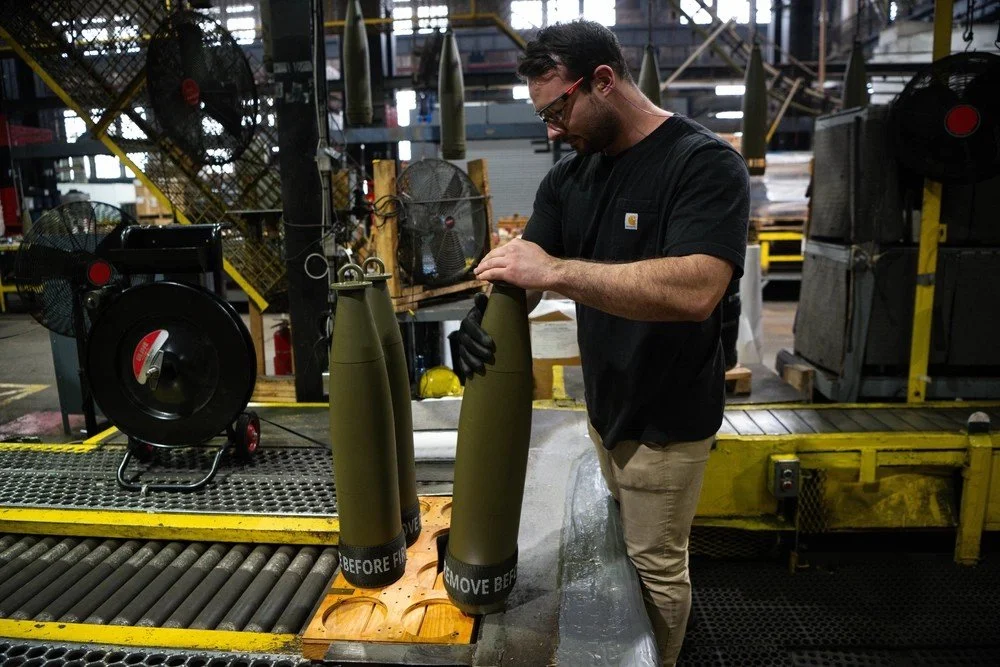
Photo: U.S. Army photo by Henry Villarama, Joint Munitions Command, March 26, 2024. The image shows artillery shell production at Scranton Army Ammunition Plant, not AMRAAM or SM-6. The appearance of U.S. Department of War visual information does not imply or constitute DoW endorsement.