
Latest Funding Opportunity Guides
Choose Your Area of Innovation:
Or search the full Non-Dilutive Funding Opportunities Database
Advanced Materials & Manufacturing
Aerospace & Spacetech
Agtech & Foodtech
Artificial Intelligence & Machines Learning
Biotech
Cleantech & Climatetech
Cybersecurity
Defensetech & Dual-Use Tech
eXtended Reality
Healthtech
Medtech
Other Tech
Quantum & Photonics
Robotics & Autonomous Systems
DIU Low Cost ISR (LC-ISR) Prize Challenge: Executive Summary for Startups
Deadline: October 14th, 2026
Funding Award Size: Prize challenge with potential prototype OT and follow-on
Description: DIU seeks mature, low-cost medium- and long-endurance ISR drones for expeditionary operations. $100M prize and initial follow-on pool. How it works, who should apply, and how to team.
Executive Summary
The Defense Innovation Unit (DIU) has opened the Low Cost ISR (LC-ISR) prize challenge for mature unmanned aircraft that deliver intelligence, surveillance and reconnaissance (ISR) at low total lifecycle cost. DIU wants medium-endurance and long-endurance systems carrying EO/IR, SAR or SIGINT payloads that can launch and recover from expeditionary or austere sites. Submissions are due by 11:59:59 PM Eastern Time on October 14, 2026.
The challenge rewards affordable scale. DIU states that it may favor lower-cost solutions that provide sufficient mission capability at greater scale over higher-performing solutions whose cost limits the quantity that can be fielded. Companies that succeed in the fly-offs receive cash prizes and become eligible for prototype agreements and follow-on work.
Solicitation at a Glance
- Agency: Defense Innovation Unit (DIU), Department of War
- Opportunity: Low Cost ISR (LC-ISR) Prize Challenge
- Project ID: PROJ00711
- Authority: 10 U.S.C. § 4025 (prize competitions), with potential follow-on under 10 U.S.C. §§ 4022 and 4023
- Funding: $100M total prize and initial follow-on pool; up to $250M additionally budgeted for development, production and theater integration
- Technology Maturity: Mature, flying systems (DIU: "mature solutions, not concepts")
- Submissions Due: October 14, 2026, 11:59:59 PM Eastern Time
Think your company or platform team qualifies? Talk with BW&CO before the October 14 deadline.
What Is the LC-ISR Prize Challenge?
LC-ISR is a DIU prize competition. Companies submit a pitch deck, DIU selects participants for pitches, and selected companies fly their systems in government fly-offs. The challenge is designed to find ISR aircraft the joint force can buy in quantity, so cost, sustainment and production readiness are evaluated alongside sensor and flight performance.
Because the challenge runs under 10 U.S.C. § 4025, DIU states that submissions constitute a competitive procedure for purposes of potential follow-on actions. That means DIU may use the results to award prototype agreements or other follow-on actions without running a separate competition. Other Department of War components may also use the results.
What Problem Is DIU Trying to Solve?
The joint force needs persistent ISR in places where large, expensive aircraft and long runways are not practical. DIU is looking for systems that can deploy by expeditionary means, set up quickly, operate with small crews and keep collecting in contested conditions, at a cost low enough to field in meaningful numbers.
Priority Capability Areas: What DIU Is Looking For
- Two endurance classes: Medium endurance (3 to 12+ hours) and long endurance (12 to 24+ hours).
- Multi-intelligence payloads: EO/IR, SAR and SIGINT.
- Expeditionary operations: Launch and recovery from austere sites, transport by truck, military helicopter, ISO or MIL containers or pallets, and launch within three hours of offload.
- Low lifecycle cost: Platform, sensors, personnel, operations and sustainment.
- Open, integrable architecture: A third-party C2 integration technical data package (interface documentation and SDK/API), a Modular Open Systems Approach supporting future integration with Project AVO (Autonomous Vehicle Orchestrator), and the ability to pass sensor data over government-directed radios and waveforms.
- Contested operations: Beyond-line-of-sight operation (SATCOM and RF-contested considerations are viewed favorably) and reliable navigation in GNSS-degraded or denied environments.
- Minimal manpower: Small crews for launch, recovery, maintenance, logistics and operations, plus autonomy that reduces operator workload.
DIU's evaluation areas include sensor performance, flight performance, expeditionary capability, cost, payload modularity, architecture design, autonomy, command and control in contested environments, reliability and maintainability, environmental suitability, manufacturing readiness and future business models. DIU also wants to explore ISR as a Service and contractor-owned/contractor-operated (COCO) or government-owned/contractor-operated (GOCO) models.
Prize Structure and Funding
- Fly-Off 1 (early Q2 FY27): $250,000 cash prize to each participant who demonstrates successfully.
- Fly-Off 2 (Q3 FY27): $50,000 cash prize to each participant who demonstrates successfully.
- Follow-on eligibility: Successful participants become eligible for further prizes or agreements.
- $100M pool: The $100M figure is a combined prize and initial follow-on pool. DIU has not published how it splits between prizes and follow-on work.
- Additional budget: The government has budgeted up to $250M more for further development, system improvement, scaled production and sustained theater integration, based on government needs and program execution.
- Subject to change: Prize amounts, structure, continuation criteria and the number of awards remain subject to government refinement.
Eligibility and Participation
- Companies may submit independently or as part of a team, partnership or joint venture.
- DIU is interested in both U.S. and non-U.S. capabilities. Participants are subject to a security screening before the fly-off.
- Participants provide the aircraft, payloads and operational teams, and are responsible for travel, transportation and logistics costs identified in later guidance.
- SAM.gov registration and a CAGE code are required to receive a prototype agreement. Start early if you do not have them.
- Section 889 compliance is required. Non-compliance may prevent an award.
- Small businesses and nontraditional defense contractors are encouraged to participate.
How to Apply
- Submit a pitch deck through the DIU submission form on the project page: a horizontal 16:9 PDF, 15 slides maximum, 10 MB maximum.
- Propose one platform per submission, for either endurance category and either fly-off, or one platform addressing multiple categories and fly-offs. Multiple submissions are allowed.
- Separate demonstrated capability from developmental capability, with supporting evidence.
- Make the cost case. Include a rough order of magnitude (ROM) cost, indicative pricing for individual systems, expected unit-cost reductions at higher production quantities and evidence that you can reach low-rate production quickly.
- Keep it CUI or below. Submissions may include Controlled Unclassified Information (CUI) but nothing higher.
What Happens After You Submit?
- November 2026: DIU notifies companies selected to pitch.
- November to December 2026: Pitches.
- By December 17, 2026: Fly-off selection notifications.
- Early Q2 FY27 and Q3 FY27: Fly-Off 1 and Fly-Off 2. Location to be announced.
- After the fly-offs: DIU may award prototype agreements or other follow-on actions without further competition, based on the results.
All dates after the submission deadline are tentative.
Is This Opportunity a Good Fit for Your Company?
LC-ISR is a strong fit for companies that already fly a medium- or long-endurance aircraft and can price it for volume production. It also creates a real route for companies that do not build airframes. Sensor makers (EO/IR, SAR, SIGINT), autonomy and C2 software companies, communications and navigation providers, and launch and recovery suppliers can join a platform team, because DIU explicitly evaluates payload modularity, third-party C2 integration, open architecture and contested navigation.
If you are still at the concept or lab-prototype stage, this challenge is likely too early. DoD SBIR/STTR or a DIU Commercial Solutions Opening may be a better first step, with LC-ISR follow-on iterations as a later target.
How BW&CO Can Help
BW&CO has helped deep-tech and dual-use founders secure more than $350M in non-dilutive funding. For DIU prize challenges like LC-ISR, we help you:
- Confirm fit against DIU's maturity, cost and expeditionary requirements
- Build a 15-slide pitch deck that separates demonstrated and developmental capability and makes the pricing and production case
- Identify platform or subsystem teaming partners and structure the team's submission
- Prepare for the pitch, the fly-off and prototype agreement negotiation
- Map adjacent pathways such as DoD SBIR/STTR, DIU CSOs and other OT routes if LC-ISR is not the right fit
Frequently Asked Questions
What is the DIU LC-ISR prize challenge?
LC-ISR (Low Cost ISR) is a DIU prize competition, Project PROJ00711, seeking mature medium- and long-endurance unmanned aircraft that deliver multi-intelligence ISR at low lifecycle cost for expeditionary operations.
When are submissions due?
Submissions are due by October 14, 2026, at 11:59:59 PM Eastern Time.
How much funding is available?
DIU describes a total prize and initial follow-on pool of $100 million, plus up to $250 million budgeted for further development, production and theater integration. Cash prizes are $250,000 per successful participant at Fly-Off 1 and $50,000 at Fly-Off 2, subject to government refinement.
Does my company need to own an aircraft?
Every submission must include a mature, flying platform, and participants provide the aircraft, payloads and operational teams. Companies that make payloads, autonomy, C2 or communications can participate as part of a team, partnership or joint venture.
What should the submission include?
A 16:9 PDF pitch deck of up to 15 slides and 10 MB, separating demonstrated from developmental capability, with a ROM cost, indicative unit pricing, unit-cost reductions at volume and evidence of low-rate production readiness.
Can non-U.S. companies participate?
Yes. DIU is interested in U.S. and non-U.S. capabilities, subject to a security screening before the fly-off.
What happens after the fly-offs?
DIU may use the results to award prototype agreements or other follow-on actions without further competition, under 10 U.S.C. § 4025.
Who pays for the fly-off?
Participants are responsible for their own aircraft, crews, travel, transportation and logistics costs identified in later guidance.
Can BW&CO help with an LC-ISR submission?
Yes. BW&CO helps companies confirm fit, build the pitch deck and pricing case, structure teams and prepare for the pitch and fly-off. Book a call with our team.
Source: DIU, Low Cost ISR (LC-ISR), PROJ00711, released September 29, 2026
MedTech Innovator Vantage Non-Dilutive Funding Program: Up to $200K for Health Security Diagnostics and Devices
Deadline: October 15th
Funding Award Size: $50k - $200k
Description: MedTech Innovator and BARDA fund six-month projects advancing health security diagnostics, patient monitoring, and medical devices. See funding fit, priority areas, and how to apply.
MedTech Innovator Vantage is a joint partnership between MedTech Innovator and the Biomedical Advanced Research and Development Authority (BARDA), part of the U.S. Department of Health and Human Services. Vantage is one of five specialized hubs in the BARDA Accelerator Network. Its Non-Dilutive Funding Program awards $50,000 to $200,000 for six-month, milestone-based projects that develop, evaluate, and validate diagnostic and medical device technologies for health security, preparedness, and response.
Deadline: Proposals are due October 15, 2026. Off-cycle applications for BARDA-aligned technologies are also accepted on a rolling basis.
Why This Opportunity Matters
Most early-stage medtech companies chase SBIR as their first federal dollar. Vantage is a faster, smaller entry point. A $50K to $200K award gives a startup proof-of-concept or validation data, a BARDA-aligned project record, and six months of project management and mentoring from subject matter experts. That record strengthens a later BARDA BAA, DRIVe, or SBIR application.
Key Facts at a Glance
- Sponsors: MedTech Innovator and BARDA (HHS), through the BARDA Accelerator Network
- Award size: $50,000 to $200,000
- Project length: 6 months, milestone-based
- Who can apply: Early-stage startups and university-backed projects
- Proposal window: September 1 to October 15, 2026
- Guided revisions: January 2027, with subject matter experts
- Award announcements: Anticipated March to April 2027
- Support included: Project management support and regular expert mentoring during the award
- Contact: vantage@medtechinnovator.org
Priority Technology Areas
Vantage funds diagnostic and medical device technologies that strengthen U.S. health security. Current priority areas include:
- Continuous patient monitoring: Platforms with advanced sensors, with emphasis on radiation injury and acute radiation syndrome
- Multiplexed point-of-care rapid tests: High-sensitivity tests, including botulinum toxin detection that distinguishes serotypes
- Deployable diagnostics: Low-cost tools for resource-limited settings
- Rapid triage diagnostics: Including low-throughput next-generation sequencing platforms for pathogen identification
What Is Out of Scope
- Oncology and chronic disease research
- Gain-of-function research involving pathogen manipulation
Is Your Company a Fit?
Vantage is a strong fit if your company:
- Is an early-stage startup or a university-backed spinout
- Is building a diagnostic, patient monitoring, or medical device technology with a clear health security use case
- Can define concrete, measurable milestones achievable in six months
- Plans to pursue larger BARDA or other federal funding after proof-of-concept
If your device targets cancer or a chronic disease without a preparedness or emergency response angle, other programs such as NIH SBIR are a better match.
How to Apply
- Confirm alignment. Review BARDA's mission and the DRIVe target product profiles to map your technology to a stated health security need.
- Define six-month milestones. Reviewers fund projects with specific development, evaluation, or validation outcomes that a $50K to $200K budget can deliver.
- Submit by October 15, 2026. Proposals go to MedTech Innovator during the September 1 to October 15 window.
- Revise with experts. Selected applicants refine proposals with subject matter experts in January 2027.
- Award decision. Announcements are expected March to April 2027.
How BW&CO Helps
BW&CO has helped deep-tech, medtech, and biotech founders secure $350M+ in non-dilutive funding. We help you test fit against BARDA priorities, frame milestones reviewers trust, and plan the path from a Vantage award to BARDA BAA, DRIVe, and SBIR funding.
Frequently Asked Questions
What is the MedTech Innovator Vantage Non-Dilutive Funding Program?
It is a BARDA-aligned funding program run by MedTech Innovator that awards $50,000 to $200,000 for six-month projects developing, evaluating, and validating diagnostic and medical device technologies for health security.
When is the Vantage application deadline?
The 2026 proposal window runs September 1 to October 15, 2026. Off-cycle applications for BARDA-aligned technologies are accepted on a rolling basis.
Who is eligible to apply?
Early-stage startups and university-backed projects developing diagnostic or medical device technologies aligned with BARDA's health security mission.
Is Vantage funding dilutive?
No. Vantage awards are non-dilutive, so companies do not give up equity.
What technologies does Vantage prioritize?
Continuous patient monitoring for radiation injury, multiplexed point-of-care rapid tests such as botulinum toxin detection, low-cost deployable diagnostics, and rapid triage diagnostics including low-throughput NGS pathogen identification.
What is excluded from Vantage funding?
Oncology and chronic disease research, and gain-of-function research involving pathogen manipulation.
When are Vantage awards announced?
Selected applicants complete guided revisions in January 2027, and awards are anticipated in March to April 2027.
TRISH Catalyst Grants Program: NASA-Funded Space Health Awards for Companies and Researchers
Deadline: Rolling through December 2026
Funding Award Size: Up to $150k (Tier 1), $150k+ (Tier 2)
Description: NASA’s Translational Research Institute for Space Health funds proof-of-concept and technology development projects that reduce astronaut health risks. See funding fit, focus areas, and how to apply.
The Translational Research Institute for Space Health (TRISH) funds disruptive, high-impact technologies and studies that protect astronaut health. TRISH is led by Baylor College of Medicine's Center for Space Medicine and funded through a NASA cooperative agreement with the NASA Human Research Program (HRP). The Catalyst Grants Program supports proof-of-concept projects and directed technology development. Tier 1 awards reach up to $150,000 over 12 months, and Tier 2 awards are $150,000 or more for larger projects.
Deadline: Rolling. Preliminary proposals are reviewed quarterly, and TRISH is accepting submissions through December 2026.
Why This Opportunity Matters
Many medtech problems in spaceflight mirror problems on Earth: remote monitoring, point-of-care diagnostics, blood clot prevention, behavioral health, and care with no specialist nearby. TRISH lets medtech and healthtech companies fund that work with NASA money, without the SBIR calendar. The two-page first step is light, U.S. companies are eligible, and a TRISH award builds a NASA track record that supports later NASA SBIR/STTR and HRP proposals.
Key Facts at a Glance
- Sponsor: TRISH at Baylor College of Medicine, funded by NASA's Human Research Program
- Tier 1: Under $150,000 total, up to 12 months
- Tier 2: $150,000 or more total, up to 18 months
- Budget rules: All direct and indirect costs count toward the total; minimum 10% cost share (cash or in-kind)
- Who can apply: U.S. institutions and companies with a documented base of ongoing R&D
- Submission: Rolling, with quarterly Step-1 reviews, through December 2026
- Notification: About 3 to 4 months after a Step-2 full proposal
- Contact: spacehealth-info@bcm.edu
What TRISH Funds
Catalyst projects must address critical human system risks on the NASA HRP roadmap, represent a unique, high-impact idea, and fall outside other open TRISH solicitations. Recent example topics include:
Ground-Based Research
- Countermeasures for internal jugular venous flow reversal
- Decompression sickness prevention
- Managing behavioral emergencies in remote environments
- Early detection of behavioral health decline
Flight Research
- Continuous characterization of venous flow during spaceflight
- Comparing venous thromboembolism countermeasures
- Evaluating post-flight motor control recovery
Is Your Company a Fit?
TRISH Catalyst is a strong fit if your company:
- Builds wearables, remote monitoring, point-of-care diagnostics, vascular, neuro, or behavioral health technology
- Can show how the technology reduces a specific spaceflight health risk
- Has ongoing R&D and preliminary data
- Can commit at least 10% cost share
- Wants a NASA relationship that extends into Earth-based clinical markets
How to Apply
- Map to an HRP risk. Tie your technology to a named human system risk on the NASA Human Research Roadmap.
- Submit a Step-1 preliminary proposal. Two pages maximum covering specific aims, deliverables, an implementation roadmap, TRISH alignment, and spaceflight health benefits. No institutional sign-off is required.
- Prepare a Step-2 full proposal if invited. Tier 1 allows an 8-page project description and Tier 2 allows 15 pages, plus NASA SciENcv biosketches, Current and Pending Support, budget justification, a 2-page data management plan, and research security training certification.
- Merit review. Reviewers score innovation, significance to NASA risk reduction, approach, and team, then assess budget, timeline, and data management.
- Award. Decisions come about 3 to 4 months after Step-2, and start dates may shift with NASA budget availability.
How BW&CO Helps
BW&CO has helped deep-tech, medtech, and aerospace founders secure $350M+ in non-dilutive funding, including NASA awards. We help you frame your technology around NASA HRP risks, write a sharp two-page Step-1, and connect a TRISH award to NASA SBIR/STTR and Earth-based commercialization.
Frequently Asked Questions
What is the TRISH Catalyst Grants Program?
It is a NASA-funded program run by the Translational Research Institute for Space Health at Baylor College of Medicine that funds proof-of-concept projects and technology development addressing astronaut health risks.
Can companies apply for TRISH Catalyst grants?
Yes. U.S. institutions and companies are eligible if they have a documented base of ongoing research and development in science, healthcare, or technology.
How much funding does TRISH Catalyst provide?
Tier 1 awards are under $150,000 for up to 12 months. Tier 2 awards are $150,000 or more for up to 18 months. All direct and indirect costs count toward the total.
Is cost share required?
Yes. TRISH requires a minimum 10% cost share, which can be cash or in-kind.
What is the TRISH Catalyst deadline?
Submissions are rolling with quarterly Step-1 reviews, and TRISH is accepting applications through December 2026.
What does the Step-1 preliminary proposal require?
A two-page document covering specific aims, deliverables, an implementation roadmap, alignment with TRISH, and spaceflight health benefits. No institutional sign-off is needed.
How long does a TRISH award decision take?
Award notification is expected about 3 to 4 months after the Step-2 full proposal is submitted.
USDA SBIR/STTR Phase II USDA-NIFA-SBIR-012221: Executive Summary for Ag and Food Tech Startups
Deadline: November 17th
Funding Award Size: $600k - $650k
Description: USDA NIFA invites prior Phase I winners to advance agriculture, food, forestry, and rural innovations toward market. See funding fit, topic areas, and how to apply via USDA SBIR and STTR.
Executive Summary
Sponsor: USDA National Institute of Food and Agriculture (NIFA)
Award size: Up to $600,000, or up to $650,000 with Technical and Business Assistance (TABA)
Deadline: November 17, 2026, 5:00 PM ET
Eligible applicants: Prior USDA SBIR or STTR Phase I recipients
Funding type: Non-dilutive grant, no cost share required
Funding opportunity number: USDA-NIFA-SBIR-012221
USDA NIFA is accepting Phase II applications from small businesses that have completed a USDA SBIR or STTR Phase I award. Phase II funds the research and development needed to take a proven concept and move it toward the marketplace. Projects typically run 24 months, total program funding is $24.75 million, and NIFA expects to fund roughly half of the applications it receives, making this one of the more favorable success rates in federal non-dilutive funding.
Who Should Apply
This opportunity is open only to companies that previously won a USDA SBIR or STTR Phase I grant. Your Phase II application must show that Phase I achieved its objectives and demonstrated technical feasibility, supported by preliminary data and results.
- SBIR: The principal investigator must be primarily employed (more than 50 percent) by the small business, and the company must perform at least 50 percent of the research.
- STTR: The small business must perform at least 40 percent of the work and a single U.S. research institution partner (university, nonprofit research organization, or FFRDC) must perform at least 30 percent.
- All research and development must be performed in the United States.
Topic Areas
- 8.1 Forests and Related Resources: Forest productivity, management, and value-added forest materials.
- 8.2 Plant Production and Protection (Biology): Crop production, stress protection, and pollinator health.
- 8.3 Animal Production and Protection: Technologies that improve agricultural animal production and health.
- 8.4 Management of Natural Resources: Soil health, erosion reduction, water quality, and nutrient management.
- 8.5 Food Science and Nutrition: Food safety, food processing, and nutrition innovation.
- 8.6 Rural and Community Development: Technologies supporting economic and social development in rural America.
- 8.7 Aquaculture: Technologies that expand domestic aquaculture production.
- 8.8 Biofuels and Biobased Products: Biofuels and industrial chemicals from agricultural materials.
- 8.12 Small and Mid-Size Farms: Sustainability and profitability for farms with under $1 million in annual sales.
- 8.13 Plant Production and Protection (Engineering): Engineering solutions for crop production efficiency and pest and pathogen protection.
How Applications Are Evaluated
- Phase I results and technical feasibility (20 percent): Quality of preliminary data and likelihood of Phase II success.
- Phase II technical approach (20 percent): Clear objectives, sound methodology, and measurable outcomes.
- Commercial potential (20 percent): Market analysis, commercialization strategy, IP protection, revenue projections, and track record.
- Importance of the problem (10 percent): Significance and public benefit.
- Team and resources (10 percent): Expertise and partnerships to complete the work.
- Alignment with USDA priorities: Connection to current USDA priorities such as farmer profitability, market expansion, invasive species protection, soil health, and precision nutrition.
What Goes Into the Application
- Project summary of up to 250 words
- Project narrative of up to 20 pages
- Commercialization plan of up to 10 pages, including a Phase III financing strategy
- TABA plan of up to 3 pages if requesting the additional $50,000
- Required disclosure of foreign affiliations or relationships to foreign countries
Key Considerations
- Commercialization carries real weight. With 20 percent of the score tied to commercial potential and a dedicated 10 page plan, a strong market and Phase III financing story is essential.
- TABA adds up to $50,000. Funds can support IP strategy, regulatory and market services, and other commercialization help from a vendor you select.
- Foreign disclosure is now required. Applicants must disclose foreign ownership, joint ventures, contracts, licensing, and related relationships.
- Experienced awardees face benchmarks. Companies with 20 or more prior Phase I awards must meet Phase I to Phase II transition and commercialization benchmarks.
- Plan for the next cycle too. NIFA lists a tentative FY 2027 deadline of September 21, 2027.
Frequently Asked Questions
When is the USDA SBIR/STTR Phase II FY 2026 deadline?
Applications are due November 17, 2026 at 5:00 PM Eastern Time through Grants.gov. NIFA lists a tentative FY 2027 deadline of September 21, 2027.
How much funding does a USDA SBIR/STTR Phase II award provide?
Awards are up to $600,000, or up to $650,000 when including up to $50,000 in Technical and Business Assistance (TABA). Projects typically run 24 months. Total program funding is $24.75 million.
Who is eligible for USDA SBIR/STTR Phase II?
Only small businesses that previously received a USDA SBIR or STTR Phase I award are eligible. Applicants must show that Phase I objectives were met and technical feasibility was demonstrated.
What topic areas does USDA SBIR/STTR Phase II fund?
Topics include forests and related resources, plant production and protection (biology and engineering), animal production and protection, natural resources management, food science and nutrition, rural and community development, aquaculture, biofuels and biobased products, and small and mid-size farms.
Does USDA SBIR/STTR Phase II require cost sharing?
No. There is no cost sharing or matching requirement for this opportunity.
How are USDA SBIR/STTR Phase II applications evaluated?
Reviewers score Phase I results and feasibility (20 percent), the Phase II technical approach (20 percent), commercial potential (20 percent), importance of the problem (10 percent), team and resources (10 percent), and alignment with USDA priorities.
Can BW&CO help with a USDA SBIR/STTR Phase II application?
Yes. BW&CO helps founders turn Phase I results into a strong technical narrative, build a commercialization plan that scores, and align projects with USDA priorities. BW&CO has helped clients secure more than $350 million in non-dilutive funding.
Turn Your Phase I Win Into a Phase II Award
BW&CO helps agtech, foodtech, and biobased founders translate Phase I results into a compelling technical narrative, build a commercialization plan that scores, and align with current USDA priorities. With a November 17 deadline, now is the time to start.
DARPA Atomically Precise Molecules (APM) DARPA-PS-26-141: Complete Guide for Proposers
Deadline: October 27th (abstracts), December 18th (proposals)
Funding Award Size: Not published (OT for Prototype awards)
Description: DARPA seeks revolutionary synthesis methods for programmable precision polymers and nonlinear optical materials, starting with sub-nanosecond electro-optic modulators. See funding fit, phases, and how to apply.
Executive Summary
DARPA's Atomically Precise Molecules (APM) program is soliciting proposals for new ways to synthesize polymeric materials and nonlinear optical (NLO) materials with molecular level control over sequence, orientation, and composition. DARPA calls these programmable precision polymers.
The program's first target application is the sub-nanosecond electro-optic modulator. Teams must show they can scale their synthesis to quantities that matter for integration, and the program culminates in a prototype demonstration of a new NLO material integrated into a functional government-provided electro-optic modulator. DARPA also points to broader defense and commercial uses such as LiDAR and communications.
APM is released as Program Solicitation DARPA-PS-26-141 and uses Other Transaction (OT) for Prototype agreements with milestone payments. This is not an SBIR or STTR topic, and it has no small business set-aside.
DARPA APM at a Glance
- Solicitation number: DARPA-PS-26-141
- Agency: Defense Advanced Research Projects Agency (DARPA), Multi X Office
- Program manager: John M. Hoffman
- Published: September 25, 2026
- Abstract deadline: October 27, 2026
- Proposal deadline: December 18, 2026, 1:00 PM Eastern
- Award instrument: Other Transaction for Prototype, paid against milestones
- Program length: 36 months across two phases
- Set-aside: None
- NAICS: 541715, Research and Development in the Physical, Engineering, and Life Sciences
- Contact: APM PS Coordinator, apm@darpa.mil
What DARPA Wants to Fund
DARPA is looking for revolutionary advances in material synthesis, not refinements of today's materials. Strong proposals will show a credible path to:
- New chemistries that give precise control over polymer sequence, orientation, and composition
- NLO materials that outperform the current state of the art for high speed electro-optic modulation
- Synthesis that scales to quantities relevant for device integration
- A prototype NLO material integrated into a functional government-provided electro-optic modulator
What Is Out of Scope
The solicitation is explicit about what it will not fund:
- Research that mainly produces evolutionary improvements to the existing state of practice
- Proposals built on exceptional claims that cannot be technically justified
- Approaches that use only inorganic materials with no polymeric component
- Modifying or repurposing existing NLO materials for incremental gains
How the Two-Phase Program Works
Phase 1: New Chemistries (12 months)
Teams develop new chemistries capable of producing programmable precision polymers and prove out the level of molecular control they claim.
Phase 2: Materials and Devices (24 months)
Teams apply those chemistries to synthesize advanced NLO materials at useful quantities and integrate them into functional electro-optic modulator devices.
Who Should Apply
APM rewards multidisciplinary teams. The strongest proposers will bring together polymer synthesis, computational chemistry and materials simulation, characterization, microfabrication, and photonics. Prior NLO experience helps but is not required. Startups with a novel synthesis platform should consider teaming with a university lab or a photonics partner to cover device integration.
How to Apply
- Step 1, abstract: Submit an abstract using the provided template (Attachment A) by October 27, 2026. An abstract is a low-effort way to get DARPA's read on fit before you invest in a full proposal.
- Step 2, full proposal: Submit Volume I (Technical) and Volume II (Price) by December 18, 2026 at 1:00 PM Eastern, along with the proposal summary slide, Task Description Document, price detail spreadsheet, schedule of milestones and payments, and OT certifications.
- Step 3, submission: Proposals go through the DARPA BAA Tool (BAAT) submission portal. Register early, since portal access can take time.
Funding and Award Terms
The notice on SAM.gov does not publish a total program budget or a per-award ceiling. Awards are made as Other Transaction for Prototype agreements, which means payments are tied to milestones you propose in your schedule. Your price volume and milestone plan carry real weight, so build them alongside the technical approach rather than at the end.
Controlled Unclassified Information
The solicitation includes a program CUI guide (Attachment J). Expect some program information and deliverables to be handled as Controlled Unclassified Information, and make sure your organization can meet those safeguarding requirements before you submit.
How to Prepare Now
- Read the full solicitation and every attachment on SAM.gov, including the proposer checklist
- Write a one-page technical concept that states why your chemistry is revolutionary, not incremental
- Line up partners for any gaps in synthesis, modeling, characterization, or photonics integration
- Draft milestones that map cleanly to the two phases and to measurable NLO performance
- Register for the DARPA BAAT portal and confirm your SAM.gov registration is active
Frequently Asked Questions
What is DARPA-PS-26-141? It is the Program Solicitation for DARPA's Atomically Precise Molecules (APM) program, which funds new synthesis methods for programmable precision polymers and nonlinear optical materials, starting with sub-nanosecond electro-optic modulators.
When is the deadline? Abstracts are due October 27, 2026. Full proposals are due December 18, 2026 at 1:00 PM Eastern.
Is APM an SBIR or STTR opportunity? No. It is a DARPA Program Solicitation awarded through Other Transaction for Prototype agreements, and it has no small business set-aside.
How much funding is available? DARPA has not published a total budget or award ceiling in the SAM.gov notice. Funding is paid against the milestones in each awarded agreement.
How long is the program? 36 months. Phase 1 runs 12 months and focuses on new chemistries. Phase 2 runs 24 months and focuses on materials synthesis and device integration.
What will DARPA not fund? Incremental improvements, purely inorganic approaches with no polymeric component, repurposed existing NLO materials, and claims that cannot be technically justified.
Who should I contact with questions? The APM PS Coordinator at apm@darpa.mil.
Sources
- SAM.gov: Atomically Precise Molecules (APM), DARPA-PS-26-141
- DARPA: Atomically Precise Molecules program page
Get Your APM Abstract Ready
DARPA programs move fast, and the abstract window is short. BW&CO helps deep-tech teams test fit, shape a revolutionary technical story, and build milestone plans that hold up under DARPA review. Book a free strategy call with our team to see if APM is right for you.
Army Advanced Manufacturing (AdvM) Commercial Solutions Opening W9124P26SC001: Complete Guide for Startups
Deadline: Open until canceled (Calls for Solutions have short individual deadlines)
Funding Award Size: Not published (firm-fixed-price awards)
Description: The Army Advanced Manufacturing CSO accepts white papers on 18 capability gap areas at any time, from robotics and additive manufacturing to predictive maintenance. See what it buys, how to submit, and how to prepare for short Calls.
Executive Summary
The Army Advanced Manufacturing (AdvM) Commercial Solutions Opening asks for innovative commercial solutions that establish and advance manufacturing capability across the Army's Organic Industrial Base (OIB) and out to the tactical edge.
The CSO was first issued on July 15, 2026. Amendment 1 was posted on SAM.gov on August 27, 2026. It is an umbrella CSO with no deadline, and the document says it "will remain open and accept submissions continuously" until the Army cancels it.
Companies can respond in two ways:
- General submission. Submit at any time against one of 18 Active Capability Gap (ACG) areas of interest.
- Call for Solutions. Respond to a specific Call, which addresses a defined need and has its own short deadline.
Phase 1 is a one-page quad chart and a five-page white paper sent by email. Awards are firm-fixed-price only.
For a startup with a commercial manufacturing, automation, inspection or industrial software product, this is one of the broadest Army entry points open right now. The main thing to understand: a general submission gets you on file, and a Call usually means the Army has already identified a specific need.
Army AdvM CSO at a Glance
- Solicitation number: W9124P26SC001 (W9124P-26-S-C001), Amendment 1
- Issuing office: Army Contracting Command-Redstone Arsenal (ACC-RSA), Redstone Services and Information Technology Solutions Branch
- Customer: Headquarters U.S. Army Materiel Command (HQ AMC)
- Status: Open in perpetuity until canceled. Individual Calls for Solutions carry their own deadlines.
- Authorities:
- The CSO document cites Section 803 of the FY2022 NDAA.
- The SAM.gov notice also lists 10 U.S.C. § 3458 with DFARS RFO 212.70, 10 U.S.C. § 4022 prototype OTs, RFO 6.101(b)(3), and the Employee Stock Ownership Pilot Program.
- Areas of interest: 18 Active Capability Gap areas, and the CSO "is open to any novel advanced manufacturing solution"
- Phase 1 submission: One-page quad chart plus white paper of up to five pages, emailed as two separate PDFs
- Award type: Firm-fixed-price only, per DFARS RFO 212.7002(b)
- Instruments: RFO Part 12 purchase orders and BPAs, Part 12 and 15 contracts, Part 16 IDIQs and BOAs, or prototype OTs under 10 U.S.C. § 4022
- Eligibility: Industry, academia and nontraditional partners. Small businesses are generally nontraditional defense contractors under 10 U.S.C. § 3014. Active SAM.gov registration is required for award.
- Submission and questions: usarmy.redstone.acc.mbx.acc-rsa-advm-cso@army.mil (primary POC on SAM.gov: Stephanie Dillon)
The 18 Active Capability Gap Areas
The CSO says it is open to any novel advanced manufacturing solution. It names these 18 areas of particular interest:
- Robotics and Automation. Automating manual manufacturing and depot maintenance processes, such as robotic welding, automated material handling and cobots for assembly.
- Additive Manufacturing. On-demand polymer, metal or composite parts, including large-format and multi-material printing and quality assurance and certification for critical components.
- Advanced Materials. High-strength alloys, composites, self-healing materials and other materials that improve performance, weight or corrosion resistance.
- Digital Twin and Digital Thread. Virtual models of assets and processes for predictive maintenance, process optimization and lifecycle management.
- Smart and Connected Factories (IIoT). Sensors, analytics and IIoT to monitor equipment health, track production and optimize the factory floor.
- Advanced Non-destructive Testing and Inspection. Advanced ultrasonics, thermography, automated computer-aided inspection and similar methods.
- Workforce Development and Manufacturing Skills. Training material, concepts or methods for a digital manufacturing workforce.
- Supply Chain Risk Management. Tools to identify and address strategic manufacturing value chain vulnerabilities in the defense industrial base.
- Cybersecurity. Tools to build DoW Risk Management Framework requirements into processes, product design and documentation.
- Enterprise Data Integration. A centralized AdvM data repository for qualified part data, technical data packages and IP, with data exchange with the Defense Logistics Agency.
- AdvM at the Tactical Edge. The right mix of AdvM capability in expeditionary and tactical environments, including point-of-need solutions.
- Army AdvM Consortium. Managing an alliance of government, industry, nonprofits and academia to qualify AdvM vendors, processes and parts.
- OIB and AdvM Innovation Centers. Machines, tooling, technology and talent for a network of innovation hubs.
- Metrology. Advanced measurement systems, such as optical or blue light scanning, to verify machines and parts meet tolerances.
- Qualification and Certification. Technologies and methods to qualify and certify manufacturing processes and parts.
- Advanced Electronics Manufacturing. Flexible hybrid electronics and additively manufactured electronics.
- Advanced Coatings and Surface Engineering. Coatings and surface modifications for durability, corrosion resistance, thermal management and signature management.
- Predictive Maintenance Analytics. AI and machine learning models that predict component failures, optimize maintenance schedules and forecast sustainment needs.
The CSO's general invitation to "any novel advanced manufacturing solution" acts as a catch-all beyond these named areas.
Not sure which area your technology fits, or whether it fits at all? We can tell you on a short call.
What Recent Calls for Solutions Looked Like
The CSO says the Army "may issue specific 'Calls for Solutions' as amendments" to address focused gaps. In practice, recent Calls were posted as separate SAM.gov notices titled "AdvM Call for Solutions" and linked from the CSO page:
- Modern Radar Systems Organic Capability Development (PANRSA-26-P-0000-039852): closed August 14, 2026.
- Expeditionary Additive Manufacturing (EAM) Systems (PANRSA-26-P-0000040885): posted August 24, due August 31 at noon CT. Seven days to respond.
- Modernized Paint Line at Tobyhanna Army Depot (PANRSA-26-P-0000-040601): posted August 27, due September 16 at noon CT after amendment. The Army asked for a complete system: hardware, automated parts handling and open-architecture SCADA software for paint application, curing and shop operations.
- Automated Parts Handling for Plating at Tobyhanna Army Depot (PANRSA-26-P-0000-040599): posted August 27, due September 16 at noon CT after amendment.
No AdvM Call was active on SAM.gov as of October 1, 2026.
Two lessons stand out. The windows are short: seven days at the low end, about three weeks with extensions. And the Calls can ask for an integrated, working system. A startup that owns one piece of that system may be better positioned as a supplier or teammate to an integrator.
The SAM notice also says RFIs posted under the CSO are for market research only, and the government has no obligation to follow one with a Call.
How the Three-Phase Process Works
Phase 1: White paper and quad chart. You submit both as two separate PDFs by email to usarmy.redstone.acc.mbx.acc-rsa-advm-cso@army.mil. Use the subject line "CSO Submission – Advanced Manufacturing – [Your Company Name]". Content past the page limits will not be read.
The quad chart is one page and follows Attachment 1. Its four quadrants are:
- Objective and Description: objective, description of effort and commerciality.
- Graphic or Illustration.
- Benefits and Challenges: benefits, challenges and current maturity (TRL/MRL).
- Execution Plan: milestones, deliverables, proposed funding, period of performance and contact information.
The white paper follows Attachment 2: up to five pages, 8.5 x 11 inches, one-inch margins, single-spaced, 12-point Times New Roman. It has eight sections:
- Project title, offeror, and area of interest or Call number
- Executive summary
- Description of effort, including why it is commercial in nature
- Benefits to the Army
- Technical challenges, with risks and mitigation
- Rough order of magnitude cost and schedule
- Corporate and personnel qualifications
- Data rights
Phase 2: Oral presentation or demonstration. This happens at the government's discretion. Offerors with meritorious white papers may be invited to present or demonstrate to a panel of government subject matter experts. The government may skip Phase 2 and go directly to Phase 3.
Phase 3: Request for Solution Proposal. Offerors who are evaluated successfully may be invited to submit a full written proposal with technical, price and contractual portions. An award may follow a favorable evaluation.
The government does not pay for preparing or submitting documents or presentations in any phase.
How Submissions Are Evaluated
The government first checks compliance with the format rules in Section 4.1 and Attachments 1 and 2. A submission that fails the check may be excluded before technical review.
Submissions are evaluated on their own merit, not against each other. The factors, in descending order of importance, are:
- Technical merit and relevance: applicability to the area of interest or Call, technical feasibility, and potential to enhance Army readiness and manufacturing capability.
- Innovation and uniqueness: how new, underused or uniquely applied the solution is.
- Company viability: relevant corporate experience in advanced manufacturing, industrial operations or commercializing similar technology, plus personnel qualifications and a sound business model.
- Price and affordability.
All non-price factors combined are significantly more important than price.
After Phase 1, every submission gets one of three outcomes:
- Selected for Further Consideration: invited to the next phase.
- Retained for Future Consideration: the submission meets the criteria, and "will be retained in a repository for future consideration into the next phase once a Government need, manpower, and funding is available."
- Not Selected for Further Consideration.
The middle outcome matters most for general submissions. A strong white paper against an area of interest can sit in the repository until a depot need and funding line up.
Funding: What You Can and Cannot Expect
The CSO publishes no award ceiling or funding pool. It states, "Any award is subject to the availability of funds." The government may award some, all or none of the proposals. FY2027 began October 1 under a continuing resolution through December 11, 2026, which can slow new obligations.
The quad chart asks you to state proposed funding and a period of performance. The white paper asks for a rough order of magnitude cost and schedule. A scope the Army can fund and execute quickly is easier to move than a large multi-year program.
Depot modernization CSOs do produce real awards. In March 2026, Red River Army Depot awarded Hadrian $39.2 million, with up to $80 million in cumulative value, to establish advanced automation manufacturing at the depot. That award came through Red River's own OIB modernization CSO, not the AdvM CSO. It is not a ceiling or a typical award size, but it shows how quickly a depot can move once a need and funding align.
Data Rights
The government says it wants only the data rights it needs. Identify any data rights restrictions clearly in the proposal, and use section 8 of the white paper for a preliminary list. Negotiations follow DFARS data and software rights clauses.
How to Prepare Before the Next Call
- Pick one problem. Choose one area of interest and one depot or field problem your technology solves. Describe it in measurable terms: throughput, turnaround time, labor hours, hazardous exposure, scrap, inspection backlog or downtime.
- Build the package to the templates. Follow Attachments 1 and 2 exactly. The compliance check comes before technical review.
- Submit against the general area now. Even a "Retained for Future Consideration" result puts your solution in the repository the Army draws on when a need is funded.
- Make it reusable. Write the package so it can be tailored to a Call within 48 hours. Include the ROM, the period of performance and an implementation plan covering installation, training, cybersecurity and sustainment at a government facility.
- Watch for Calls. Save a SAM.gov search for "AdvM Call for Solutions" and follow W9124P26SC001.
- Decide your role early. If a likely Call needs a full system, line up the integrator or partner now.
- Look at the depot CSOs too. See our guides to the Sierra Army Depot CSO and the Anniston Army Depot CSO.
Frequently Asked Questions
What is solicitation W9124P26SC001? The Army Advanced Manufacturing Commercial Solutions Opening, issued by ACC-Redstone for Headquarters Army Materiel Command, to acquire innovative commercial manufacturing solutions for the Organic Industrial Base and the tactical edge.
What is the deadline? The CSO itself has none. It is open in perpetuity until canceled. Each Call for Solutions has its own deadline, and recent Calls closed between seven days and about three weeks after posting.
Is there an open Call right now? No AdvM Call for Solutions was active on SAM.gov as of October 1, 2026.
What do I submit? A one-page quad chart and a white paper of up to five pages in 12-point Times New Roman, as two separate PDFs, emailed to usarmy.redstone.acc.mbx.acc-rsa-advm-cso@army.mil with the subject line "CSO Submission – Advanced Manufacturing – [Your Company Name]."
How much funding is available? No amount is published. Any award is subject to the availability of funds, and only firm-fixed-price arrangements can be awarded.
Can a startup with no government contracts apply? Yes. The CSO invites industry, academia and other nontraditional partners, and small businesses are generally nontraditional defense contractors. You need an active SAM.gov registration to receive an award.
What happens if my white paper is good but there is no funding? It can be marked "Retained for Future Consideration" and held in a repository until a government need, manpower and funding are available.
Does the government pay proposal costs? No. The government does not pay for preparation or submission in any phase.
Sources
- SAM.gov, Army Advanced Manufacturing (AdvM) CSO, W9124P26SC001, updated August 27, 2026, verified October 1, 2026: https://sam.gov/opp/7f9b0cd559494155a50c7e5af0f11bbd/view
- ACC-RSA, "Commercial Solutions Opening (CSO) Solicitation Number W9124P-26-S-C001 Amendment 1 for Advanced Manufacturing" (attachment on SAM.gov)
- SAM.gov, AdvM Call for Solutions, Expeditionary Additive Manufacturing Systems: https://sam.gov/opp/69a143cc118243b48a82fb5cfea2a3b8/view
- SAM.gov, AdvM Call for Solutions, Modernized Paint Line in SOD: https://sam.gov/opp/ab97e088933e40a5bf2289daed14d4b4/view
- SAM.gov, AdvM Call for Solutions, Automated Parts Handling for Plating in SOD: https://sam.gov/opp/64f3745e095c4cedb8d066f6da1bba33/view
- U.S. Army, "Army accelerates advanced manufacturing with contracting award at Red River," March 18, 2026: https://www.army.mil/article/291165
Get Ready Before the Next Call
AdvM Calls can close in seven days. BW&CO helps deep tech and dual-use founders pick the right area of interest, build a quad chart and white paper that follow the CSO templates, and tailor the package fast when a Call drops. We have helped clients secure more than $350 million in non-dilutive funding.
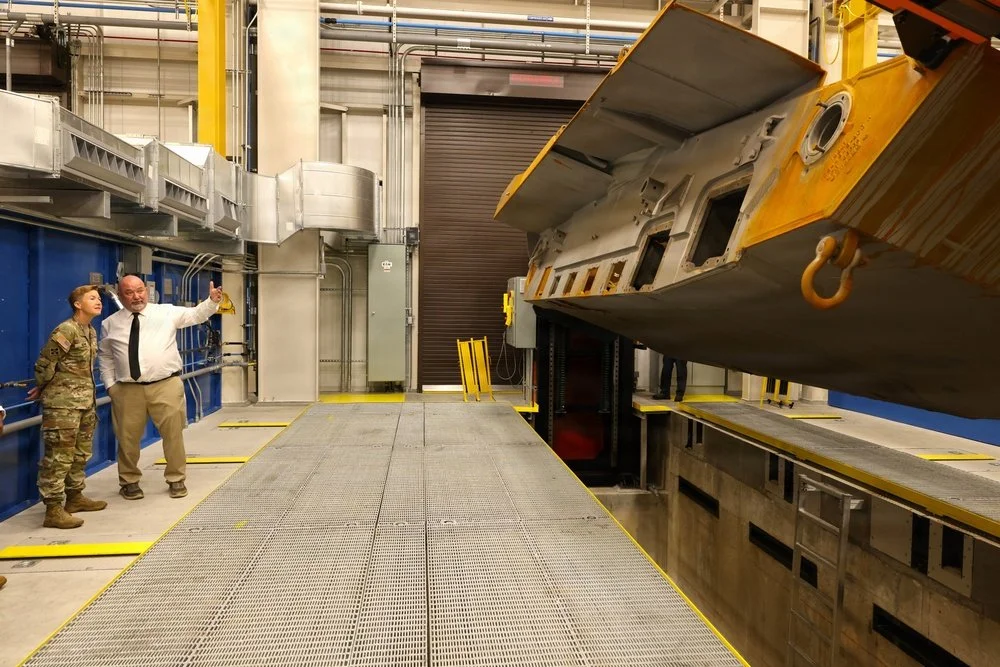
Featured image: U.S. Army photo by Mark Cleghorn. The appearance of U.S. Department of War visual information does not imply or constitute DoW endorsement.
GRA Development Grant: Executive Summary for Georgia Startups
Deadline: Six review cycles per year
Funding Award Size: $10k - $250k
Description: The Georgia Research Alliance funds milestone-driven commercialization projects led by Georgia university faculty. See funding fit, eligible activities, and how to pair it with SBIR and STTR.
Executive Summary
Sponsor: Georgia Research Alliance (GRA), Innovation & Entrepreneurship Program
Award size: $10,000 to $250,000 per grant
Deadline: Six review cycles per year
Eligible applicants: Faculty researchers at accredited public or private universities in Georgia
Funding type: Non-dilutive grant (GRA takes no financial stake in the project)
The GRA Development Grant funds milestone-driven projects that move a Georgia university technology toward commercialization or startup formation. It is built for teams that have moved past the idea stage and now need to reduce technical risk, prove a competitive advantage, and generate the evidence that investors and federal reviewers expect to see.
What the Development Grant Funds
Projects are organized around a defined set of milestones. Typical activities include:
- Prototype refinement and technology validation
- Preclinical testing for medtech and biotech technologies
- Pilot manufacturing and scale-up studies
- IP landscape and regulatory pathway analysis
- Customer pilots and market validation
GRA may award more than one Development Grant to the same project as it continues to hit milestones, which makes the program a practical bridge from lab result to fundable company.
Who Should Apply
- Faculty founders at Georgia institutions such as Georgia Tech, Emory, the University of Georgia, Augusta University, Georgia State, and Kennesaw State
- Pre-spinout teams preparing to license university IP and form a company
- Deep-tech, biotech, medtech, and dual-use researchers whose technology shows commercial promise but still needs validation before outside investors will engage
Companies that were not founded on Georgia university technology are not eligible for GRA grants.
Where It Fits in the GRA Funding Ladder
- Exploratory Grant (up to $10,000, rolling): answers focused go/no-go questions on technical feasibility, early customer discovery, or lightweight whitespace analysis
- Development Grant ($10,000 to $250,000): advances commercialization or startup formation through defined milestones
- Startup Loan (up to $250,000): available after company formation to Georgia companies built on Georgia university technology, released in milestone-based tranches with a modest warrant and an option to convert in a future financing
Why It Pairs Well With SBIR and STTR
Federal SBIR and STTR reviewers reward proposals backed by strong preliminary data, a clear commercialization path, and evidence of customer demand. A GRA Development Grant pays for exactly that work. Georgia teams that use GRA funding to validate their technology are better positioned to pursue NIH, NSF, DoD, DOE, and NASA SBIR/STTR awards, and STTR in particular is a natural next step because it already requires a research institution partner.
GRA-backed projects have attracted more than $2.3 billion in follow-on investment, and GRA reports that 87% of its startups are still operating after four years.
How to Apply
- Download the Development Grant Application (MS Word) from the GRA Innovation & Entrepreneurship documents page
- Follow the instructions on pages 1 and 2 and complete the proposal inside the application file, not in a separate document
- Submit ahead of one of the six annual review cycles
- Plan for a progress report six months after funding begins and every six months after that
- Direct eligibility questions to Andrew Short, GRA Director of Innovation Programs, or grants@gra.org
Frequently Asked Questions
What is the GRA Development Grant?
The GRA Development Grant is a non-dilutive award of $10,000 to $250,000 from the Georgia Research Alliance Innovation & Entrepreneurship Program. It funds milestone-driven projects that advance Georgia university technologies toward commercialization or startup formation.
Who is eligible for a GRA Development Grant?
Faculty researchers employed by accredited public or private universities in Georgia are eligible. Companies not founded on Georgia university technology are not eligible for GRA grants.
What activities can a GRA Development Grant fund?
Typical activities include prototype refinement, technology validation, preclinical testing, pilot manufacturing, IP and regulatory analysis, and customer pilots.
When are GRA Development Grant applications reviewed?
GRA holds six Development Grant review cycles per year. Exploratory Grants of up to $10,000 are accepted on a rolling basis.
Does GRA take equity in exchange for a Development Grant?
No. GRA grants are non-dilutive and GRA holds no financial stake in grant-funded projects. GRA Startup Loans, available after company formation, do include a modest warrant component and an option to convert in a future financing.
How does a GRA Development Grant help with SBIR and STTR funding?
A Development Grant pays for the preliminary data, validation, and customer evidence that SBIR and STTR reviewers look for. Georgia faculty and spinouts can use GRA funding to strengthen proposals to NIH, NSF, DoD, DOE, and NASA. BW&CO helps teams build that full non-dilutive funding strategy.
Turn Your GRA Award Into Federal Funding
BW&CO helps Georgia founders and faculty map a GRA Development Grant into a full non-dilutive funding strategy, from milestone planning to SBIR and STTR proposals across NIH, NSF, DoD, DOE, and NASA. With more than $350M in funding secured for our clients, we know what reviewers look for.
FAA Aviation Research BAA 692M15-25-R-00004: Executive Summary for Startups
Deadline: Rolling through December 4th, 2034
Funding Award Size: $100k - $1.2m
Description: The FAA William J. Hughes Technical Center funds aviation safety research across airport pavements, hydrogen, eVTOL controls, AI assurance, and pilot training. See funding fit, focus areas, and how to apply via white paper.
Executive Summary
The Federal Aviation Administration (FAA) Aviation Research Broad Agency Announcement, solicitation number 692M15-25-R-00004, is a long-running open call for applied and basic research that advances aviation safety. It is sponsored by the Aviation Research Division at the William J. Hughes Technical Center for Advanced Aerospace in Atlantic City, New Jersey. White papers are accepted on a rolling basis, and the BAA remains open through December 4, 2034 unless it is terminated sooner or a topic is removed. Amendment 012, issued September 29, 2026, adds four new topics covering cybersecurity for autonomous airport ground vehicles, pilot decision-making training, nationwide pilot training data, and a pilot operational decision-making aid. There are now 15 active topics, with published project budgets ranging from about $100,000 per year to as much as $1.2 million per project.
Solicitation at a Glance
Solicitation number: 692M15-25-R-00004 (Amendment 012)
Full title: Broad Agency Announcement, Aviation Research 2025
Agency: Department of Transportation, Federal Aviation Administration, William J. Hughes Technical Center for Advanced Aerospace (Atlantic City, New Jersey)
Opportunity type: Broad Agency Announcement issued under the FAA Acquisition Management System (49 USC 106(l) and (m))
Latest amendment: Amendment 012, September 29, 2026
White papers due: Rolling, through December 4, 2034 or until a topic is removed
Response time: The FAA aims to respond within 60 calendar days of receiving a white paper
Funding: Roughly $100,000 to $1.2 million per project depending on topic; several topics set the budget based on the work proposed
Period of performance: Typically 12 to 36 months; no topic accepts efforts longer than 3 years
Award types: Purchase orders, contracts, agreements, or Other Transaction Agreements (OTAs); Firm Fixed-Price awards are preferred for initial phases
Set-aside: None. Open to industry, small businesses, universities, HBCUs, minority-serving institutions, and research organizations
NAICS code: 5417, Scientific Research and Development Services
Submission method: Email to the topic's Technical Point of Contact, with 9-ACT-AAQ-600-BAA@faa.gov copied
What Is the FAA Aviation Research Division?
The Aviation Research Division at the William J. Hughes Technical Center conducts applied research and development with industry, academia, and government to solve current and future air transportation challenges. It runs five program branches: Fire Safety, Airport Technology R&D, Software and Systems, Structures and Propulsion, and Separation Standards Analysis. Research results feed directly into FAA Advisory Circulars, certification guidance, design and evaluation software such as FAARFIELD and BAKFAA, and training material for the FAA workforce.
This BAA is the standing channel for outside organizations to bring research ideas to the FAA. It is open for ten years from December 5, 2024, and the FAA adds and removes topics through amendments. The FAA may also issue "Calls" on SAM.gov when it has a more urgent need in a specific topic area.
How This BAA Differs From SBIR and STTR
Many startups first encounter federal R&D through SBIR and STTR. This BAA works differently, and understanding the differences helps you plan.
- It is not a small business program. There is no set-aside, so startups are evaluated alongside universities, large companies, and research institutions.
- There are no phases. There is no Phase I or Phase II structure. Each topic publishes its own estimated budget and period of performance.
- It is a two-step process. You submit a white paper first. If the FAA is interested and funding is available, it requests a full proposal.
- Proposals are judged on their own merits. The FAA does not rank proposals against others in the same research area.
- Awards are often Other Transaction Agreements. The FAA has historically used OTAs for this BAA, which can offer more flexible terms than traditional contracts.
The 15 Topics of Interest: What the FAA Is Looking For
Every white paper must name the specific topic number and title it responds to. Topics marked as new were added in Amendment 012.
Airport Pavements (ARAP)
ARAP0010: Rational Overload Criteria for Airport Pavements in the ACR/PCR Method. Develop engineering-based criteria for occasional overloads on flexible and rigid pavements, drawing on full-scale test data from the National Airport Pavement Test Facility, suitable for the PCR module of FAARFIELD. Up to 3 years; ROM not to exceed $200,000 per project, per fiscal year.
ARAP0012: Engineering Analysis of Field Monitoring and Instrumentation Data. Improve pavement design, construction, and management using data from instrumented operational airports, including AI/ML, pavement instrumentation, signal processing, materials characterization, and remote data collection. Budget and duration set by proposal; multiple white papers welcome.
ARAP0013: Enhancement of Airport Pavement Layer Backcalculation Software (BAKFAA). Build faster, more accurate models for characterizing asphalt and concrete from Heavy and Falling Weight Deflectometer data, including machine learning or advanced search methods that run in real time or near real time. Up to 3 years; ROM not to exceed $200,000 per project, per fiscal year.
ARAP0014: Advancing Pavement Condition Assessment Practices for Airport Pavements. Compare emerging inspection methods with the ASTM D5340 standard on coverage, accuracy, repeatability, resource needs, and compatibility with pavement management programs. Non-proprietary approaches only. About $250,000 per project, per fiscal year; 12 to 36 months.
ARAP0015: Advancing Concrete Strength Evaluation for Airport Pavement Design and Construction. Explore alternatives or supplements to flexural beam testing, methods for estimating cracking-related properties, and continuous strength measurement for decisions such as early opening. Non-proprietary approaches only. $100,000 to $300,000 per project, per fiscal year; 12 to 36 months.
Airport Safety (ARAS)
ARAS0014: Cybersecurity Concerns with Autonomous Ground Vehicle Systems (AGVS) in the Airport Environment. (New) Applied research on identifying vulnerable system components, validating operational AGVS, preventing and detecting cyberattacks, and safely recovering from a successful attack. Covers self-driving tugs, jet bridges, baggage carts, shuttles, mowers, and perimeter inspection vehicles, plus their command and control systems and field devices. Up to 12 months.
Structures and Materials (ARSM)
ARSM0001: Structural Integrity of Metallic Components. Identify data sources, capabilities, and methods that support FAA risk assessment for metallic structures on transport category airplanes under the Monitor Safety/Analyze Data (MSAD) process in FAA Order 8110.107B. Budget and duration set by proposal.
Structures and Propulsion (ARSP)
ARSP0001: Nickel Anomaly Fatigue Testing. Low-cycle fatigue testing of premium wrought nickel alloy specimens containing subsurface melt anomalies such as "dirty white spots," with baseline testing, fractography, metallography, and a teaming plan with engine manufacturer experts. About 24 months; ROM approximately $350,000.
ARSP0002: Hydrogen Aviation Safety Research. Four research areas: hydrogen leak detection, hydrogen dispersion modeling and simulation, hydrogen risk assessment and mitigation, and integration of hydrogen-powered aircraft into the National Airspace System. Interdisciplinary teams are encouraged. Up to 36 months; ROM not to exceed $650,000 per award.
Software and Systems (ARSS)
ARSS0003: Integrated Flight and Propulsion Control for Rotorcraft. Data to support airworthiness criteria for multi-rotor, powered-lift, and eVTOL vehicles, covering stability, control bandwidth, performance, failure modes, system integration, and automation that backs up the pilot. Up to 3 years; budget set by proposal.
ARSS0008: Complex Digital Systems. Assurance and verification methods for AI/ML and autonomy in safety-critical airborne systems, including formal methods, assurance cases, explainability, diverse specifications, and large language models for classifying latent risk. Up to 3 years; ROM not to exceed $400,000 per project, per fiscal year.
ARSS0009: Future of Oversight. New concepts for performance-based and Safety Management System (SMS) based oversight, future oversight workforce needs, measures of oversight effectiveness, and lessons from other regulated industries. Up to 3 years; budget set by proposal.
ARSS0010: A Training Framework for Reducing Pilot Decision-Making Errors. (New) Academic and simulator-based training modules that expose pilots to realistic decision-making errors and teach mitigations, built for Part 121 carriers and extendable to Parts 135, 91K, and 61. About 24 months; ROM up to $910,000.
ARSS0011: Improving Airline Safety Using Nationwide Pilot Training Data. (New) A voluntary, privacy-conscious framework for collecting de-identified flight simulator training data, with standardized data structures, governance, objective performance metrics, and cross-airline benchmarking. About 36 months.
ARSS0012: Pilot Operational Decision Making Aid. (New) Research and test a structured tool that gathers information scattered across flight manuals and handbooks to support pilot decisions in complex situations, with testing on B-737 and A330 simulators. Responses that rely heavily on AI will be viewed less favorably. About 24 months; ROM up to $1.2 million.
Funding Allowance: What Startups Should Expect
Funding is set topic by topic. Some topics publish a firm ceiling, some publish an approximate figure, and some leave the budget entirely to the proposal. In practice:
- Your ROM must match the topic. The white paper's Rough Order of Magnitude cost should be consistent with any dollar value the topic lists and with the scope you propose.
- Many topics are funded annually. Several pavement and software topics cap funding per fiscal year, and continuation after each milestone is at the FAA's discretion.
- Partial awards are possible. The FAA may negotiate an award for only part of a proposal if funding is limited.
- Firm Fixed-Price is preferred for initial phases, and the FAA may change the award type during negotiation.
- Cost sharing is allowed on a cost reimbursement basis with no fee, if your accounting system can support it.
Timeline and Key Dates
December 5, 2024: BAA opened for white papers.
September 29, 2026: Amendment 012 added ARAS0014, ARSS0010, ARSS0011, and ARSS0012.
Anytime: White papers may be submitted on a rolling basis, or in response to a specific Call posted on SAM.gov.
Within about 60 days of submission: The FAA aims to respond, and may request a technical and cost proposal.
December 4, 2034: The BAA expires unless terminated sooner. Awards may still be made after expiration if the white paper was received before that date.
Because topics can be removed by amendment at any time, earlier submissions carry less risk.
How to Apply
Step 1: Contact the Contracting Officer
The FAA strongly encourages applicants to email 9-ACT-AAQ-600-BAA@faa.gov with "Question for the CO" in the subject line before writing, to confirm interest in the proposed effort and whether funding is available. Technical questions go to the topic's Technical Point of Contact (TPOC), and discussions with the TPOC about your white paper are permitted.
Step 2: Submit a White Paper
A white paper is required before any proposal. Offerors who submit a proposal without first submitting a white paper may not be eligible for award.
- Maximum of 5 pages, single sided, single spaced, Times New Roman 12 point, in Word or PDF
- The ROM cost estimate does not count toward the 5 pages
- State the topic number and title in the document and in the email subject line
- Email to the topic TPOC with 9-ACT-AAQ-600-BAA@faa.gov on the cc line
Each white paper must cover the purpose of the research, the research method and how its validity will be demonstrated, the expertise of each team member and any aviation industry partners or endorsements, the current state of development, a proposed timeline, testing and evaluation procedures, and a good faith ROM cost including any fee.
Step 3: Submit a Full Proposal (By Invitation)
If invited, you will receive a Request for Proposal with specific instructions. Proposals are submitted as three separate files, sent only to 9-ACT-AAQ-600-BAA@faa.gov without copying the TPOC:
- Cover letter on company letterhead with the topic, UEI, business type, place and period of performance, estimated cost, proposed award type, and an authorized signature
- Volume I, Technical: up to 25 pages covering background, objectives, feasibility, methodology, technical uncertainties, program management, key personnel resumes (up to 3 pages each, not counted), conflicts of interest, subcontracting, past performance, and intellectual property
- Volume II, Price/Cost: up to 10 pages with costs broken down by task and cost element, plus a funding profile
Proposals should remain valid for at least 180 days.
How Proposals Are Evaluated
Proposals go through peer review and technical feasibility assessment. They are judged on their own merit and relevance, not ranked against other proposals in the same area. The FAA considers:
- Scientific and technical merit: The overall quality and soundness of the proposed research.
- Mission relevance: Potential contribution to the FAA Aviation Research mission.
- Team competency: The experience and capability of the people doing the work.
- Project plan: An effective plan for completing the project.
- Risk: Technical and implementation risk.
Cost is not scored, but the FAA analyzes it for completeness, reasonableness, realism, magnitude, and affordability, including the cost impact of any intellectual property restrictions you assert.
Registration Requirements
Offerors cannot receive an award without an active SAM.gov registration, and Certifications and Representations must be completed there. The cover letter also requires your SAM Unique Entity ID. Registration can take several weeks, so startups without an active registration should begin now. Foreign-owned companies must submit disclosure information for an eligibility review.
A Note on Intellectual Property
Proposals must include a representation of ownership or licensing rights for all intellectual property used, and a list of any technical data or software to be delivered with restricted rights. If you do not submit that list, the FAA assumes it has unlimited rights. Awardees must deliver all technical data and software developed under the award, including source code. Startups should decide early what they will protect and mark it correctly.
Is This BAA a Good Fit for Your Startup?
This BAA tends to fit startups and research teams with a clear technical approach to a real FAA safety or certification problem. Strong candidates include companies working on:
- Airport pavement engineering, sensors, instrumentation, and materials testing
- Cybersecurity for autonomous vehicles and connected ground systems
- Hydrogen sensors, fuel systems, dispersion modeling, and hydrogen infrastructure
- Advanced air mobility, eVTOL, and powered-lift flight controls
- AI/ML assurance, formal methods, and safety-critical software
- Aviation human factors, pilot training, flight simulation, and safety data analytics
- Aerospace metallurgy, fatigue testing, and structural integrity
It is a weaker fit for companies whose main goal is validating a proprietary product, since several topics exclude that, and for companies that need a large, guaranteed award on a fixed timeline.
Strategic Tips for Startup Applicants
- Ask the Contracting Officer first. A short inquiry about interest and funding can save weeks of effort on a topic with no budget.
- Mirror the topic language. Use the topic's terminology and connect your work to the specific FAA guidance, software, or standard it is meant to improve.
- Lead with quality, not length. The FAA states that quality matters far more than quantity, and weak white papers may be declined without further review.
- Show industry support. White papers must describe aviation industry interest, endorsements, or partners, so line up letters or teaming partners early.
- Keep the ROM realistic. Match the topic's published range and tie costs to tasks and milestones.
- Watch for new Calls and amendments. Topics are added and removed regularly, and Calls can signal urgent FAA priorities.
Frequently Asked Questions
What is the FAA Aviation Research BAA 2025?
It is the FAA's Broad Agency Announcement 692M15-25-R-00004, an open call from the William J. Hughes Technical Center for applied and basic research that advances aviation safety across airport pavements, airport safety, structures and materials, propulsion, hydrogen safety, and software and systems.
What is the deadline for the FAA Aviation Research BAA?
White papers are accepted on a rolling basis. The BAA is open through December 4, 2034, unless it is terminated sooner or a specific topic is removed by amendment.
How much funding is available?
Funding varies by topic. Published estimates range from about $100,000 per project per fiscal year for pavement topics to as much as $1.2 million per project for the Pilot Operational Decision Making Aid topic. Several topics set the budget based on the work proposed.
What topics were added in Amendment 012?
Amendment 012, issued September 29, 2026, added ARAS0014 Cybersecurity Concerns with Autonomous Ground Vehicle Systems in the Airport Environment, ARSS0010 A Training Framework for Reducing Pilot Decision-Making Errors, ARSS0011 Improving Airline Safety Using Nationwide Pilot Training Data, and ARSS0012 Pilot Operational Decision Making Aid.
Can startups and small businesses apply?
Yes. The BAA has no set-aside and is open to industry, small businesses, small disadvantaged businesses, universities, HBCUs, minority-serving institutions, and research organizations. Teaming arrangements are welcome.
Is the FAA Aviation Research BAA an SBIR or STTR program?
No. It is a Broad Agency Announcement issued under the FAA Acquisition Management System. It has no phase structure and no small business eligibility requirement, and awards are often made as Other Transaction Agreements.
How long can a white paper be?
White papers may not exceed 5 pages, single sided, single spaced, in Times New Roman 12 point font. The Rough Order of Magnitude cost estimate does not count toward the page limit.
How do I submit a white paper?
Email the white paper to the Technical Point of Contact listed for your topic and copy 9-ACT-AAQ-600-BAA@faa.gov, with the topic number and title in the subject line. The FAA recommends first emailing the same mailbox with "Question for the CO" in the subject line to confirm interest and funding.
How long does it take to hear back?
The FAA aims to respond within 60 calendar days of receiving a white paper, but may take longer. It may respond by requesting a technical and cost proposal.
How are proposals evaluated?
Proposals are peer reviewed on scientific and technical merit, relevance to the FAA Aviation Research mission, team competency and experience, the project completion plan, and technical and implementation risk. Cost is analyzed for reasonableness and affordability rather than scored.
What type of award will the FAA make?
Awards may be purchase orders, contracts, agreements, or Other Transaction Agreements. The FAA has historically used Other Transaction Agreements for this BAA and prefers Firm Fixed-Price awards for initial research phases.
What registrations are required?
You must have an active SAM.gov registration with completed Certifications and Representations to receive an award, and your SAM Unique Entity ID is required in the proposal cover letter.
Get Help With Your FAA White Paper
BW&CO helps deep-tech, aerospace, and dual-use startups pick the right FAA topic, frame the Contracting Officer inquiry, write focused five-page white papers, and build compliant technical and cost proposals, including intellectual property assertions and OTA terms. With more than $350M in non-dilutive funding secured for our clients, we make innovation funding simple.
With rolling submissions and topics that can be removed at any time, the best time to start is now. Book a free strategy call to see if your technology fits.
NIH Highlighted Topic: Improving Diagnostic Safety and Quality in Healthcare
Deadline: January 5th
Funding Award Size: $320k - $2m
Description: NIBIB, NCI, and NIDA highlight AI, point-of-care, and digital tools that reduce diagnostic errors and delays. See funding fit, focus areas, and how to apply via NIH SBIR and STTR.
Below is a brief summary. Please check the full solicitation before applying (link in resources section).
Executive Summary:
The National Institutes of Health (NIH) is encouraging research that closes critical gaps in diagnostic safety and quality, particularly diagnostic failures that contribute to patient harm. The topic prioritizes three strategic areas: technology and innovation, infrastructure and system design, and advancing the science of diagnosis.
On the technology side, NIH highlights AI-enabled tools including large language models, telehealth and other digital health solutions, point-of-care diagnostic testing, enhanced data sources, sensors, and analytic methods, and other novel diagnostic tests. System-level priorities include coordinating care across the full diagnostic trajectory, integrating clinical tools with patient-reported information, and improving communication among patients, clinicians, and care teams.
NIBIB, the lead institute, focuses on technologies with broad applicability, such as AI to improve point-of-care imaging quality, motion correction for radiological imaging, 3D-printed phantoms, AI surveillance of diagnostic errors, workflow platforms that reduce diagnostic delays, and VR and AR visualization tools. NCI seeks faster, more accurate cancer diagnosis, including rare and early-onset cancers and quicker follow-up after abnormal screening results. NIDA is interested in AI, digital biomarkers, and neuroimaging for detecting substance use disorder and related conditions.
How to apply: This is a Highlighted Topic rather than a standalone NOFO, so it has no dedicated solicitation or deadline of its own. Small businesses should apply through the NIH SBIR omnibus (PA-27-100) or STTR omnibus (PA-27-102) and reference this Highlighted Topic by name in the Specific Aims or Significance section so program staff can connect the application to this priority. We also recommend contacting the central NIBIB scientific contact or the relevant institute contact to confirm fit before writing.
This highlighted topic is led by the National Institute of Biomedical Imaging and Bioengineering (NIBIB) with participation from NCI, NIDA, NIDCR, and the Office of Behavioral and Social Sciences Research (OBSSR). NIDCR notes it may give special consideration to meritorious applications in this area. The topic is active from July 28, 2026 through July 28, 2028.
How much funding would I receive?
Awards provide up to $323,090 for Phase I projects (up to 2 years) and $2,153,927 for Phase II projects (up to 3 years). Some topics approved by NIH may exceed these limits. Fast-Track and Phase IIB (follow-on) options allow continuous or extended funding beyond Phase II.
What could I use the funding for?
Funding may support the research, development, validation, and commercialization of diagnostic technologies and workflow tools that reduce diagnostic errors and delays.
Eligible activities may include:
AI and large language model tools for diagnostic decision support and error surveillance
Point-of-care diagnostic tests and imaging quality enhancements
Motion correction, phantom, and advanced visualization technologies for radiology
Workflow and reporting platforms that close the loop on abnormal test results
Telehealth and digital health diagnostic solutions
Clinical validation studies using real-world data
Regulatory strategy, commercialization planning, and market validation
Funding may also support personnel, materials and supplies, equipment, contract research, academic collaborations, intellectual property protection, and commercialization activities necessary to advance a scalable and commercially viable diagnostic product aligned with NIH priorities.
Are there any additional benefits I would receive?
Beyond the formal funding award, awardees gain several strategic advantages:
Government Validation and Credibility:
Being selected for an NIH-backed SBIR grant signals technical excellence and alignment with national health and biomedical priorities. This validation builds investor and partner confidence.Enhanced Visibility and Market Recognition:
Awardees are featured in NIH and HHS announcements, helping attract partnerships, media attention, and future contracting opportunities.Access to the Federal Innovation Ecosystem:
Recipients join a national network of researchers and agencies advancing life science innovation, often opening doors to collaborations with NIH laboratories and federal health programs.Stronger Commercial and Exit Potential:
By maturing technology through nondilutive funding, companies strengthen valuation, de-risk commercialization, and increase attractiveness for acquisition or follow-on private investment.
What is the timeline to apply and when would I receive funding?
Applications are accepted each year on January 5th, April 5th, and September 5th. The next standard deadline is January 5, 2027. This Highlighted Topic remains active until July 28, 2028. Funding is received approximately 9 months after submission.
Where does this funding come from?
Funding comes from the U.S. Department of Health and Human Services, with statutory set-asides requiring NIH, CDC, and FDA to devote portions of their extramural R&D budgets (3.2% for SBIR, 0.45% for STTR) to support small business innovation.
Who is eligible to apply?
Applicants must be U.S. small business concerns (SBCs) that:
Are organized for profit with a U.S. place of business.
Have 500 or fewer employees including affiliates.
Are more than 50% owned by U.S. citizens or permanent residents, qualifying U.S. entities, or combinations thereof.
What companies and projects are likely to win?
Projects that demonstrate:
A clear unmet medical or public-health need,
Strong scientific rationale and feasibility,
High commercialization potential, supported by a realistic market and regulatory strategy, and
Alignment with an NIH Institute's specific research mission, including an explicit connection to this Highlighted Topic.
Competitive applicants often have an early prototype, preliminary data, and a defined path to market adoption.
Are there any restrictions I should know about?
Companies must complete multiple federal registrations (SAM.gov, Grants.gov, eRA Commons, SBA Company Registry) before applying.
Foreign entities are not eligible.
Disclosure of foreign affiliations and compliance with national security screening are mandatory. Currently we do not recommend any sort of foreign affiliation.
How long will it take me to prepare an application?
For a first-time applicant, preparing a competitive submission will likely take 120 to 200 hours in total.
How can BW&CO help?
Our team specializes in complex federal R&D proposals and can:
Triple your likelihood of success through proven strategy and insider-aligned proposal development
Reduce your time spent on the proposal by 50 to 80%, letting your team focus on technology and operations
Ensure you are targeting the best opportunity for your project and positioning your company for long-term growth.
NIH Highlighted Topic: Microphysiological System Pilot Studies in Diabetes Research
Deadline: January 5th
Funding Award Size: $320k - $2m
Description: NIDDK highlights multi-tissue organ-on-chip models of diabetes and its kidney and urologic complications. See funding fit, focus areas, and how to apply via NIH SBIR and STTR.
Below is a brief summary. Please check the full solicitation before applying (link in resources section).
Executive Summary:
The National Institutes of Health (NIH) is encouraging collaborative research that applies human microphysiological systems (MPSs), often called organ-on-chip or tissue-chip platforms, to cell and tissue types relevant to diabetes and its kidney and urologic complications. MPSs are a New Approach Methodology (NAM) that support long-term culture of human cells under physiologically relevant conditions, enable real-time observation, biosensing, and frequent sampling, and can connect multiple tissue or organ models.
A central goal is pairing engineering and device developers with biology and physiology researchers so MPSs can be more widely adopted in diabetes research. High-priority areas include systems with at least two diabetes-relevant human tissues that demonstrate stability and durability, validation of diabetes pathophysiology through biosensors and multiplexed monitoring, studies of crosstalk between tissues, models with mature cell types and interacting compartments such as vasculature, nerves, and stroma, disease phenotypes created through gene editing or environmental perturbation, and multi-tissue models of diabetic kidney disease and urologic complications.
Relevant tissues include pancreatic islets, liver, adipose tissue, gut, vasculature, and skeletal muscle. The topic is part of the NIH MAHA Chronic Disease Initiative and NIH's broader push for NAMs, which NIH, FDA, and EPA have all committed to using where appropriate.
How to apply: This is a Highlighted Topic rather than a standalone NOFO, so it has no dedicated solicitation or deadline of its own. Small businesses should apply through the NIH SBIR omnibus (PA-27-100) or STTR omnibus (PA-27-102) and reference this Highlighted Topic by name in the Specific Aims or Significance section so program staff can connect the application to this priority. NIDDK asks that responsive projects be tightly focused and short in duration (1 to 3 years) to establish proof of concept and demonstrate feasibility, which fits naturally with a focused SBIR Phase I scope. STTR is a strong option for company and university engineering partnerships. We also recommend contacting the listed NIDDK scientific contacts to confirm fit before writing.
This highlighted topic is supported by the National Institute of Diabetes and Digestive and Kidney Diseases (NIDDK). NIDDK notes it may dedicate funds to this area, depending on availability and the number of meritorious applications, and may give special consideration to meritorious applications. The topic is active from September 10, 2026 through September 10, 2028.
How much funding would I receive?
Awards provide up to $323,090 for Phase I projects (up to 2 years) and $2,153,927 for Phase II projects (up to 3 years). Some topics approved by NIH may exceed these limits. Fast-Track and Phase IIB (follow-on) options allow continuous or extended funding beyond Phase II.
What could I use the funding for?
Funding may support the research, development, validation, and commercialization of microphysiological systems, biosensors, and enabling tools for diabetes research.
Eligible activities may include:
Multi-tissue MPS platforms incorporating two or more diabetes-relevant human tissues
Integrated biosensors and multiplexed sampling for real-time metabolic readouts
Vascularized or innervated tissue models built with mature human cell types
Disease-phenotype models created through gene editing or environmental perturbation
Models of diabetic kidney disease and urologic complications
Standardization, reproducibility, and validation studies against human data
Commercialization planning and market validation with pharma and research end users
Funding may also support personnel, materials and supplies, equipment, contract research, academic collaborations, intellectual property protection, and commercialization activities necessary to advance a scalable and commercially viable microphysiological system product aligned with NIH priorities.
Are there any additional benefits I would receive?
Beyond the formal funding award, awardees gain several strategic advantages:
Government Validation and Credibility:
Being selected for an NIH-backed SBIR grant signals technical excellence and alignment with national health and biomedical priorities. This validation builds investor and partner confidence.Enhanced Visibility and Market Recognition:
Awardees are featured in NIH and HHS announcements, helping attract partnerships, media attention, and future contracting opportunities.Access to the Federal Innovation Ecosystem:
Recipients join a national network of researchers and agencies advancing life science innovation, often opening doors to collaborations with NIH laboratories and federal health programs.Stronger Commercial and Exit Potential:
By maturing technology through nondilutive funding, companies strengthen valuation, de-risk commercialization, and increase attractiveness for acquisition or follow-on private investment.
What is the timeline to apply and when would I receive funding?
Applications are accepted each year on January 5th, April 5th, and September 5th. The next standard deadline is January 5, 2027. This Highlighted Topic remains active until September 10, 2028. Funding is received approximately 9 months after submission.
Where does this funding come from?
Funding comes from the U.S. Department of Health and Human Services, with statutory set-asides requiring NIH, CDC, and FDA to devote portions of their extramural R&D budgets (3.2% for SBIR, 0.45% for STTR) to support small business innovation.
Who is eligible to apply?
Applicants must be U.S. small business concerns (SBCs) that:
Are organized for profit with a U.S. place of business.
Have 500 or fewer employees including affiliates.
Are more than 50% owned by U.S. citizens or permanent residents, qualifying U.S. entities, or combinations thereof.
What companies and projects are likely to win?
Projects that demonstrate:
A clear unmet medical or public-health need,
Strong scientific rationale and feasibility,
High commercialization potential, supported by a realistic market and regulatory strategy, and
Alignment with an NIH Institute's specific research mission, including an explicit connection to this Highlighted Topic.
Competitive applicants often have an early prototype, preliminary data, and a defined path to market adoption.
Are there any restrictions I should know about?
Companies must complete multiple federal registrations (SAM.gov, Grants.gov, eRA Commons, SBA Company Registry) before applying.
Foreign entities are not eligible.
Disclosure of foreign affiliations and compliance with national security screening are mandatory. Currently we do not recommend any sort of foreign affiliation.
How long will it take me to prepare an application?
For a first-time applicant, preparing a competitive submission will likely take 120 to 200 hours in total.
How can BW&CO help?
Our team specializes in complex federal R&D proposals and can:
Triple your likelihood of success through proven strategy and insider-aligned proposal development
Reduce your time spent on the proposal by 50 to 80%, letting your team focus on technology and operations
Ensure you are targeting the best opportunity for your project and positioning your company for long-term growth.
NIH Highlighted Topic: Digital Twins for Biomedical, Biological and Behavioral Research
Deadline: January 5th
Funding Award Size: $320k - $2m
Description: NIH ODSS and 18 partner institutes highlight bidirectional digital twins for research and care. See funding fit, focus areas, and how to apply via NIH SBIR and STTR.
Below is a brief summary. Please check the full solicitation before applying (link in resources section).
Executive Summary:
The National Institutes of Health (NIH) is encouraging innovative research and prototype development of digital twin technologies for biomedical, biological, and behavioral research and human health. NIH uses the 2023 National Academies definition: a digital twin is a virtual model that mimics a real system, is dynamically updated with data from its physical counterpart, has predictive capability, and informs decisions. The two-way link between the virtual and the physical is central.
NIH wants fit-for-purpose digital twins that accelerate discovery, support intelligent medical technologies, and enable decision support across clinical, laboratory, and healthcare settings. Priority areas include verification, validation, and uncertainty quantification (VVUQ), real-time assimilation of multimodal and longitudinal data, interoperable and scalable computational architectures, and responsible governance of digital twin technologies.
Institute interests are broad. NCI wants cancer digital twins that predict treatment response and inform clinical trial design. NHLBI highlights patient-specific modeling and medical device design. NEI is interested in twins for glaucoma, macular degeneration, and diabetic retinopathy. NIBIB supports sensor-linked physical assets and readiness evaluation tools, while NIDDK, NIMH, NIDA, and NIGMS each outline uses ranging from clinical decision support to virtual clinical trials and drug-response prediction.
How to apply: This is a Highlighted Topic rather than a standalone NOFO, so it has no dedicated solicitation or deadline of its own. Small businesses should apply through the NIH SBIR omnibus (PA-27-100) or STTR omnibus (PA-27-102) and reference this Highlighted Topic by name in the Specific Aims or Significance section so program staff can connect the application to this priority. The Office of Data Science Strategy does not award grants itself, so applications must also fit the mission of at least one participating Institute or Center. We recommend contacting the relevant ICO scientific contact to confirm fit before writing.
This highlighted topic is led by the NIH Office of Data Science Strategy (ODSS) with participation from NCATS, NCCIH, NCI, NEI, NHGRI, NHLBI, NIAAA, NIAID, NIBIB, NIDA, NIDCR, NIDDK, NIEHS, NIGMS, NIMH, NIMHD, NLM, and ORWH. NCCIH, NIDA, NIDCR, NIDDK, and NIMHD note they may give special consideration to meritorious applications in this area. The topic is active from September 10, 2026 through September 10, 2028.
How much funding would I receive?
Awards provide up to $323,090 for Phase I projects (up to 2 years) and $2,153,927 for Phase II projects (up to 3 years). Some topics approved by NIH may exceed these limits. Fast-Track and Phase IIB (follow-on) options allow continuous or extended funding beyond Phase II.
What could I use the funding for?
Funding may support the research, development, validation, and commercialization of digital twin platforms, software, and enabling tools for biomedical research and healthcare.
Eligible activities may include:
Fit-for-purpose, bidirectional digital twin prototypes for a defined disease, organ system, or care setting
Verification, validation, and uncertainty quantification (VVUQ) tools and benchmarking frameworks
Real-time data assimilation pipelines linking sensors, wearables, imaging, and EHR data to virtual models
Interoperable, modular digital twin architectures and reusable software platforms
Virtual clinical trial and in silico testing tools for drugs, devices, and interventions
Clinical decision support prototypes and usability testing with clinicians and research end users
Commercialization planning, regulatory strategy, and market validation
Funding may also support personnel, materials and supplies, equipment, contract research, academic collaborations, intellectual property protection, and commercialization activities necessary to advance a scalable and commercially viable digital twin product aligned with NIH priorities.
Are there any additional benefits I would receive?
Beyond the formal funding award, awardees gain several strategic advantages:
Government Validation and Credibility:
Being selected for an NIH-backed SBIR grant signals technical excellence and alignment with national health and biomedical priorities. This validation builds investor and partner confidence.Enhanced Visibility and Market Recognition:
Awardees are featured in NIH and HHS announcements, helping attract partnerships, media attention, and future contracting opportunities.Access to the Federal Innovation Ecosystem:
Recipients join a national network of researchers and agencies advancing life science innovation, often opening doors to collaborations with NIH laboratories and federal health programs.Stronger Commercial and Exit Potential:
By maturing technology through nondilutive funding, companies strengthen valuation, de-risk commercialization, and increase attractiveness for acquisition or follow-on private investment.
What is the timeline to apply and when would I receive funding?
Applications are accepted each year on January 5th, April 5th, and September 5th. The next standard deadline is January 5, 2027. This Highlighted Topic remains active until September 10, 2028. Funding is received approximately 9 months after submission.
Where does this funding come from?
Funding comes from the U.S. Department of Health and Human Services, with statutory set-asides requiring NIH, CDC, and FDA to devote portions of their extramural R&D budgets (3.2% for SBIR, 0.45% for STTR) to support small business innovation.
Who is eligible to apply?
Applicants must be U.S. small business concerns (SBCs) that:
Are organized for profit with a U.S. place of business.
Have 500 or fewer employees including affiliates.
Are more than 50% owned by U.S. citizens or permanent residents, qualifying U.S. entities, or combinations thereof.
What companies and projects are likely to win?
Projects that demonstrate:
A clear unmet medical or public-health need,
Strong scientific rationale and feasibility,
High commercialization potential, supported by a realistic market and regulatory strategy, and
Alignment with an NIH Institute's specific research mission, including an explicit connection to this Highlighted Topic.
Competitive applicants often have an early prototype, preliminary data, and a defined path to market adoption.
Are there any restrictions I should know about?
Companies must complete multiple federal registrations (SAM.gov, Grants.gov, eRA Commons, SBA Company Registry) before applying.
Foreign entities are not eligible.
Disclosure of foreign affiliations and compliance with national security screening are mandatory. Currently we do not recommend any sort of foreign affiliation.
How long will it take me to prepare an application?
For a first-time applicant, preparing a competitive submission will likely take 120 to 200 hours in total.
How can BW&CO help?
Our team specializes in complex federal R&D proposals and can:
Triple your likelihood of success through proven strategy and insider-aligned proposal development
Reduce your time spent on the proposal by 50 to 80%, letting your team focus on technology and operations
Ensure you are targeting the best opportunity for your project and positioning your company for long-term growth.
DIU CLASS ACT Maritime Counter-Unmanned Systems Opportunity: Executive Summary for Startups
Deadline: October 13th, 2026
Funding Award Size: Prototype OT with follow-on production
Description: DIU seeks cleared nontraditional contractors with maritime counter-UxV sensors and effectors. Eligibility, deadline (Oct 13, 2026), and how to apply.
Executive Summary
The Bridge Program at the Defense Innovation Unit (DIU) is seeking Top Secret cleared nontraditional defense contractors that provide sensors and effectors to defeat adversarial unmanned systems in and around maritime environments. The topic falls under the Classified Access to Address Critical Technology (CLASS ACT) Solicitation HQ084526SC002, and responses are due by 11:59:59 PM Eastern Time on October 13, 2026.
This opportunity is built for mature, commercially backed companies that have never held a facility clearance. CLASS ACT is designed to bring those companies into the cleared vendor base so they can support classified operational needs. Selected companies can move into a Prototype Other Transaction (OT) agreement with a potential noncompetitive follow-on production contract.
Solicitation at a Glance
- Agency: Defense Innovation Unit (DIU), Department of War, Bridge Program
- Solicitation: CLASS ACT, HQ084526SC002
- Project ID: PROJ00718
- Award Vehicle: Prototype Other Transaction (OT) agreement, with potential follow-on production
- Technology Maturity: TRL 7 or higher
- Responses Due: October 13, 2026, 11:59:59 PM Eastern Time
Think your company qualifies? Talk with BW&CO before the October 13 deadline.
What Is CLASS ACT?
CLASS ACT is a pilot effort run by the Bridge Program at DIU. It is not a traditional DIU Commercial Solutions Opening (CSO). Its purpose is to increase the number of cleared nontraditional defense contractors that can support the Department of War, which raises the odds that proven commercial technology actually gets adopted for missions that require a clearance.
Offerors should review the full Bridge Program CLASS ACT Solicitation HQ084526SC002 on SAM.gov before submitting. DIU specifically instructs applicants not to rely on the standard DIU Commercial Solutions Opening for this topic.
What Problem Is DIU Trying to Solve?
Adversaries are using unmanned systems underwater, on the surface, and in the air to threaten ports, harbors, naval forces, and other critical maritime infrastructure. These systems may be tethered, pre-programmed, or hardened to resist detection and interference.
DIU wants to expand its pool of Top Secret cleared nontraditional contractors that provide passive and active sensors, as well as effectors, to defeat adversarial unmanned systems (UxV) in and around maritime environments.
Priority Capability Areas: What DIU Is Looking For
- Long-range passive detection: Detection at 60 km or more, across domains and UxV sizes.
- Swarm detection and tracking: Assured active detection and tracking of swarms of hundreds of UxVs at distances greater than 5 km, across domains and sizes, with emphasis on Group 3 systems.
- Lower cost per kill: Effectors that reduce cost per kill compared to currently available systems.
Eligibility Requirements
DIU notes this list is not exhaustive. Applicants must meet all of the following:
- No current or previously held facility clearance
- Qualifies as a nontraditional defense contractor
- Offers a sensor or an effector
- Solution is at TRL 7 or higher (prototype demonstrated in an operational environment)
- Has raised at least $10 million in equity financing
- Has booked annual revenue of $2 million or more, not backed by adversarial capital
- Key management personnel, as defined by DCSA, are U.S. citizens
These thresholds make CLASS ACT a fit for growth-stage companies, not early-stage startups. If you are pre-revenue or still at the lab prototype stage, an SBIR or STTR pathway is likely a better starting point.
How to Apply
- Submit a solution brief through the DIU submission form on the project page. The brief must be a single PDF of 10 MB or smaller.
- Keep it unclassified. Submissions may not contain data designated higher than Controlled Unclassified Information (CUI). CUI and FOUO material may be accepted.
- Confirm Section 889 compliance. Any resulting agreement will require compliance with Section 889 of the FY2019 NDAA, which restricts certain telecommunications and video surveillance equipment.
- Have company details ready, including SAM.gov registration and CAGE code status, ownership and subsidiary information, and whether the company or product is in stealth mode.
What Happens After You Submit?
- Initial review: DIU aims to respond within 30 days if it wants to hear a pitch.
- Pitch and proposal: If there is a strong match with a DoD partner, DIU invites a full proposal and begins negotiating terms for a prototype agreement.
- Prototype OT award: Successful offerors enter a Prototype Other Transaction agreement.
- Follow-on production: Under 10 U.S.C. § 4022(f), a successfully completed prototype may lead to a follow-on production contract or transaction without further competition. That contract can be used by multiple DoD organizations, so it may be significantly larger than the prototype award.
Is This Opportunity a Good Fit for Your Company?
For many commercial defense tech companies, the lack of a facility clearance is the single biggest barrier to working on the Department's most pressing missions. CLASS ACT addresses that barrier directly while also offering a production pathway through the OT structure. For companies building counter-UxV technology for ports, harbors, and naval forces, this is a rare chance to move from commercial traction to cleared, program-level work.
How BW&CO Can Help
BW&CO has helped deep-tech and dual-use founders secure more than $350M in non-dilutive funding. For DIU opportunities like CLASS ACT, we help you:
- Confirm eligibility against the TRL, financing, revenue, and ownership requirements
- Position your technology against DIU's stated priorities for detection range, swarm tracking, and cost per kill
- Write a sharp, unclassified solution brief that stands out to DIU reviewers
- Prepare for the pitch, proposal, and OT negotiation stages
- Map adjacent pathways such as DoD SBIR/STTR and other OT consortia if CLASS ACT is not the right fit
Plan Your CLASS ACT Submission
Frequently Asked Questions
What is the DIU CLASS ACT solicitation?
CLASS ACT (Classified Access to Address Critical Technology) is a DIU Bridge Program pilot, Solicitation HQ084526SC002, that aims to increase the number of cleared nontraditional defense contractors supporting the Department of War.
When are submissions due for the maritime counter-unmanned systems topic?
Responses are due by October 13, 2026, at 11:59:59 PM Eastern Time.
Can a company that already has a facility clearance apply?
No. Applicants must not have a current or previously held facility clearance.
What are the financial requirements to apply?
Companies must have raised at least $10 million in equity financing and booked annual revenue of at least $2 million, not backed by adversarial capital.
What technology maturity is required?
Solutions must be at TRL 7 or higher, meaning a prototype has been demonstrated in an operational environment.
What capabilities is DIU most interested in?
Long-range passive detection at 60 km or more, active detection and tracking of swarms of hundreds of UxVs beyond 5 km with emphasis on Group 3 systems, and effectors that lower cost per kill.
What type of award will DIU make?
DIU awards Prototype Other Transaction agreements, which may lead to a noncompetitive follow-on production contract after successful prototype completion.
What should be included in the submission?
A solution brief saved as a single PDF of 10 MB or smaller, containing no information designated higher than CUI, along with company and submitter information entered in the DIU form.
How long does DIU take to respond?
DIU aims to respond within 30 days if it is interested in learning more through a pitch.
Can BW&CO help with a DIU CLASS ACT submission?
Yes. BW&CO helps companies confirm eligibility, craft the solution brief, and prepare for the pitch and OT negotiation. Book a call with our team.
NIH Highlighted Topic: Advanced Biomaterials for Biomedical Research
Deadline: January 5th
Funding Award Size: $320k - $2m
Description: NCI and NIDCR highlight responsive, programmable biomaterials that better model living tissue. See funding fit, focus areas, and how to apply via NIH SBIR and STTR.
Below is a brief summary. Please check the full solicitation before applying (link in resources section).
Executive Summary:
The National Institutes of Health (NIH) is encouraging innovative research on advanced biomaterials that overcome a core limitation of today's research tools: traditional biomaterials fail to recapitulate the tissue complexity, heterogeneity, and dynamic change seen in living systems. This highlighted topic seeks new materials that let material scientists and biomedical researchers work together to solve fundamental biological problems.
NIH is particularly interested in biomaterials that enable dynamic physical properties, detect and respond to tissue-specific changes, behave in robust and predictable ways, and improve reproducibility in disease models. Multidisciplinary teams that combine materials scientists, physical scientists, bioengineers, and biomedical researchers are strongly encouraged.
Areas of interest include responsive and programmable biomaterials (pH, thermal, light, electrostatic, and stiffness responsive), functionalized materials that model the transition from normal tissue to tumor microenvironment, biomaterials that modulate immune, nerve, vascular, or lymphatic components, and approaches that pair material science with synthetic biology to study cancer.
How to apply: This is a Highlighted Topic rather than a standalone NOFO, so it has no dedicated solicitation or deadline of its own. Small businesses should apply through the NIH SBIR omnibus (PA-27-100) or STTR omnibus (PA-27-102) and reference this Highlighted Topic by name in the Specific Aims or Significance section so program staff can connect the application to this priority. STTR is a natural fit for company and university materials science partnerships. We also recommend contacting the listed NCI or NIDCR scientific contact to confirm fit before writing.
This highlighted topic is supported by the National Cancer Institute (NCI) and the National Institute of Dental and Craniofacial Research (NIDCR). NIDCR notes it may give special consideration to meritorious applications in this area. The topic is active from September 9, 2026 through September 9, 2028.
How much funding would I receive?
Awards provide up to $323,090 for Phase I projects (up to 2 years) and $2,153,927 for Phase II projects (up to 3 years). Some topics approved by NIH may exceed these limits. Fast-Track and Phase IIB (follow-on) options allow continuous or extended funding beyond Phase II.
What could I use the funding for?
Funding may support the research, development, validation, and commercialization of advanced biomaterials, engineered tissue models, and enabling research tools that more faithfully reproduce living tissue.
Eligible activities may include:
Stimuli-responsive and programmable hydrogels, scaffolds, and matrices
Materials with tunable stiffness, porosity, and degradation for disease modeling
Engineered tumor microenvironment models for cancer research and drug testing
Biomaterials that incorporate immune, vascular, lymphatic, or nerve components
Material platforms combined with synthetic biology and engineered cells
Embedded sensing materials that detect and report tissue-specific changes
Dental, oral, and craniofacial biomaterials and tissue models
Standardized, reproducible biomaterial kits for research laboratories
Scale-up and manufacturing process development for research-grade materials
Characterization, quality control, and validation studies
Prototype development and usability testing with research end users
Commercialization planning and market validation
Funding may also support personnel, materials and supplies, equipment, contract research, academic collaborations, intellectual property protection, and commercialization activities necessary to advance a scalable and commercially viable biomaterial product aligned with NIH priorities.
Are there any additional benefits I would receive?
Beyond the formal funding award, awardees gain several strategic advantages:
Government Validation and Credibility:
Being selected for an NIH-backed SBIR grant signals technical excellence and alignment with national health and biomedical priorities. This validation builds investor and partner confidence.Enhanced Visibility and Market Recognition:
Awardees are featured in NIH and HHS announcements, helping attract partnerships, media attention, and future contracting opportunities.Access to the Federal Innovation Ecosystem:
Recipients join a national network of researchers and agencies advancing life science innovation, often opening doors to collaborations with NIH laboratories and federal health programs.Stronger Commercial and Exit Potential:
By maturing technology through nondilutive funding, companies strengthen valuation, de-risk commercialization, and increase attractiveness for acquisition or follow-on private investment.
What is the timeline to apply and when would I receive funding?
Applications are accepted each year on January 5th, April 5th, and September 5th. The next standard deadline is January 5, 2027. This Highlighted Topic remains active until September 9, 2028. Funding is received approximately 9 months after submission.
Where does this funding come from?
Funding comes from the U.S. Department of Health and Human Services, with statutory set-asides requiring NIH, CDC, and FDA to devote portions of their extramural R&D budgets (3.2% for SBIR, 0.45% for STTR) to support small business innovation.
Who is eligible to apply?
Applicants must be U.S. small business concerns (SBCs) that:
Are organized for profit with a U.S. place of business.
Have 500 or fewer employees including affiliates.
Are more than 50% owned by U.S. citizens or permanent residents, qualifying U.S. entities, or combinations thereof.
What companies and projects are likely to win?
Projects that demonstrate:
A clear unmet medical or public-health need,
Strong scientific rationale and feasibility,
High commercialization potential, supported by a realistic market and regulatory strategy, and
Alignment with an NIH Institute's specific research mission, including an explicit connection to this Highlighted Topic.
Competitive applicants often have an early prototype, preliminary data, and a defined path to market adoption.
Are there any restrictions I should know about?
Companies must complete multiple federal registrations (SAM.gov, Grants.gov, eRA Commons, SBA Company Registry) before applying.
Foreign entities are not eligible.
Disclosure of foreign affiliations and compliance with national security screening are mandatory. Currently we do not recommend any sort of foreign affiliation.
How long will it take me to prepare an application?
For a first-time applicant, preparing a competitive submission will likely take 120 to 200 hours in total.
How can BW&CO help?
Our team specializes in complex federal R&D proposals and can:
Triple your likelihood of success through proven strategy and insider-aligned proposal development
Reduce your time spent on the proposal by 50 to 80%, letting your team focus on technology and operations
Ensure you are targeting the best opportunity for your project and positioning your company for long-term growth.
NAVFAC EXWC Broad Agency Announcement N39430-26-S-5000: Executive Summary for Startups
Deadline: Rolling until June 14, 2027 (final abstract deadline)
Funding Award Size: $2m - $5m
Description: Everything startups need to know about NAVFAC EXWC BAA N39430-26-S-5000: 13 Navy topics, Topic 11 LMR rules, funding, deadlines, eligibility, and FAQs.
Executive Summary
The Naval Facilities Engineering and Expeditionary Warfare Center (NAVFAC EXWC) Command Wide Broad Agency Announcement, solicitation number N39430-26-S-5000, is an open, year-long U.S. Navy solicitation for research, development, testing, and evaluation (RDT&E) across 13 technology topic areas, from expeditionary construction and shore energy to control systems cybersecurity and living marine resources. Abstracts are accepted on a rolling basis until June 14, 2027 at 4:00 PM PDT. There is no small business set-aside, no published funding ceiling, and no funding reserved in advance. Startups, small businesses, large businesses, universities, FFRDCs, UARCs, and nonprofits can all submit. Technologies must fall within applied research (6.2), advanced technology development (6.3), or advanced component development and prototypes (6.4).
Solicitation at a Glance
Solicitation number: N39430-26-S-5000
Full title: Command Wide Broad Agency Announcement for Naval Facilities Engineering and Expeditionary Warfare Center (NAVFAC EXWC) Research, Development, Testing, and Evaluation
Agency: Department of Defense, Department of the Navy, NAVFAC, Expeditionary Warfare Center (Port Hueneme, California)
Opportunity type: Broad Agency Announcement issued under FAR 6.102(d)(2) and FAR 35.016
Published: June 15, 2026
Abstracts due: June 14, 2027 at 4:00 PM PDT
Review cadence: Technical Evaluation Boards meet approximately every 3 months
Set-aside: None. Open to all organization types
Research categories accepted: 6.2 applied research, 6.3 advanced technology development, 6.4 advanced component development and prototypes
Funding: No ceiling published and no funding reserved in advance
NAICS code: 5417, Scientific Research and Development Services
Submission method: Email to both points of contact
Points of contact: Nicole Mendes (nicole.m.mendes2.civ@us.navy.mil, 805-895-5260) and Katelyn Rydberg (katelyn.t.rydberg.civ@us.navy.mil, 805-895-5299)
What Is NAVFAC EXWC?
NAVFAC EXWC is the Navy's RDT&E center for specialized facility, ocean system, and expeditionary solutions that support the warfighter. Its work covers the full range of Navy infrastructure: advanced bases built in contested environments, ship-to-shore logistics, piers and dry docks, undersea cable and sensor infrastructure, shore energy, installation environmental compliance, and the science that keeps Navy at-sea training and testing in compliance with marine species protection laws.
This Command Wide BAA is the front door for outside organizations that want to bring a technology or methodology to NAVFAC EXWC. It is open for one year and is re-advertised annually, so it functions as a standing channel rather than a single competition.
How This BAA Differs From SBIR and STTR
Many startups first encounter the Department of Defense through SBIR and STTR. This BAA works differently, and understanding the differences helps you plan.
It is not a small business program. There is no set-aside, so startups are evaluated alongside universities, large primes, FFRDCs, UARCs, and nonprofits.
There are no phases. There is no Phase I or Phase II structure and no fixed award size. Your project scope and cost estimate define the ask.
It is a two-step process. You submit an abstract first. If the Navy is interested, it requests a detailed proposal.
Abstracts are judged on their own merits. They are not ranked against each other, so a strong abstract is not competing for a fixed number of slots.
Funding is sought after acceptance. Because no money is reserved in advance, NAVFAC EXWC shares qualified abstracts with other federal activities to find test sites and funding sponsors.
Funding Allowance: What Startups Should Expect
The solicitation does not publish an award ceiling, an award floor, an anticipated number of awards, or a total program budget. It states plainly that no funding has been reserved in advance and that the Navy makes no commitment to issue any award or to cover any costs incurred before an award.
In practice, this means:
Your budget is proposal-driven. You estimate what it takes to execute the project to completion, and the Navy evaluates whether that cost is appropriate relative to the technical approach.
Accepted abstracts can reach multiple sponsors. NAVFAC EXWC shares qualified abstracts with other federal government activities to seek sites and funding, which can expand the pool of potential buyers for your technology.
Cost realism is an evaluation criterion. The project plan, including cost, schedule, and execution plan, is scored relative to the technical approach. Oversized or thinly justified budgets weaken an abstract.
Topic 11 has specific cost rules. Living Marine Resources abstracts must include a cost estimate broken out by calendar year, project management costs, and annual travel for the Principal Investigator to the LMR In-Progress Review in Santa Barbara, California. Details appear in the Topic 11 section below.
Timeline and Key Dates
June 15, 2026: BAA published on SAM.gov and opened for abstracts.
Ongoing, approximately every 3 months: Technical Evaluation Boards review submitted abstracts.
Within about 3 months of your submission: If the Navy wants a detailed proposal, you will be notified. If you have not heard back within 3 months, the solicitation instructs you to assume non-selection.
One year from your submission date: Your abstract remains valid for consideration, even if it was not selected in its first review cycle.
June 14, 2027 at 4:00 PM PDT: Final deadline for abstracts under this BAA.
June 29, 2027: The notice becomes inactive on SAM.gov.
Annually: NAVFAC EXWC re-advertises the BAA, so organizations that miss this cycle can expect a future window.
Each fall, for funded Topic 11 projects: The Principal Investigator attends the 3-day LMR In-Progress Review in Santa Barbara, California.
Because review happens on a rolling basis, earlier submissions get more chances. An abstract submitted early in the cycle can be reviewed by a board, remain valid for a year, and still be shared with other federal activities looking for solutions.
Technology Maturity Requirements
To be eligible, your technology or methodology must fall within one of three Department of Defense RDT&E budget activities:
6.2 Applied Research: Work that translates promising scientific findings into solutions for defined military needs, typically ending with a proof of concept or early laboratory demonstration.
6.3 Advanced Technology Development: Work that develops and integrates subsystems and components into prototypes, with demonstrations in relevant or simulated operational environments.
6.4 Advanced Component Development and Prototypes: Work that evaluates integrated technologies and prototypes in realistic operating environments to prepare for transition.
Basic research (6.1) is outside the scope of this BAA. For Topic 11, if your project contains basic research elements, the guide asks you to clearly separate the basic and applied portions and to provide evidence, including references, that the approach is mature enough for applied research funding.
The 13 Topic Areas: What NAVFAC EXWC Is Looking For
Every abstract must address at least one of the following topic areas and advance Naval capabilities.
Topic 1: Expeditionary Construction, Battle Damage Repair, and Advanced Naval Base Construction Technologies
Technologies for rapidly building, repairing, and developing infrastructure in austere, contested, or damaged environments. Interests include lightweight, multi-functional equipment for diverse terrain; advanced construction and repair materials; automated and robotic construction systems; site and damage assessment tools; modular and scalable structures; site preparation and soil stabilization; and mobile, self-sufficient solutions with a minimal logistics footprint.
Topic 2: Logistics Over the Shore Technologies
Technologies that move personnel, equipment, and supplies from ship to shore where port infrastructure is limited or unavailable. Interests include amphibious connector craft and lighterage, modular and rapidly deployable causeways and piers, automated cargo handling that reduces beach time and increases throughput, mobile fuel and water distribution, all-terrain material handling equipment, and real-time cargo tracking and visibility.
Topic 3: Waterfront Facilities and Systems
Technologies that sustain waterfront facilities in harsh marine environments, including cathodic protection, corrosion and weathering, metallurgy, concrete and pavements, and paints and coatings. Special interests include resilience of dry docks and harbor facilities to extreme weather; improved inspection of piers, wharves, water and fuel tanks, dams, and bridges; marine and offshore structures; fleet moorings; passive waterfront barriers; and underwater and waterfront construction tools and methods.
Topic 4: Undersea Facilities and Systems
Technologies for engineering, installing, and maintaining ocean and littoral underwater systems and magnetic silencing facilities. Interests include physical and numerical modeling, survey and route planning, installation and repair methods for fleet ranges, undersea surveillance and tactical communication facilities, undersea power infrastructure, and geotechnical engineering for seafloor interactions and heavy load handling of shipboard cabled sensor systems.
Topic 5: Shore Facilities, Equipment, and Systems
Technologies across the full lifecycle of Naval shore infrastructure, from planning and design through construction, operations, maintenance, repair, and disposal. Examples include advanced survey and design tools, industrialized and alternative construction methods, corrosion control, concrete and pavement materials, materials chemistry and testing, roofing, structural modeling, improvements to the safety and resilience of petroleum, oils, and lubricants infrastructure, and research that closes knowledge gaps in blast effects on structures.
Topic 6: Facilities Inspections
Technologies that advance inspection of Naval facilities, including unique high value facility inspections, interpretation of inspection data, and projection of how facility condition affects mission.
Topic 7: Shore Energy Technology
Technologies that improve energy security, efficiency, reliability, and resilience at Naval shore installations. Program expertise includes microgrid control systems, critical power applications, geothermal exploration and systems management, distributed energy resources, and alternatively fueled vehicles and supporting infrastructure.
Topic 8: Facilities Related Control Systems Cybersecurity and Cyber Warfare
Technologies that secure facilities infrastructure controls and expeditionary systems, spanning both Information Technology (IT) and Operational Technology (OT), to mitigate cyber threats and resolve cybersecurity incidents.
Topic 9: Installation Restoration, Munitions Response, and Groundwater Management
Technologies and methodologies that return military lands to use and reduce risk to human health. This includes assessing, managing, and remediating past releases of hazardous chemicals, munitions and explosives of concern, material potentially presenting an explosive hazard, and chemicals of emerging concern in soil, sediment, surface water, groundwater, and subsurface vapor. It also covers waste containment, remedy reliability, hydrogeologic investigation, and aquifer management for installation groundwater resources.
Topic 10: Installation Compliance and Water Resource Management
Technologies that help shore and marine operations meet regulatory requirements while lowering environmental risk and cost. Focus areas include drinking water, stormwater, wastewater, air quality, oil spill response, hazardous and solid waste, and water resource management covering supply, usage, infrastructure, and delivery systems at installations.
Topic 11: Living Marine Resources
Information and technology solutions that support the Navy's at-sea compliance and permitting for legally protected marine species. Focus areas include data to support the Navy Acoustic Effects Model (NAEMO), data processing and analysis tools, monitoring and mitigation technology demonstrations, and standards and metrics development. Topic 11 has its own abstract submission guide, covered in detail below.
Topic 12: Marine Energy Development
Technologies for generating, storing, managing, and distributing energy in the marine environment, both surface and undersea, to power persistent surveillance, autonomous vehicle recharging, communications nodes, and other applications where conventional power delivery is unavailable or limited.
Topic 13: Physical Security, Locks, and Barriers
Physical security and asset tracking for large facilities and expeditionary missions. Interests include lightweight, forced entry resistant security containers; finite element and physical modeling to validate security systems against mechanical, energetic, and ballistic threats; tamper detection for inventory and intermodal transit; personnel and force protection technologies; unmanned and remotely manned systems for perimeter defense and situational awareness; and integration of emerging technologies to multiply the effectiveness of security operations.
Topic 11 Deep Dive: Living Marine Resources Program
The Living Marine Resources (LMR) program is an applied RDT&E program with one core mission: protecting the Navy's ability to conduct uninterrupted at-sea training and testing. The Navy must hold permits and demonstrate compliance with marine species protection laws to train and test at sea. Without that compliance, training and testing can be interrupted, and without training and testing, readiness suffers. LMR funds Navy driven research that strengthens the science behind those permits.
LMR Investment Areas
The LMR program makes its primary investments in five areas:
Data to Support Risk Threshold Criteria: Research that informs how the Navy estimates the effects of sound and other activities on marine species, including data that feeds the Navy Acoustic Effects Model (NAEMO).
Data Processing and Analysis Tools: Software, algorithms, and analytical methods that turn large monitoring datasets into usable results.
Monitoring Technology Demonstrations: Field demonstrations of sensors, platforms, and systems for monitoring and mitigating effects on protected species.
Standards and Metrics: Development of standards, methods, and metrics that make data comparable, defensible, and repeatable.
Emergent Topics: New needs that arise as Navy compliance requirements evolve.
Check the LMR Proposals Page First
Before submitting under Topic 11, visit the LMR program Proposals page at https://exwc.navfac.navy.mil/Products-and-Services/Environmental-Security/LMR/Proposals/ to check for specific need topics. The LMR guide describes an abstract as a response to a specific need topic, and it notes that the program accepts abstracts only during an open season specified on the BAA. If a need topic is posted, align your abstract directly to it. If none is posted, contact the BAA points of contact to confirm how the program will consider unsolicited Topic 11 abstracts before investing in a full submission. The LMR website also lists current and completed projects, publications, newsletters, and annual reports, which are the best available evidence of what the program has funded before.
Topic 11 Format Rules
No specific template is required.
Submit a single consolidated PDF file.
The abstract may not exceed 10 pages.
One-page CVs for the Principal Investigator and each key team member are required and do not count toward the 10-page limit.
Required First Page Information for Topic 11
Submittal date
Contact information: Name, address, phone, and email for both a technical point of contact and a contracting point of contact
Organization information: Organization type (large business, small business, academia, FFRDC, UARC, or nonprofit), name and address, SAM Unique Entity Identifier (UEI), and CAGE code
Solicitation number: N39430-26-S-5000
Topic number and name: TOPIC 11: Living Marine Resources
Project title
Cost estimate by calendar year: A summary of total project costs to completion, broken out by calendar year
Required Project Management Costs for Topic 11
Project management must appear in the abstract, either within technical tasks or as its own task. Required project management activities include:
Developing a project fact sheet
Submitting quarterly status reports
Managing budget and invoicing
Presenting progress at the LMR In-Progress Review each year
Writing a 1 to 2 page summary of the effort each year for the LMR annual report
Budgets must include a trip each fall for the Principal Investigator to attend the 3-day In-Progress Review (IPR) in Santa Barbara, California. The PI must attend all three days. No more than two people from the entire project team, including subcontractors, may attend. Teams with an existing LMR project that already covers IPR travel should not include those costs again.
Required Content for the Remaining Pages of a Topic 11 Abstract
Technical approach: Describe the project and background, state clearly how it addresses the need topic, discuss any demonstration and validation phase, show evidence of maturity for applied research funding, define performance criteria for success, note any leveraged funding from other programs, identify limitations and technical risks, and break the approach into distinct tasks with deliverables.
Offeror's related experience: Evidence that your organization has experience directly related to the proposed solution.
Principal Investigator and key team member experience: A summary listing each person's name, highest degree, organization or affiliation, location, and years of experience, plus a one-page CV for each person.
Project benefits: Expected benefits to the Navy, the key need topic issues addressed, potential applications of the results, and advantages over current technologies, methods, or costs.
Schedule and milestones: Overall start and completion dates and a detailed breakdown of tasks, development stages, field tests or studies, deliverables, and publications with proposed dates.
Product implementation: Three required elements. First, products and deliverables. Second, implementation requirements, including the intended end user (such as the Navy marine species monitoring program, the Navy environmental compliance community working under MMPA, ESA, and NEPA, or the broader scientific community), the transition method, how implementation differs across Navy, regulatory, and scientific audiences, any restrictions such as permits, patents, or proprietary data, and any proposed guidance documentation. Third, technical risks to successful implementation.
How Abstracts Are Evaluated
A peer review board evaluates each abstract on its own merits. Abstracts that meet all evaluation criteria are accepted into the BAA program. The four criteria are:
Scientific and technical merit: The merits and objectives of the proposed work.
Offeror qualifications: Your team's capabilities, related experience, techniques, or unique combination of these that are integral to achieving the objectives.
Project plan: Cost, schedule, and execution plan relative to the technical approach.
Topical alignment: Fit with current command priorities and availability of resources to pursue the work.
The fourth criterion matters more than many applicants realize. A technically excellent abstract can still be passed over if it does not match what the command is prioritizing right now, which is why reading the topic language closely and checking program pages for current needs pays off.
How to Submit
Topics 1 through 10, 12, and 13: Use the BAA Abstract Submittal Form provided as Attachment 1 to the solicitation on SAM.gov.
Topic 11: Follow the Topic 11 LMR Abstract Submission Guide. No template is required, but every required element in the guide must be included in a single PDF of no more than 10 pages, plus CVs.
Delivery: Email your abstract to both nicole.m.mendes2.civ@us.navy.mil and katelyn.t.rydberg.civ@us.navy.mil before the deadline.
Questions: Direct questions about the BAA to the same two points of contact.
Registration Requirements
No award will be made to any organization that is not registered, or in the process of registering, in the System for Award Management (SAM.gov). Registration provides your Unique Entity Identifier (UEI), and Topic 11 abstracts also require a CAGE code on the first page. SAM registration can take several weeks, so startups without an active registration should begin immediately rather than waiting until an abstract is selected.
A Note on Sensitive Information
Because NAVFAC EXWC shares qualified abstracts with other federal activities to find sites and funding, and some of those activities use civilian support contractors to evaluate technologies, the solicitation advises offerors not to submit information that would be sensitive to review by those personnel. Startups should write abstracts that demonstrate technical credibility without disclosing trade secrets, and should be deliberate about which details are held back for a detailed proposal.
Is This BAA a Good Fit for Your Startup?
This BAA tends to fit startups that have moved past pure discovery and can show a working concept, prototype, or field-ready method tied to a real Navy infrastructure or compliance problem. Strong candidates include companies working on:
Robotic, automated, or additive construction and rapid repair materials for austere sites
Corrosion control, coatings, advanced concrete, and structural health monitoring for marine infrastructure
Inspection technologies such as drones, underwater robotics, and AI driven inspection data analysis
Undersea cable installation, seafloor geotechnics, and undersea power systems
Microgrids, distributed energy, geothermal systems, and marine energy harvesting
Operational technology and industrial control system cybersecurity
Environmental remediation, groundwater characterization, and water treatment
Passive acoustic monitoring, marine species detection and classification tools, and at-sea monitoring platforms
Tamper detection, asset tracking, forced entry resistant containers, and perimeter security
It is a weaker fit for companies still doing fundamental research, companies whose technology has no clear Navy facility, expeditionary, or compliance application, and companies that need a guaranteed, fixed award amount on a predictable timeline.
Strategic Tips for Startup Applicants
Mirror the topic language. Reviewers score topical alignment directly. Name the specific topic, use its terminology, and connect your technology to the capability gap it describes.
Prove maturity. Show where your technology sits within 6.2, 6.3, or 6.4, and back it up with data, prior demonstrations, or publications.
Build a credible, task-based budget. Tie every cost to a task and deliverable. For Topic 11, include calendar year breakouts, project management, and IPR travel.
Name the end user and the transition path. Explain who in the Navy uses the result and how it gets to them, whether through a publication, software tool, method, or fielded system.
Submit early. Boards meet about every 3 months and abstracts stay valid for a year, so early submissions get more review opportunities.
Use this BAA alongside SBIR and STTR. A NAVFAC EXWC abstract can open conversations with Navy stakeholders that support SBIR and STTR topic development, Phase III transitions, and other non-dilutive pathways.
Frequently Asked Questions
What is NAVFAC EXWC BAA N39430-26-S-5000?
It is the Command Wide Broad Agency Announcement for the Naval Facilities Engineering and Expeditionary Warfare Center, a year-long U.S. Navy solicitation that accepts abstracts for research, development, testing, and evaluation across 13 topic areas covering facilities, expeditionary, ocean, energy, cybersecurity, environmental, marine species, and physical security technologies.
When is the deadline for the NAVFAC EXWC BAA?
Abstracts are due by June 14, 2027 at 4:00 PM PDT. The BAA opened June 15, 2026 and accepts abstracts on a rolling basis, with Technical Evaluation Boards meeting approximately every 3 months.
How much funding is available under the NAVFAC EXWC BAA?
The solicitation does not publish a funding ceiling, award floor, or number of awards, and no funding has been reserved in advance. Award size depends on the scope and cost estimate in your proposal. NAVFAC EXWC shares qualified abstracts with other federal government activities to seek sites and funding.
Can startups and small businesses apply?
Yes. The BAA has no set-aside and is open to small businesses, large businesses, academic institutions, FFRDCs, UARCs, and nonprofit organizations. Startups compete on the merits of their abstract rather than in a small business only pool.
Is the NAVFAC EXWC BAA an SBIR or STTR program?
No. It is a Broad Agency Announcement issued under FAR 6.102(d)(2) and FAR 35.016. It has no phase structure, no small business eligibility requirement, and no fixed award amount. It can complement SBIR and STTR strategies by building relationships with Navy stakeholders.
What technology readiness level is required?
The technology or methodology must be in applied research (6.2), advanced technology development (6.3), or advanced component development and prototypes (6.4). Basic research is outside the scope. Topic 11 applicants with basic research elements must clearly separate basic and applied work.
What topics does the NAVFAC EXWC BAA cover?
There are 13 topics: expeditionary construction and battle damage repair, logistics over the shore, waterfront facilities, undersea facilities, shore facilities and equipment, facilities inspections, shore energy, facilities control systems cybersecurity, installation restoration and groundwater management, installation compliance and water resources, living marine resources, marine energy development, and physical security, locks, and barriers.
What is Topic 11 Living Marine Resources looking for?
Topic 11 funds information and technology solutions that support the Navy's at-sea compliance and permitting for legally protected marine species. Its investment areas are data to support risk threshold criteria including the Navy Acoustic Effects Model (NAEMO), data processing and analysis tools, monitoring technology demonstrations, standards and metrics, and emergent topics.
How long can a Topic 11 abstract be?
A Topic 11 abstract must be a single PDF of no more than 10 pages. No template is required. One-page CVs for the Principal Investigator and key team members are required and do not count toward the page limit.
What costs must a Topic 11 budget include?
Topic 11 budgets must be broken out by calendar year and include project management, covering a project fact sheet, quarterly status reports, budget and invoicing management, an annual In-Progress Review presentation, and a 1 to 2 page annual summary. Budgets must also include annual travel for the Principal Investigator to the 3-day fall In-Progress Review in Santa Barbara, California.
How do I submit an abstract?
Email your abstract to both nicole.m.mendes2.civ@us.navy.mil and katelyn.t.rydberg.civ@us.navy.mil. Topics 1 through 10, 12, and 13 use the BAA Abstract Submittal Form attached to the solicitation. Topic 11 follows the LMR Abstract Submission Guide.
How are abstracts evaluated?
A peer review board evaluates each abstract on its own merits against four criteria: scientific and technical merit, offeror qualifications and related experience, the project plan including cost and schedule, and topical alignment with current command priorities and available resources.
How long does it take to hear back?
If the Navy wants a detailed proposal, it will notify you, typically within about 3 months of submission. If you have not been notified within 3 months, the solicitation says to assume non-selection. Abstracts remain valid for one year from submission.
What registrations are required?
You must be registered, or in the process of registering, in SAM.gov to receive an award, which provides your Unique Entity Identifier (UEI). Topic 11 abstracts also require a CAGE code on the first page.
Will my abstract be kept confidential?
Not entirely. NAVFAC EXWC shares qualified abstracts with other federal government activities to seek sites and funding, and some of those activities use civilian contractors to evaluate technologies. The solicitation advises against submitting information that would be sensitive to review by those personnel.
What happens after an abstract is accepted?
Abstracts that meet all evaluation criteria are accepted into the BAA program. The Navy may then request a detailed proposal. Because funding is not reserved in advance, accepted abstracts may also be shared with other federal activities that could sponsor or host the work.
Get Help With Your NAVFAC EXWC Abstract
BW&CO helps deep-tech, defense-adjacent, and dual-use startups identify the right Navy topic, position their technology for 6.2 through 6.4 funding, build credible task-based budgets, and write abstracts that align with command priorities. With more than $350M in non-dilutive funding secured for our clients, we make innovation funding simple.
EPA SBIR 2026 Phase I Solicitation: Complete Guide for Startups
Deadline: November 8, 2026 (full proposal)
Funding Award Size: $100k
Description: EPA SBIR 2026 Phase I opens September 24, 2026. Up to $100K Phase I, $400K Phase II, plus $100K commercialization. Topics, timeline, and FAQs for startups.
Status: Open. Proposals due November 8, 2026, 11:59 p.m. Eastern via FedConnect. About 25 Phase I awards of up to $100,000.
Executive Summary
The U.S. Environmental Protection Agency (EPA) opened its 2026 Small Business Innovation Research (SBIR) Phase I solicitation (68HERW26R0102) on September 24, 2026. Proposals are due November 8, 2026, at 11:59 p.m. Eastern through FedConnect. EPA expects about 25 Phase I awards, which are firm fixed price contracts of up to $100,000 for a six month proof of concept, followed by Phase II awards of up to $400,000 over two years and an additional commercialization option of up to $100,000. Proposals must respond directly to one of EPA's ten published 2026 topics and are submitted through FedConnect, not Grants.gov.
EPA SBIR 2026 Phase I at a Glance
Agency: U.S. Environmental Protection Agency, SBIR Program
Solicitation: 68HERW26R0102, issued September 24, 2026
November 8, 2026, 11:59 p.m. Eastern: November 8, 2026, 11:59 p.m. Eastern. Proposals go through the FedConnect response function, not FedConnect messages.
Award instrument: contract, not a grant. This is a critical distinction that changes your registration setup and your reporting obligations.
Phase I award: up to $100,000, including profit, for up to six months, as a firm fixed price contract. EPA expects about 25 awards. Technical and business assistance (TABA) of up to $6,500 is available in addition to the $100,000.
Phase II award: up to $400,000 over two years, available only to companies that have completed an EPA Phase I
Commercialization option: up to an additional $100,000 in Phase II for companies that secure third party investment
Submission portal: FedConnect. Each company may submit one proposal, as a single PDF of no more than 36 pages.
Topic count: 10 topics across 4 environmental focus areas
Equity given up: none. SBIR is non dilutive funding.
What Is the EPA SBIR Program?
The EPA SBIR program funds U.S. small businesses developing commercially viable technologies that solve environmental problems within EPA's mission. EPA is one of eleven federal agencies participating in the SBIR program, and it runs a single annual Phase I solicitation.
Two features make EPA different from the larger SBIR agencies such as NIH, NSF, and the Department of Defense. First, EPA awards contracts rather than grants, which means your SAM.gov registration must be configured to accept contract awards and your proposal is evaluated as an offer under federal acquisition rules. Second, EPA runs a modest budget relative to other SBIR agencies, so responsiveness to the specific published topic is decisive. A brilliant environmental technology that does not map cleanly onto one of the eleven 2026 topics will not be competitive, no matter how strong the science is.
If your technology addresses PFAS, water reuse, air monitoring, food waste, critical minerals, battery recycling, safer chemicals, or lead detection, this solicitation deserves a serious look.
2026 EPA SBIR Phase I Topics: What EPA Is Actually Looking For
EPA published ten topics across four focus areas for the 2026 Phase I cycle. Topic areas change every year, so prior year topic language should not be reused. Below is an overview of each topic and the problem space behind it. The binding technical requirements, including any performance thresholds, exclusions, and deliverable expectations, live in the solicitation document itself, so read the topic text in full before writing.
Focus Area 1: Clean and Safe Water
Topic 1A: Monitoring Technologies for Water Reuse. Water reuse systems, whether municipal, industrial, agricultural, or onsite, need real time or near real time assurance that treated water is safe for its intended end use. EPA is looking for monitoring approaches that reduce reliance on slow offsite laboratory analysis and give operators actionable data on contaminants, pathogens, or treatment performance. Strong proposals typically address sensor durability in real matrices, calibration and drift, data integration with existing SCADA or operator workflows, and unit economics at the scale of a real reuse facility.
Topic 1B: Treatment of PFAS in Wastewater Sewage Sludge and Biosolids. PFAS accumulate in the solids stream at wastewater treatment plants, and land application of biosolids has become a major pathway for PFAS to reenter soil and groundwater. EPA wants treatment or destruction technologies that work on the sludge and biosolids matrix specifically, which is a far harder problem than treating clear water. Expect reviewers to focus on destruction efficiency, byproduct and incomplete fluorinated product formation, energy demand, and whether the approach can be retrofitted at a working treatment plant.
Topic 1C: Technologies for the Removal and/or Destruction of PFAS in Groundwater. This topic targets in situ or ex situ approaches for contaminated groundwater, including sites near airports, fire training areas, and manufacturing facilities. Competitive concepts usually show a cost or performance advantage over granular activated carbon and ion exchange, address the full range of chain lengths including short chain PFAS, and have a credible answer for what happens to the captured or concentrated PFAS. Note that EPA directs PFAS sensing concepts to Topic 2A rather than this topic.
Focus Area 2: Air Quality
Topic 2A: Sensors to Detect PFAS in Environmental Matrices. This is the detection topic, and it covers environmental matrices broadly, including water. The underlying need is field deployable, lower cost PFAS measurement that does not require shipping samples to a laboratory for liquid chromatography mass spectrometry. Reviewers will look closely at detection limits relative to current health advisory and regulatory levels, selectivity across PFAS species and against interferences, reusability, and the path toward method acceptance.
Topic 2B: Advancing Technologies to Monitor Carbon Monoxide. Carbon monoxide monitoring spans ambient air quality networks, indoor and occupational exposure, and combustion source characterization. EPA is looking for improvements in accuracy, cost, power consumption, size, or deployment density over current instrumentation. If your concept enables distributed or community scale monitoring, quantify the data quality tradeoff explicitly rather than leaving reviewers to guess.
Focus Area 3: Circular Economy and Sustainable Materials
Topic 3A: Innovative Technologies to Prevent and Recycle Food Waste. Food waste is one of the largest single streams in U.S. landfills and a significant source of methane. EPA's framing here covers both prevention, meaning technologies that keep food from becoming waste in the first place, and recycling, meaning conversion of food waste into usable products. Proposals should be specific about where in the supply chain the technology sits, what it displaces, and who pays for it.
Topic 3B: Critical Mineral Recovery from Lithium-Ion Batteries and Safe Recycling/Reuse of Batteries. This topic sits at the intersection of domestic critical mineral supply and battery end of life safety. EPA is interested in recovery of lithium, cobalt, nickel, graphite, and other critical materials, and in safer handling, sorting, discharging, and reuse pathways for spent cells and packs. Competitive proposals address recovery yield and purity, chemistry flexibility across cell types, fire and thermal runaway risk, and the economics against virgin material pricing.
Topic 3C: Technologies that Mitigate the Impacts of Critical Mineral Mining or Extract Critical Minerals from Acid Mine Drainage. Acid mine drainage is both an environmental liability and a potential feedstock, since it often carries rare earth elements and other critical minerals in solution. EPA wants technologies that either reduce the environmental footprint of critical mineral mining or turn legacy drainage into a recovery opportunity. Site access, real world water chemistry variability, and sludge management are recurring weak points in proposals here.
Focus Area 4: Safer Chemicals
Topic 4A: Rubber Anti-Degradants That Are Lower Concern for Human Health and The Environment. Antiozonants and antioxidants are essential to tire and rubber performance, but the transformation products of widely used compounds have drawn serious environmental scrutiny, most notably in connection with aquatic toxicity in stormwater runoff. EPA is looking for alternative chemistries that preserve rubber performance and service life while presenting lower hazard for people and ecosystems. Proposals need both a toxicological rationale for why the alternative is safer and real performance data against the incumbent.
Topic 4B: Improved Lead Test Kits. Field usable lead test kits remain a bottleneck for renovation, repair, and painting compliance and for consumer and community lead screening. EPA wants improvements in sensitivity, specificity, false positive and false negative rates, ease of use by non technical users, and applicability across substrates. If your kit targets EPA recognition, address the recognition performance criteria directly in the proposal.
EPA SBIR Funding Amounts and Award Structure
Phase I: Proof of Concept
Phase I provides up to $100,000 for a six month period of performance. The objective is to establish technical merit, feasibility, and commercial potential before EPA commits further federal support. Because the period of performance is only six months, the work plan has to be genuinely achievable in that window. Overscoped Phase I plans are a common reason strong technologies score poorly.
Phase II: Development and Commercialization
Phase II provides up to $400,000 over two years and is available only to companies that have received and completed an EPA Phase I award. Selection is based on results achieved in Phase I along with technical merit, commercial potential, and impact. EPA states that Phase II contracts typically start in mid October.
Commercialization Option: Matching Private Investment
EPA offers a commercialization option of up to an additional $100,000 during Phase II for companies that secure third party investment. This is effectively a non dilutive match on private capital and is one of the more underused levers in the EPA program. If you expect to raise or close a strategic partnership during your Phase II window, build that into your commercialization plan from the start.
Total Potential Non Dilutive Funding
A company that moves through the full EPA pathway can access up to $600,000 in non dilutive federal funding across Phase I, Phase II, and the commercialization option, without giving up equity, board seats, or IP ownership.
EPA SBIR 2026 Timeline and Key Dates
September 16, 2026: EPA SBIR informational webinar covering the 2026 topics and proposal requirements. The recording, slides, and a Q and A document are posted on EPA's webinar resources page.
September 24, 2026: 2026 Phase I solicitation (68HERW26R0102) opened on FedConnect.
Closing date: Phase I proposals are due through the FedConnect response function. Plan a submission buffer of at least 48 hours.
Early December (typical): Phase I contracts typically start, per EPA.
Mid October (typical): Phase II contracts typically start, per EPA.
Work backward from registration, not from the deadline. EPA states that the required registrations can take 6 to 8 weeks. If you are not already registered in SAM.gov, FedConnect, and the SBA Company Registry, registration is your binding constraint on this cycle, not writing time.
Registration Requirements Before You Can Submit
All of the following must be complete before proposal submission. Start today if any are missing.
Employer Identification Number (EIN)
EPA requires the EIN prior to issuance of a funding award. For an organization this is the IRS Tax Identification Number.
System for Award Management (SAM.gov)
You must have an active SAM registration and maintain it with at least annual renewal. Renewal can take as long as the original registration, so check your expiration date now. Critical detail specific to EPA: because EPA SBIR awards are contracts, your SAM profile must be configured to allow the award of "contracts" or "all awards." A profile set up only for grants will block you.
Unique Entity Identifier (UEI)
DUNS numbers were retired in April 2022. Your UEI is assigned through SAM.gov and is visible in your SAM.gov profile.
FedConnect Registration
FedConnect is the portal EPA uses for proposal submission. Your company must be registered in FedConnect to submit. FedConnect support is reachable at (800) 899-6665 or support@fedconnect.net, Monday through Friday, 8:00 a.m. to 8:00 p.m. Eastern time.
SBA Company Registry
All applicants must register in the SBA Company Registry before submission and include the resulting SBC Control ID with the proposal. This is a frequent last minute scramble for first time applicants.
How EPA Evaluates Proposals
Internal and external reviewers score proposals against three criteria groups, and each group carries one third of the overall score. Commercial merit is weighted equally with technical merit, which surprises many first time applicants from research heavy backgrounds.
Technical Review (one third)
Technical approach
Company and team, technical capability
Relevancy Review (one third)
Impact and relevance to the specific topic
Commercial Review (one third)
Innovation and intellectual property
Market opportunity
Company and team, commercial capability
Commercialization approach
Proposals are ranked by score, and EPA may also apply programmatic balance, agency priorities, and available funding in the selection decision. The practical implication is that a technically excellent proposal with a thin market section is leaving a full third of the score on the table.
Human Subjects Research and EPA Phase I
Research involving human subjects may fall under 40 CFR 26 and other federal and state requirements. Research is considered to involve human subjects if it obtains information or biospecimens through intervention or interaction with human subjects, or obtains data through using, studying, analyzing, or generating identifiable private information. Survey research counts. Any time you administer a survey, questionnaire, or other data collection instrument, you are interacting with human subjects.
Unless exempt under 40 CFR 26.104, human subjects research requires review and approval by a federally approved Institutional Review Board. EPA specifically does not recommend submitting Phase I offers that require human subjects research, because IRB approval can take 6 to 12 months and the Phase I period of performance is only six months. If your concept depends on human data, restructure the Phase I scope so that the six month work plan does not sit behind an IRB approval.
Who Is Eligible for EPA SBIR
EPA follows standard SBA SBIR eligibility rules. In general terms, the applicant must be a U.S. for profit small business with 500 or fewer employees, more than 50 percent owned and controlled by U.S. citizens or permanent residents, and the work must be performed in the United States with the principal investigator primarily employed by the company at the time of award and during the project. Ownership structures involving venture capital, private equity, or hedge fund investment, multiple affiliates, or foreign parent entities require a careful eligibility review before you invest weeks in a proposal. Confirm current requirements against the SBA SBIR site and the solicitation. Two EPA rules matter for 2026: the principal investigator must be primarily employed by your company at award and during the work, and EPA will not accept proposals from firms owned in majority part by multiple venture capital operating companies, hedge funds or private equity firms.
Common Reasons EPA SBIR Proposals Fail
Weak topic responsiveness. The proposal describes a good technology but does not directly answer the topic as written. With a modest budget and a full third of the score tied to relevance, this is the fastest path to a low ranking.
Six month scope creep. A Phase I work plan that implicitly needs twelve months signals poor project management to reviewers.
Commercialization as an afterthought. Market size assertions without customers, pricing, channel, or a realistic competitive comparison against incumbent technologies.
Registration failure. SAM lapsed, SAM configured for grants only, no FedConnect account, or no SBC Control ID.
Submission mechanics. FedConnect deadlines are enforced to the minute, and EPA has historically required the full proposal as a single PDF. Do not test the portal for the first time on deadline day.
Ignoring the byproduct question. In the PFAS and critical minerals topics especially, reviewers want to know what happens to the contaminant or residual stream after your process runs.
Frequently Asked Questions About the EPA SBIR 2026 Phase I Solicitation
Is the EPA SBIR 2026 Phase I solicitation open?
Yes. EPA issued the 2026 Phase I solicitation (68HERW26R0102) on September 24, 2026, and it is open now.
When is the EPA SBIR 2026 Phase I deadline?
Proposals are due November 8, 2026, at 11:59 p.m. Eastern. Submit through the FedConnect response function. EPA will not consider proposals sent through FedConnect messages.
How much funding does EPA SBIR Phase I provide?
EPA SBIR Phase I provides up to $100,000 for a six month proof of concept project.
How much is an EPA SBIR Phase II award?
Phase II provides up to $400,000 over two years, plus a commercialization option of up to an additional $100,000 for companies that secure third party investment. Total potential funding across the pathway is up to $600,000.
Is EPA SBIR a grant or a contract?
EPA SBIR awards are contracts, not grants. This matters practically, because your SAM.gov registration must permit the award of contracts or all awards, and your proposal is submitted as an offer through FedConnect rather than through Grants.gov.
Where do I submit an EPA SBIR proposal?
Proposals are submitted through the FedConnect portal using its response function. Your company must be registered in FedConnect before you can submit.
What registrations do I need before applying to EPA SBIR?
You need an EIN, an active SAM.gov registration configured for contract awards, a Unique Entity Identifier from SAM.gov, a FedConnect account, and an SBA Company Registry registration with an SBC Control ID. EPA advises that the full registration process can take 6 to 8 weeks.
How long do EPA SBIR registrations take?
EPA states the registration process may take 6 to 8 weeks. SAM.gov renewal can take as long as an initial registration, so verify your status early rather than assuming an existing registration is active.
What topics does the EPA SBIR 2026 solicitation cover?
The 2026 solicitation covers ten topics in four areas: Clean and Safe Water, which includes monitoring for water reuse and PFAS treatment in biosolids and groundwater; Air Quality, which includes PFAS sensors and carbon monoxide monitoring; Circular Economy and Sustainable Materials, which includes food waste, critical mineral recovery from lithium-ion batteries, and critical minerals from mining and acid mine drainage; and Safer Chemicals, which includes lower concern rubber anti-degradants and improved lead test kits.
Can I apply to EPA SBIR if my technology does not fit a published topic?
No. EPA requires proposals to be responsive to the specific topics listed in the annual solicitation. Given EPA's modest program budget, topic responsiveness is one third of your total score and is not something reviewers stretch on your behalf.
How are EPA SBIR proposals scored?
Reviewers score proposals in three equally weighted groups, each worth one third: technical review covering technical approach and technical team, relevancy review covering impact and relevance to the topic, and commercial review covering innovation and intellectual property, market opportunity, commercial team, and commercialization approach. EPA may also consider programmatic balance, agency priorities, and available funding.
Can I apply directly to EPA SBIR Phase II?
No. Phase II is available only to companies that have received an EPA Phase I award, and funding decisions are based on the results achieved in Phase I along with technical merit and commercial potential.
Does EPA SBIR take equity in my company?
No. SBIR is non dilutive funding. EPA does not take equity, board seats, or ownership of your intellectual property, and SBIR data rights protections apply to data generated under the award.
Can my EPA SBIR Phase I project involve human subjects?
EPA does not recommend it. Human subjects research generally requires Institutional Review Board approval under 40 CFR 26, which can take 6 to 12 months, and that conflicts with the six month Phase I period of performance. Survey and questionnaire research counts as human subjects research.
What happens if my EPA SBIR proposal is not funded?
EPA notifies applicants through FedConnect once funding decisions are made. If your proposal is not funded, you can request feedback on it. That debrief is valuable input for the next cycle and for other agency solicitations.
Is there a webinar or recording for the 2026 EPA SBIR solicitation?
Yes. EPA held an informational webinar on September 16, 2026 covering the 2026 topics and proposal requirements. The recording, presentation slides, and a Q and A document are available on EPA's webinar resources page.
Official EPA Notice
The EPA SBIR 2026 Phase I solicitation opened September 24, 2026. Proposals are due November 8, 2026, at 11:59 p.m. Eastern. Find more information on how to apply at the How to Apply Page. Please check back for updates or sign up for the EPA SBIR Listserv to receive notifications of new funding opportunities.
Next Steps for Your EPA SBIR Application
Confirm eligibility and registration status this week. Check whether your SAM.gov registration is active and whether it permits contract awards. Registration is the single most common reason companies miss a cycle.
Map your technology to a specific topic. Pick one topic and write to it. Hedging across two topics reads as a weak fit for both.
Scope a six month work plan with clear go and no go milestones. Feasibility, not full development, is the Phase I objective.
Build the commercialization case in parallel with the technical narrative. It is a full third of your score.
Read the full solicitation now and put the November 8, 11:59 p.m. Eastern deadline in your calendar with a submission buffer of at least 48 hours.
Work With BW&CO on Your EPA SBIR Proposal
BW&CO helps deep tech, cleantech, and environmental technology founders win non dilutive federal funding across EPA, NIH, NSF, DOE, DoD, NASA, and ARPA-H. Our team has supported more than $350M in funding secured for innovators building real technology. If you are evaluating whether the EPA SBIR 2026 Phase I solicitation is the right fit, or you want a proposal strategy built around the three part scoring rubric rather than a template, we should talk.
Sierra Army Depot Commercial Solutions Opening (CSO) W912GY-25-S-C001: Complete Guide for Startups
Deadline: Rolling until June 30, 2030
Funding Award Size: $5 million
Description: Complete guide to Army CSO W912GY-25-S-C001 at Sierra Army Depot. Eight Areas of Interest, five page solution briefs, fixed price awards, open until 2030.
Executive Summary
The U.S. Army Contracting Command at Sierra Army Depot (ACC-SIAD) is running an open, continuously accepting Commercial Solutions Opening (CSO) for Organic Industrial Base (OIB) modernization under solicitation number W912GY-25-S-C001. The solicitation is posted on SAM.gov and is open until June 30, 2030, with no fixed proposal deadline. Companies submit a five page solution brief against one of eight published Areas of Interest (AoIs), and awards are made as fixed price contracts under FAR Part 12 commercial item procedures. Both traditional and nontraditional defense contractors are eligible, and no prior government contracting history is required.
For a venture backed startup or a commercially focused small business, this is one of the more accessible entry points into Army depot modernization. There is no 50 page proposal, no cost accounting standards burden at the front end, and no requirement to have an existing defense customer. What the Army wants is a commercially available or near commercially available product that solves a specific, physical, unglamorous depot problem.
Sierra Army Depot CSO at a Glance
Solicitation number: W912GY-25-S-C001
Issuing office: U.S. Army Contracting Command, Sierra Army Depot (ACC-SIAD), Herlong, California
Program: Organic Industrial Base (OIB) Modernization
Authority: 10 U.S.C. Section 3458, implemented by DFARS Subpart 212.70
Solicitation type: Commercial Solutions Opening, a competitive procedure similar to a Broad Agency Announcement
Where it is posted: SAM.gov (the Government Point of Entry)
Status: Continuously open, currently reflecting CSO Amendment 02 and AoI Amendment 01, both dated August 18, 2026
Closes: June 30, 2030, with the government reserving the right to extend by amendment
Areas of Interest: Eight continuously open AoIs
Phase 1 submission: Five single sided pages in 12 point font, or fifteen briefing slides
Award type: Fixed price, including fixed price incentive fee, primarily FAR Part 12
Typical period of performance: Generally not more than 12 months unless the AoI states otherwise
Eligibility: Traditional and nontraditional defense contractors, small businesses, nonprofit research institutions, and foreign owned businesses subject to clearance limitations
Contracting Officer: Ms. Melissa Kaarbo, melissa.m.kaarbo.civ@army.mil
Additional point of contact: Ms. Kimberly Hunter, kimberly.a.hunter.civ@army.mil
What Is a Commercial Solutions Opening and Why It Matters for Startups
A Commercial Solutions Opening is a competitive acquisition procedure that lets Department of Defense contracting officers buy innovative commercial products, technologies, and services without running a traditional Request for Proposals. It was authorized permanently under 10 U.S.C. Section 3458 and is implemented through DFARS Subpart 212.70. Under a CSO, the government may competitively select proposals received in response to a general solicitation based on peer review by scientific, technological, or other subject matter experts.
Three features of the CSO make it materially different from a standard federal procurement, and all three favor a startup:
It is a competitive procedure by statute. Selection under a CSO satisfies the competition requirements of 10 U.S.C. Chapter 221 and FAR 6.102. The Army does not have to justify a sole source, which removes a common source of internal friction and delay.
Everything is treated as commercial. Contracting officers must treat products and services bought under a CSO as commercial products and services. That means FAR Part 12 terms, simplified contract clauses, and no default requirement to build a government approved accounting system before you can be paid.
Your submission is evaluated on its own merits. The solicitation is explicit that solution briefs are evaluated against the stated criteria, not against other companies' submissions. You are not competing head to head against an incumbent prime for a single slot.
The solicitation itself lists five benefits of the process: a streamlined application requiring only minimal corporate and technical information, fast track evaluation timelines, negotiable payment terms for non-dilutive capital, negotiable intellectual property rights, and direct feedback from end users and mission partners inside the Department of Defense who actually operate the equipment.
What Sierra Army Depot Is Actually Trying to Solve
Sierra Army Depot is a major Army logistics and storage installation with a large footprint of open storage, maintenance shops, demilitarization operations, an airfield, and out-loading operations that push materiel to the field. The Organic Industrial Base is the network of Army depots, arsenals, and ammunition plants that manufacture, repair, and sustain equipment. The Army's stated position is that its decisive military advantage over peer competitors is steadily eroding and that modernizing the OIB is a prerequisite for closing that gap.
The solicitation names six technology domains where the Army says modernization is most needed: agile and flexible facilities, a connected digital enterprise, advanced manufacturing, digital twin, automation, and cyber security. The framing throughout the document is about throughput and speed, described as increasing the "Speed of Battle," rather than about basic research.
This matters for how you write. The Army is not asking for a science project. It is asking how your technology moves more materiel through the depot faster, with fewer people doing dangerous or repetitive work, at lower lifecycle cost, in compliance with environmental and safety rules.
The Eight Areas of Interest in Detail
All eight AoIs are continuously open, and all solution briefs submitted under them are evaluated against the Phase 1 criteria in Section 3.2.2 of the CSO. If government funding or resources are not available for a proposed effort, the solution brief is retained in the ACC-SIAD library rather than discarded, which means a strong brief can be pulled forward when funding appears later.
1. Agile and Adaptive Facilities
Scalable, world class facilities that can rapidly adapt to changing mission requirements. The stated emphasis is on integrating physical and virtual processes to create flexible production, maintenance, and demilitarization lines so the depot can respond quickly to engineering changes and supply chain variation.
Companies that fit here typically offer reconfigurable production cells, modular tooling and fixturing, digital twin and factory simulation software, rapid line changeover systems, modular or relocatable industrial structures, and manufacturing execution software that reconfigures workflows without a capital rebuild.
2. Advanced Manufacturing and Maintenance
Technologies that increase the speed, scale, and precision of depot operations, with a specific call out of the depot's maintenance processes and parts capabilities. The solicitation names wash, blast, weld, paint, preservation, and repair processes supporting a wide variety of systems and platforms, and it asks respondents to address safety, environmental compliance, capacity, and efficiency.
Relevant technologies include metal and polymer additive manufacturing for obsolete or long lead spare parts, cold spray and other repair deposition methods, robotic and automated welding, advanced coatings and surface preparation, laser ablation stripping, non-destructive inspection, reverse engineering and scan to part workflows, and predictive maintenance analytics. If you make legacy parts available on demand instead of through a 40 week procurement lead time, this is your AoI.
3. Automation and Robotics
The solicitation defines automation as an automatic control measure that uses feedback loops from sensors, cameras, encoders, lasers, and probes to control a process, mechanism, or system, achieved through mechanical, hydraulic, pneumatic, electrical, electronic, and computing means in combination. The applied focus is automated and robotic systems for materiel handling, warehousing (pick, sort, and store), and processing, with the goal of reducing manual labor in repetitive or hazardous tasks and increasing accuracy and speed.
Strong fits include autonomous mobile robots and automated guided vehicles, robotic piece picking and palletizing, automated storage and retrieval systems, machine vision inspection and sortation, collaborative robots for shop floor tasks, teleoperation for hazardous environments, and exoskeletons or lift assist systems. Hazardous task removal is called out directly, so demilitarization, chemical handling, and heavy lift use cases are well aligned.
4. Logistics and Inventory Management Modernization
Re-engineering inventory and warehouse management systems to increase accuracy, reduce loss, and improve efficiency. The solicitation specifically points to modern hardware and software, naming Warehouse Management Systems, to streamline receiving, storage, and picking.
This is the most software friendly AoI. Candidate solutions include warehouse management and warehouse execution platforms, RFID and passive sensing for asset tracking across large open storage areas, computer vision inventory audit, drone based cycle counting, digital yard management, demand forecasting and inventory optimization, and integration layers that connect commercial systems to Army logistics systems of record. Note that any software touching Army networks will eventually face cybersecurity and authority to operate requirements, so address your security posture early.
5. Airfield Maintenance
Comprehensive inspection, preservation, and repair of airport infrastructure and grounds required for safe and efficient aircraft operations. Named aspects include pavement markings and electrical systems, snow and ice management, debris and vegetation control, and coordination with air traffic control to minimize operational impact. The AoI explicitly includes the Automated Weather Observing System (AWOS), which provides continuous real-time weather information to airports, pilots, and aviation stakeholders.
Fits include automated pavement condition assessment, foreign object debris detection, runway marking and striping automation, airfield lighting systems, snow and ice removal or anti-icing technologies, vegetation management, and AWOS hardware, sensors, modernization, or data integration. The AWOS mention is unusually specific for a continuously open AoI, which generally signals a live need.
6. Energy, Environmental, and Chemical Management
Safe, sustainable, and efficient use of energy, fuels, and chemicals across depot facilities and operations. The AoI specifically asks for innovative solutions for surface coating, cleaning, stripping, and plating that reduce hazardous waste and improve sustainability.
Relevant technologies include hexavalent chromium and PFAS free coatings and platings, non-hazardous cleaning and degreasing chemistries, laser and dry media stripping that eliminates blast media waste, closed loop water and solvent recovery, VOC and emissions reduction, waste minimization and treatment, energy efficiency and on-site generation, microgrids and energy storage, and industrial process electrification. Regulatory and environmental compliance pressure on legacy depot chemistries makes this AoI durably funded across the Army.
7. Public Private Partnerships (P3) Opportunities
Collaborations with private industry that bring commercial innovation, investment, and expertise into the depot. The stated aim is to accelerate modernization, improve operational efficiency, and sustain critical depot capabilities through shared resources and shared risk.
This AoI is structurally different from the other seven. It is less about a discrete product and more about a business model: co-investment in depot capability, shared use of depot facilities or equipment, work share arrangements, technology transfer, or arrangements where a company brings capital equipment onto the installation in exchange for guaranteed throughput. If your go to market depends on placing capital equipment somewhere and operating it, read this AoI closely.
8. Advanced Packaging Manufacturing at the Point-of-Need
This AoI was added by AoI Amendment 01 dated August 18, 2026, and it is the most sharply defined requirement in the set. The Army is seeking on-site fabrication technologies and non-lumber material solutions that let Sierra Army Depot manufacture customized crates, pallets, skids, and blocking on demand.
The stated requirements are specific. Solutions must deliver a highly versatile, scalable manufacturing capability that can rapidly adapt to produce an effectively unlimited variety of dimensions, using lightweight, weather resistant, and easily recyclable materials. The technology must replace legacy carpentry operations in order to eliminate labor intensive bottlenecks, high material washout rates, continuous lumber procurement costs, and ISPM-15 Wood Packaging Material compliance risk. The stated outcome is modernized out-loading throughput and reduced lifecycle logistics costs.
If you work in automated packaging fabrication, on-demand box and crate manufacturing, thermoformed or molded composite packaging, honeycomb or engineered paperboard structures, recyclable polymer shipping containers, or CAD driven cut and assemble systems, this AoI is a direct match. The level of detail here, combined with the fact that it was added by amendment rather than included at the original posting, generally indicates an identified and prioritized requirement rather than general market research.
Funding Allowance: What You Can and Cannot Expect
This is the part most companies misread, so it is worth stating plainly. The CSO does not publish an award ceiling, a floor, or a reserved pool of funding. The solicitation states directly that because of government budget uncertainties, no specific dollars have been reserved for awards under this CSO, and that requests for a Commercial Solution Proposal are subject to the availability of government funds.
Here is what the solicitation does commit to:
Award instrument: Contracts or agreements under this authority shall be fixed price, including fixed price incentive fee. The government intends to primarily award FAR-based contracts under Part 12 commercial item procedures, but reserves the right to award other contract or agreement types depending on the AoI and industrial base response.
Period of performance: Generally no greater than 12 months for any solution brief or CSP submitted under this CSO, unless a specific AoI states otherwise. Size your proposed effort and your price to a 12 month scope.
Payment terms: The solicitation lists negotiable payment terms for non-dilutive capital as a benefit of the process. The Contracting Officer reserves the right to negotiate terms and conditions directly with the company prior to execution, including payment terms. For a cash constrained startup, this is where you negotiate milestone or advance payment structures rather than pure cost reimbursement in arrears.
Intellectual property: IP rights are negotiable. You are asked to identify any IP involved and any restrictions on the government's use of that IP. IP risk is an explicit scored evaluation factor at Phase 2, so unresolved or aggressive assertions cost you points.
Pricing format: Phase 1 requires a rough order of magnitude price. Phase 2 requires a ROM in a range of minus 25 percent to plus 75 percent along with a notional schedule. Phase 3 requires a full price volume with enough detail for the government to test price reasonableness, which for time and materials line items means labor categories, direct labor hours, fully burdened fixed hourly rates, and material costs supported by vendor quotes or other bases of estimate.
And here is what the government will not pay for:
Costs of preparing and submitting a Phase 1 solution brief.
Costs associated with a Phase 2 presentation or pitch, unless a specific AoI says otherwise.
Costs of developing a Phase 3 Commercial Solution Proposal, unless a specific AoI says otherwise.
Proposal preparation costs are explicitly not recoverable and are not a direct charge to any resulting award or any other contract or agreement.
The practical read: treat this as an unfunded business development investment with a fast, cheap first step. A five page brief is a one to two week effort for most teams, which is a reasonable bet against a fixed price production or pilot contract with a customer that operates at depot scale.
Timeline and Key Dates
There is no single submission deadline. The CSO is continuously open on SAM.gov until June 30, 2030, and the government may extend that date by amendment if the underlying authority is extended. New AoIs may be added at any point during the solicitation's life, which is exactly what happened with the packaging AoI added in August 2026, so companies are advised to check SAM.gov frequently for new postings.
The internal clocks that do matter once you submit:
Phase 1 evaluation: The government will attempt to complete evaluation of solution briefs within 30 calendar days of the close of the submittal period and to notify companies of results as soon as practicable.
Phase 2 evaluation: The government aims to complete evaluation of presentations and pitches within 30 calendar days of the pitch.
Pitch validity: Presentation and pitch submissions must remain valid for no less than 90 days after evaluation.
The 90 day funding gate: If government funding or resources are not assigned to a Phase 3 CSP within 90 days after pitch evaluation, the government will issue a notification of non-eligibility and officially close that AoI selection process. This is the single most important date in the document, because it is where an otherwise successful submission can stall for reasons that have nothing to do with your technology.
CSP validity: A Phase 3 Commercial Solution Proposal must remain valid for at least 120 days from the submission date.
Notification of non-selection: Companies not advanced to the pitch or CSP phase are notified in writing as soon as practicable. Verbal feedback may be provided on request at the Contracting Officer's discretion, and it is worth asking for.
Realistically, a company entering at Phase 1 with funding already aligned to the requirement should plan for roughly three to six months from submission to award. A company entering against an AoI where funding has not yet been identified should expect the brief to sit in the ACC-SIAD library until a requirement and funding line converge.
How the Three Phase Process Works
Phase 1: Written Solution Brief
Unless a specific AoI says otherwise, the solution brief must not exceed five single sided pages in 12 point font, or alternatively may be submitted as briefing slides not exceeding fifteen slides. The brief must contain four elements:
Title page: Company name, title, date, point of contact name, email address, phone, and address, and a specific identification of which AoI you are responding to. The title page does not count against the page or slide limit.
Executive summary: A summary of the technology or service.
Technology concept: How your solution represents an application of innovative commercial products, technologies, or services, or an adaptation of existing ones, to the AoI. Describe the unique aspects of your technology and the work as it relates to the AoI. State clearly whether you are proposing a pilot or demonstration of existing commercially ready and viable technology, or development of technology for potential defense application. If development or adaptation is proposed, identify a suggested path to mature the technology. Identify any data and software you consider proprietary.
Price: A rough order of magnitude price for the proposed solution.
The executive summary, technology concept, and price sections all count against the limit. Unnecessarily elaborate brochures are explicitly not desired, and the use of a diagram or figure to depict the essence of the proposed solution is strongly encouraged. Companies may submit multiple solution briefs against a single AoI if each represents a separate and distinct concept, but an individual brief may only address one concept.
Phase 2: Presentation or Pitch, If Applicable
Companies whose briefs are evaluated to be of merit may be invited to pitch in person, virtually, or on paper, depending on the requirement. If a demonstration is required, the AoI will say so. The government may also request an additional written submission to supplement or clarify the Phase 1 brief. During the pitch you must address a description or demonstration of how the solution is an innovative application of commercial technology to the AoI, a ROM price in a minus 25 percent to plus 75 percent range with a notional schedule, any IP involved and associated restrictions on government use, and whatever additional detail the invitation specified.
Phase 3: Commercial Solution Proposal
Companies evaluated to be of merit through Phase 1, Phase 2, or a combination may be invited to submit a full written proposal in two separate volumes.
Volume I, Technical, must contain no cost information. It requires a detailed work plan showing how each objective will be accomplished, in as much detail as you consider necessary to fully explain your technical approach and all assumptions used to develop the solution and associated costs. It must demonstrate a clear understanding of the nature of the work, explain how the project will be organized, staffed, and managed, and include a list of suggested deliverables and deliverable dates.
Volume II, Price, must contain enough information for the government to perform a basic price analysis. The government reserves the right to request additional pricing support, including commercial price catalogs, previous commercial sales receipts, and other proprietary information used to determine reasonableness and future budgetary cost estimates.
Technical proposals are rated Acceptable or Unacceptable. Price proposals are rated Fair and Reasonable or Not Fair and Reasonable. Neither an Acceptable technical rating nor a Fair and Reasonable price determination guarantees award, because program priorities, negotiations, and availability of funds are also considered.
Phase Skipping Works in Both Directions
The government reserves the right to forgo Phase 1 and Phase 2 and directly request a CSP, and to move expeditiously through the phases if urgent requirements arise. Separately, companies may elect to forgo Phase 1 and Phase 2 and submit a written CSP directly. In practice, going straight to a full CSP is usually the wrong move for a first time entrant, because the five page brief is the cheapest way to test whether a real requirement and a funding line exist behind the AoI before you invest in a full proposal.
How Your Submission Will Be Evaluated
Phase 1 solution briefs are evaluated against four criteria, listed in the solicitation in descending order of importance:
Responsiveness of the brief in addressing the AoI with a commercially available product, process, or service readily available to meet the government's immediate needs.
Technical merit of the proposed solution, including the extent to which it is unique or innovative for government application.
The extent to which funding is available for the proposed effort.
The proposed milestone schedule and its ability to meet the AoI need within a relevant time period.
Read the first and third criteria together, because they set the strategy. The most heavily weighted factor is commercial readiness and immediate availability, not novelty. A mature product with fielded commercial installations outscores a more clever prototype. And because funding availability is itself a scored criterion, a brief that is cheap, fast, and scoped to a 12 month period of performance scores better than an ambitious multi-year program the depot cannot currently pay for.
Phase 2 pitches are scored on eight factors, also in descending order of importance: relevance of the solution to the AoI with a commercially available product or process, technical merit and demonstrated feasibility, uniqueness and innovation, technical risk and maturity, risk in the proposed ROM, risk in the proposed milestone schedule, risk in the company's viability and business solution, and potential risk in anticipated IP and data rights assertions.
Five of those eight factors are risk factors. Company viability is scored explicitly, which means an early stage company should proactively address runway, manufacturing capacity, key personnel, and supply chain rather than hoping the topic does not come up. The government may also use external market research to evaluate a company's viability, so assume your funding history and public footprint will be reviewed.
Both phases are evaluated on an absolute basis, not comparatively. The government reserves the right to select all, some, or none of the submissions received against any AoI.
Eligibility and Registration Requirements
Nontraditional defense contractors are expressly welcome. A nontraditional defense contractor is defined in 10 U.S.C. Section 3014 as an entity that is not currently performing and has not performed, for at least the one year period preceding the solicitation, any DoD contract or subcontract subject to full coverage under the cost accounting standards. The definition includes all small business concerns meeting the size standards in 13 C.F.R. Part 121.
Small businesses and nonprofit research institutions are both defined and contemplated in the solicitation.
Foreign owned businesses may submit independently or as part of a teaming arrangement with one or more United States owned businesses, though the ability to receive an award may depend on obtaining the necessary clearances and approvals for proscribed information.
Unique Entity ID and SAM registration are required before award. Companies are advised to begin SAM registration as soon as they identify an AoI of interest. Registration in the Procurement Integrated Enterprise Environment (PIEE) at piee.eb.mil is also required for invoicing, and PIEE registration cannot occur without an active SAM registration.
Responsibility determination: The company must be determined responsible by the Contracting Officer and must not be suspended, debarred, or otherwise prohibited by executive order or law from receiving an award.
Proprietary Data, Export Control, and Classification Rules
The government acknowledges its obligation under 18 U.S.C. Section 1905 to protect confidential information, but that protection is conditional on how you mark your submission:
Qualifying data must be clearly marked PROPRIETARY and accompanied by explanatory text so the government is clearly notified of the limitations being placed on it.
Mark only what is truly confidential, and indicate the specific portions of a page using circling, underscoring, or highlighting.
Do not mark data already in the public domain or already held by the government or third parties on an unrestricted basis. The government is not obligated to protect unmarked data.
Do not submit classified data.
Understand the tradeoff. The government sometimes uses support contractors to evaluate responses. Marking data as proprietary precludes disclosure to those support contractors, so heavily marked submissions may receive limited or no consideration. The government will use best efforts to evaluate proprietary submissions without support contractors, consistent with available resources. Mark surgically, not defensively.
Technical data with military application may require approval, authorization, or license for lawful export. Confirm your ITAR and EAR posture before you submit.
The CSO process for FAR contracts is covered by the Procurement Integrity Act as implemented through FAR Part 3.104, so the usual ethical restrictions on procurement information apply to both sides.
How to Position a Winning Solution Brief
Five pages is not much room, and most unsuccessful briefs fail for the same avoidable reasons. Based on the stated evaluation criteria, the strongest submissions do the following:
Name the AoI in the first sentence. Responsiveness is the top weighted criterion. Do not make an evaluator infer which of the eight AoIs you are answering.
Lead with commercial readiness, not the technology. Open with what is already fielded, where, at what scale, and with what measured results. Commercial traction is evidence, and it is scored ahead of novelty.
Quantify the depot outcome. Translate your capability into throughput, labor hours avoided, hazardous waste eliminated, lead time reduced, or lifecycle cost saved. Percentages tied to a baseline beat adjectives.
Use a diagram. The solicitation strongly encourages a figure depicting the essence of the solution, and it is the highest information density you can buy within the page limit.
Price to a 12 month scope and be realistic. Funding availability is a scored criterion. A credible six figure pilot that can be executed inside a fiscal year is easier to fund than a multi-year program.
Address risk before you are asked. Company viability, schedule risk, ROM risk, and IP risk are four of the eight Phase 2 scoring factors. Retiring them early in writing converts a weakness into evidence of maturity.
Be clear about maturity. The solicitation asks you to state explicitly whether you are proposing a pilot of commercially ready technology or development for defense application, and if the latter, to lay out a maturation path. Ambiguity here reads as risk.
Submit more than one brief if you have more than one concept. Multiple distinct concepts are permitted, and several AoIs overlap. A robotics company, for example, may have separate credible answers for AoI 3 and AoI 4.
Frequently Asked Questions
What is solicitation W912GY-25-S-C001?
W912GY-25-S-C001 is the Commercial Solutions Opening issued by U.S. Army Contracting Command at Sierra Army Depot (ACC-SIAD) for Organic Industrial Base modernization. It is a continuously open competitive solicitation posted on SAM.gov that seeks innovative commercial products, technologies, and services across eight Areas of Interest, and it remains open until June 30, 2030.
What is the deadline to apply to the Sierra Army Depot CSO?
There is no single deadline. The CSO is continuously open until June 30, 2030, and the government may extend that date by amendment. Because new Areas of Interest can be added at any time and specific AoIs may carry their own open periods, companies should monitor SAM.gov regularly. Submissions received after a prescribed AoI open period has ended will not be considered, reviewed, or evaluated.
How much funding is available under this CSO?
No dollar ceiling or reserved funding pool is published. The solicitation states that due to government budget uncertainties, no specific dollars have been reserved for awards, and that requests for a Commercial Solution Proposal are subject to the availability of government funds. Awards are fixed price, generally with a period of performance of 12 months or less unless a specific AoI states otherwise, and the practical award size is driven by the scope you propose and the funding the depot has identified for that requirement.
Does the government pay for my proposal costs?
No. The government will not pay for costs associated with solution briefs, presentations or pitches, or development of a Commercial Solution Proposal, unless a specific AoI stipulates otherwise. Proposal preparation costs are explicitly not recoverable and are not a direct charge to any resulting award or other contract.
Can a startup with no prior government contracts apply?
Yes. Both traditional and nontraditional defense contractors may be awarded contracts or agreements under this CSO. A nontraditional defense contractor is defined as an entity that has not performed a DoD contract subject to full cost accounting standards coverage for at least one year preceding the solicitation, and the definition expressly includes small business concerns. You must obtain a Unique Entity ID, register in SAM, and register in PIEE before award.
How long is the solution brief and what must it contain?
Unless a specific AoI says otherwise, the solution brief is limited to five single sided pages in 12 point font, or alternatively fifteen briefing slides. It must include a title page, an executive summary, a technology concept section, and a rough order of magnitude price. The title page does not count against the limit, but the other three sections do.
What are the eight Areas of Interest at Sierra Army Depot?
The eight continuously open AoIs are agile and adaptive facilities, advanced manufacturing and maintenance, automation and robotics, logistics and inventory management modernization, airfield maintenance, energy, environmental, and chemical management, public private partnership opportunities, and advanced packaging manufacturing at the point-of-need. The eighth AoI, covering on-site fabrication of crates, pallets, skids, and blocking using non-lumber materials, was added by AoI Amendment 01 dated August 18, 2026.
How long does the evaluation take?
The government will attempt to complete Phase 1 solution brief evaluation within 30 calendar days of the close of the submittal period, and aims to complete Phase 2 pitch evaluation within 30 calendar days of the pitch. Pitch submissions must remain valid for at least 90 days after evaluation, and a Phase 3 proposal must remain valid for at least 120 days from submission.
What happens if my solution brief is good but there is no funding?
If government funding or resources are unavailable for the proposed effort, solution briefs are retained in the ACC-SIAD library rather than discarded. Separately, if funding or resources are not assigned to a Phase 3 proposal within 90 days after pitch evaluation, the government provides a notification of non-eligibility and officially closes that AoI selection process. Retained briefs can be revisited when a funding line materializes.
What kind of contract results from a CSO award?
Contracts or agreements under this authority are fixed price, including fixed price incentive fee. The government intends primarily to award FAR-based contracts under Part 12 commercial item procedures, but reserves the right to award other contract or agreement types depending on the AoI and the industrial base response. Only a Contracting Officer, under FAR 1.602, can enter into or modify a binding contract on behalf of the government.
Is my intellectual property protected?
IP rights are negotiable under this CSO, and you are required to identify any IP involved and any restrictions on government use. Proprietary information must be clearly marked and accompanied by explanatory text to receive protection under 18 U.S.C. Section 1905. Be aware that marking material proprietary precludes disclosure to support contractors assisting the evaluation, which may result in limited or no consideration of that material, so mark only what is genuinely confidential.
Can foreign owned companies submit?
Yes. Foreign owned businesses may submit independently or as part of a teaming arrangement with one or more United States owned businesses. However, the ability to receive a contract or agreement may depend on the foreign owned business obtaining the necessary clearances and approvals to access proscribed information.
Can I skip straight to a full proposal?
Yes. Companies may elect to forgo Phase 1 and Phase 2 and submit a written Commercial Solution Proposal directly, and the government likewise reserves the right to skip phases and request a proposal directly based on individual merit or urgency. For most first time entrants the five page brief is the better path, because it is a low cost way to confirm that a real, funded requirement sits behind the AoI.
Who do I contact about this solicitation?
The Contracting Officer is Ms. Melissa Kaarbo at melissa.m.kaarbo.civ@army.mil, and an additional point of contact is Ms. Kimberly Hunter at kimberly.a.hunter.civ@army.mil. Questions about the objectives or preparation of a solution brief should be directed to the points of contact listed in the respective AoI, and submissions must be made electronically exactly as prescribed in that AoI.
Why the CSO Path Is Worth Your Time
For a deep tech, advanced manufacturing, robotics, or industrial software company, the Sierra Army Depot CSO offers something SBIR does not: a direct route to a fixed price commercial contract with an operating customer, with no dilution, negotiable IP terms, a five page front door, and a decision cycle measured in weeks rather than a twice yearly cycle. The tradeoff is that funding is not guaranteed, which makes the quality and targeting of the first submission the whole game.
BW&CO helps deep tech and dual use founders identify the right Area of Interest, structure a responsive solution brief, price to a fundable scope, and manage the path from brief through pitch to proposal. We have helped clients secure more than $350 million in non-dilutive funding across the Department of Defense, NIH, NSF, NASA, DOE, and ARPA-H. Innovation funding simplified.
If you are evaluating whether your technology fits one of the eight Sierra Army Depot Areas of Interest, contact BW&CO for a fit assessment.
North Carolina SBIR/STTR Phase I Incentive Funds Program: Complete FY 2026-2027 Solicitation Guide
Deadline: Rolling until June 30, 2027 (or until funds exhausted)
Funding Award Size: $12k
Description: North Carolina reimburses up to $12,000 of SBIR/STTR Phase I proposal costs. Full FY 2026-2027 guide to eligibility, expenses, deadlines, and how to apply.
Executive Summary
The One North Carolina Small Business Program reimburses North Carolina companies for up to $12,000 of the money they spend preparing and submitting a federal SBIR or STTR Phase I proposal. It is not a competitive grant, it is a reimbursement. If your company is eligible, your proposal was received by a participating federal agency, and your paperwork is complete, you get paid. You do not have to win the federal award to qualify.
The FY 2026-2027 solicitation (Funding Opportunity Number NCBSTI-FY2627I) was released on September 14, 2026 by the North Carolina Board of Science, Technology & Innovation. It covers qualifying federal Phase I proposals submitted from July 1, 2026 through June 30, 2027, and it is funded at $210,000 total. Awards are made on a rolling, first-come, first-served basis until that money runs out.
At a Glance
Program name: One North Carolina Small Business Program, SBIR/STTR Phase I Incentive Funds Program
Funding Opportunity Number: NCBSTI-FY2627I
Administering agency: North Carolina Board of Science, Technology & Innovation, supported by the Office of Science, Technology & Innovation at the N.C. Department of Commerce
Authorizing statute: N.C. Gen. Stat. Section 143B-437.80
Release date: September 14, 2026
Solicitation period: July 1, 2026 through June 30, 2027
Closing date: June 30, 2027 at 11:59 p.m. EST, or earlier if funds are exhausted
Total funds available: $210,000
Maximum award: $12,000 per company
Reimbursement rate: 75 percent of eligible costs in Development Tier 1 and Tier 2 counties, 50 percent in Tier 3 counties
Award basis: Rolling, first-come, first-served, non-competitive
Submission system: CyberGrants, with online applications available as of September 14, 2026
What the Incentive Program Actually Does
Writing a competitive SBIR or STTR Phase I proposal is expensive before a single dollar of federal money arrives. Companies spend real cash on consultants, staff time, literature searches, dedicated lab or prototyping space, and supporting materials, and they spend it with no guarantee that the agency will fund the work. Federal SBIR success rates at most agencies sit well under 20 percent, so most of that spend is a sunk bet.
North Carolina created the Incentive Funds Program to take some of that risk off the table. The state reimburses a percentage of documented proposal preparation costs, which lowers the cost of entering the competition and makes it rational for a company to submit more proposals, to more agencies, at higher quality. The program goals written into the solicitation are explicit: increase the number and quality of North Carolina Phase I applications, pull in applicants from economically distressed counties, and raise the state's presence at federal agencies where North Carolina is underrepresented in Phase I awards, with the Department of Defense named as the specific example.
The practical effect for a founder is straightforward. Your out of pocket cost to run a serious federal proposal effort drops by half or by three quarters, capped at $12,000, and the check arrives whether or not the agency funds you.
Who Is Eligible
Company requirements
To qualify, an applicant must certify under oath, signed by an authorized official, that all of the following are true:
The applicant is a for-profit small business with its principal place of business in North Carolina
The applicant has not received concurrent funding from another source that duplicates the purpose of the Incentive award
The applicant will conduct at least 51 percent of the activities described in the Phase I proposal in North Carolina, and will maintain significant North Carolina operations for the entire Phase I project if the federal award is made
The applicant has a formal written policy addressing conflicts of interest
The applicant has no overdue tax debts at the federal, state, or local level
The company must also have been registered with the North Carolina Secretary of State either before it submitted the federal SBIR or STTR application, or at least 90 days before it applies to the Incentive Program. Companies on the state's Suspension of Funding list are not eligible, and previous One NC Small Business Program recipients must be current on all prior award reporting.
Proposal requirements
The proposal must be a Phase I or Fast Track SBIR or STTR proposal submitted to a participating federal agency
The federal agency must have issued official notification of receipt during the solicitation period, meaning between July 1, 2026 and June 30, 2027
Proposals submitted between July 1, 2026 and the September 14, 2026 release date are still accepted, as long as all other eligibility requirements are met and funding remains available
What does not qualify
Direct to Phase II applications
Phase II applications
Proposals received by the federal agency outside the solicitation period
For STTR applications, the Board will only reimburse the fraction of expenses directly incurred by the small business applicant in the collaboration, not costs borne by the research institution partner.
Funding Allowance: How Much You Get Back
Reimbursement rates by county tier
Your reimbursement percentage depends on the North Carolina Development Tier designation of the county where your business is located. Tier designations are updated by the Department of Commerce every November and take effect the following January, so verify your county's current tier before you apply.
Development Tier 1 and Tier 2 counties: 75 percent of eligible documented expenses, capped at $12,000
Development Tier 3 counties: 50 percent of eligible documented expenses, capped at $12,000
What that looks like in practice
A company in a Tier 1 or Tier 2 county that documents $16,000 in eligible proposal preparation expenses receives the full $12,000, because $16,000 multiplied by 0.75 equals $12,000.
A company in a Tier 3 county needs to document $24,000 in eligible expenses to reach the same ceiling, because $24,000 multiplied by 0.50 equals $12,000.
If you document less than those thresholds, you receive the applicable percentage of whatever you actually documented. A Tier 3 company with $8,000 in documented eligible expenses receives $4,000.
Resubmissions
If a proposal that already received an Incentive award is revised and resubmitted, that resubmission is eligible for one additional award of up to $6,000, which is 50 percent of the statutory maximum. Eligible expenses on a resubmission are narrower than on an original: only additional data collection beyond what was gathered for the first proposal, and proposal preparation consulting fees paid to others.
Award limits
One Incentive award per company during this solicitation period
Ten Incentive awards per company over its lifetime
A grant to a business partnered with a North Carolina public institution of higher education does not count against the lifetime maximum, subject to budget constraints
Eligible and Ineligible Expenses
Reimbursable costs
Proposal preparation consulting fees paid to others. This is the single most important line item for most applicants. Fees paid to an outside grant consulting firm to develop and write the Phase I proposal are explicitly reimbursable
Salaries paid to individuals directly involved in preparing the Phase I proposal, not to exceed the rate stated in the federal proposal budget, with proof of payment required
Typing and word processing services
Project related supplies and postage
Database search fees for project related literature searches
Rental of space or equipment directly related to preparing the federal proposal, such as dedicated lab space or a prototyping facility
Educational program fees directly related to preparing the federal proposal
USPTO utility patent application filing, search, examination, issue, and maintenance fees, for patents submitted within 36 months of the Phase I proposal submission and directly related to it
Non-reimbursable costs
Travel
Equipment purchases over $300
Facility or leasehold improvements
Legal fees, including legal fees associated with preparing a patent
Fringe benefits
Indirect costs, including rent paid for general operations
In-kind services or deferred salaries
Documentation standards
Expenses that are incurred but not properly documented will not be reimbursed. Every receipt, invoice, or service contract must show that it was billed to the applicant with the applicant's address, the vendor name and address, the invoice date, a unique invoice number, quantity and description of the item or service with reference to the applicable SBIR or STTR proposal, unit price where applicable, total amount, and terms or due date.
Salary reimbursement requires proof of payment. That means pay stubs showing employee name, pay period dates, hours worked, rate of pay, total paid, and date and method of payment. In place of a pay stub or payroll service report, you can submit bank statements confirming the transaction plus the front and back of cleared company checks. If the hours you are claiming are less than the total hours on the pay stub, you must also submit a work log or certified statement identifying the hours that were directly related to federal proposal preparation.
USPTO receipts require payer name, payment date, payment amount, patent number, application number, fee code, fee code name, and attorney docket number.
Timeline and Key Dates
July 1, 2026: Start of the eligible solicitation period. Federal Phase I and Fast Track proposals received by an agency on or after this date can qualify
September 14, 2026: FY 2026-2027 Incentive solicitation released and online applications opened in CyberGrants
Rolling, from September 14, 2026 forward: Complete applications are reviewed and approved first-come, first-served as they arrive
Within 15 days of any request: Deadline to return supplemental materials requested by the Board or OSTI staff, or the application may be rejected without further review
June 30, 2027 at 11:59 p.m. EST: Final deadline, or earlier if the $210,000 is exhausted before that date
Within 30 days of federal Phase I award or denial notification: Final Report due in CyberGrants
Three months after your fiscal year end: State Grant Compliance reporting due for the fiscal year in which you received or expended the award
Note that a separate FY 2027 Matching Funds Program solicitation is listed by N.C. Commerce with a December 14, 2026 release date. That is a different program with a different application. See the section below.
How to Apply
All applications are submitted electronically through CyberGrants, the Board's grant management system, linked from the One North Carolina Small Business Program page on the N.C. Commerce website. The system assigns an Application Reference Number when you begin. Applications missing any required response, document, or piece of information are considered incomplete and will not be funded.
The state requires DocuSign for electronic signatures. If you do not want to use DocuSign, you must use a wet signature. In-state virtual notarization is acceptable if it complies with the North Carolina Remote Electronic Notarization Act.
Required Application Documents
A completed Grant Application and Agreement, generated by CyberGrants, including the sworn and signed eligibility attestation
A Certificate of Existence or Certificate of Authorization from the North Carolina Secretary of State, issued no more than 90 days before your application date. This is the Certificate of Good Standing from the Secretary of State, not from the Department of Revenue, and first-time requesters need to create an Online Services account to obtain it
A copy of the relevant pages of the federal SBIR or STTR Phase I solicitation showing the topic description, closing date, and topic reference number. A link to the solicitation does not satisfy this requirement
A copy of the entire Phase I or Fast Track federal proposal, including the SF424 where applicable, submission cover, abstract, budget pages, key personnel, facility and performance site information, and the SBIR/STTR information page
Evidence that the federal agency received your proposal, such as written or electronic confirmation showing the date of receipt
A Supplier Electronic Payment Request Form with bank account verification
A completed Certified Expense Table with supporting documentation in CyberGrants
Copies of all receipts and supporting documents for every expense you are claiming
If your federal proposal contains proprietary or classified material that is not relevant to your Incentive eligibility, you may exclude it, but you must submit a notarized statement from an authorized official attesting that the excluded material is proprietary or classified and that economic harm or a violation of federal classification rules would result from submitting it. Applications that attempt to restrict dissemination of large amounts of information may be rejected.
How Applications Are Reviewed
There is no scoring panel and no competitive ranking. Applications are checked for compliance with the solicitation requirements and approved on a rolling, first-come, first-served basis through the end of the period or until funds are exhausted. Incomplete or non-compliant applications are rejected without further review, though the Board or OSTI staff may at their discretion request supplemental materials, which must come back within 15 days.
Once approved, the state issues payment electronically to the account listed on your Supplier Electronic Payment Form. If this is the first state payment your company has received, it may arrive as a paper check.
Reporting Requirements After Award
Recipients file a Final Report through CyberGrants within 30 days of being notified that the federal Phase I contract was awarded or denied. The report asks for the award date and contract amount if funded, an explanation if the contract was awarded but not accepted, whether the company will continue the research with its own resources if it was not funded, what material effect the Incentive award had on the firm, general comments on the program, and a summary of progress toward the original aims with significant results and any related publications.
Recipients that receive, use, or expend less than $1,000,000 in state funds in their fiscal year must also file State Grant Compliance reports within three months of fiscal year end, including a certification sworn by the treasurer and one other authorized officer, a State Grants Compliance report, and a Schedule of Grantee Receipts and Expenditures on a cash basis. Reporting delinquency is grounds for placement on the State Suspension of Funding list, which blocks future awards.
How Competitive Is It, Really
The program is non-competitive in the sense that applications are not scored against each other. The real constraint is the money. At $210,000 total and a $12,000 ceiling, this solicitation funds as few as 17 companies if applicants max out their awards.
Recent Incentive Program history gives a sense of the pace:
FY 2026: 18 awards totaling $116,553
FY 2025: 51 awards totaling $418,863
FY 2024: 49 awards totaling $317,316
FY 2023: 48 awards totaling $345,562
FY 2022: 50 awards totaling $358,986
Across every year the Incentive Program has operated, 306 awards totaling roughly $1.8 million have gone out. Historical average awards have run well below the $12,000 ceiling, which means more than 17 companies will likely be funded this cycle. It also means companies that documented their expenses thoroughly captured substantially more than average. The two variables you control are how early you file and how completely you document.
What Comes Next: the Matching Funds Program
The Incentive Program is one half of the One North Carolina Small Business Program. The other half is the SBIR/STTR Phase I Matching Funds Program, authorized under N.C. Gen. Stat. Section 143B-437.81, which awards matching funds to North Carolina companies that have actually received a federal SBIR or STTR award. Its purpose is to bridge the funding gap between the final Phase I payment and the first Phase II payment, and to let companies intensify the Phase I research so they compete better for Phase II.
The Matching program is dramatically larger. In FY 2026 it made 32 awards totaling $2,368,507, and since 2006 it has made 662 awards totaling more than $42 million. Since its inception, the combined One NC Small Business Program has funded 525 North Carolina small businesses.
The sequence for a North Carolina company is therefore: submit your federal Phase I proposal, file for Incentive reimbursement of your proposal costs, and if you win the federal award, file for Matching funds. These are separate applications with separate solicitations and deadlines.
Common Mistakes That Cost Companies the Award
Waiting. First-come, first-served with a hard funding cap means a complete application in October is worth more than a perfect one in May
Thin receipts. An invoice without a unique invoice number, a vendor address, or a reference to the specific SBIR proposal is an invoice that does not get reimbursed
Unproven salary claims. Claiming founder or staff time without pay stubs, cleared checks, or bank records, and without a work log separating proposal hours from other hours
A stale Certificate of Existence. It expires for these purposes at 90 days, and first-time requests take time to process
Submitting the wrong proposal type. Direct to Phase II and Phase II applications are not eligible, no matter how strong they are
No conflict of interest policy on file. The solicitation includes a sample policy in its appendix. There is no reason to be missing this one
Missing the 15 day supplemental materials window after the Board requests additional information
How BW&CO Helps
BW&CO Consulting is a non-dilutive federal funding advisory firm that has helped clients secure more than $350 million in government funding across NIH, NSF, DoD, NASA, DOE, and ARPA-H. Innovation Funding Simplified is not a slogan for us, it is the workflow.
For North Carolina companies, the two programs stack in a way that is worth being deliberate about. Proposal preparation consulting fees paid to an outside firm are an explicitly reimbursable expense under this solicitation, which means the state will cover 50 to 75 percent of what you spend on professional proposal development, up to the $12,000 cap.
When a company engages BW&CO to develop its federal SBIR or STTR Phase I proposal, we prepare and submit the North Carolina Incentive Funds application on your behalf at no additional cost. You focus on the science and the federal submission. We handle the expense table, the receipts package, the Certificate of Existence timing, the attestations, and the CyberGrants filing, and we file it early enough to matter.
Frequently Asked Questions
What is the One North Carolina SBIR/STTR Phase I Incentive Funds Program?
It is a North Carolina state reimbursement program that pays qualified North Carolina small businesses back for a portion of the costs they incurred preparing and submitting a federal SBIR or STTR Phase I proposal. It is authorized under N.C. Gen. Stat. Section 143B-437.80 and administered by the North Carolina Board of Science, Technology & Innovation. The FY 2026-2027 solicitation number is NCBSTI-FY2627I.
How much money can my company receive?
Up to $12,000. Companies in Development Tier 1 and Tier 2 counties are reimbursed 75 percent of eligible documented expenses, and companies in Tier 3 counties are reimbursed 50 percent. To hit the $12,000 ceiling, a Tier 1 or Tier 2 company needs $16,000 in documented eligible expenses and a Tier 3 company needs $24,000.
What is the deadline for the FY 2026-2027 solicitation?
June 30, 2027 at 11:59 p.m. EST, or earlier if the available funds are exhausted first. Because awards are made first-come, first-served against a $210,000 pool, the practical deadline is whenever the money runs out.
Do I have to win the federal SBIR award to get this money?
No. Reimbursement is triggered by proof that a participating federal agency received your qualifying Phase I or Fast Track proposal, not by whether the agency funds it. You do have to file a Final Report within 30 days of learning whether the federal award was made or denied.
Are SBIR consulting fees reimbursable under this program?
Yes. Proposal preparation consulting fees paid to others are the first item on the solicitation's list of reimbursable costs. Fees paid to an outside grant writing or proposal development firm qualify, as long as they are properly invoiced and documented.
Are Direct to Phase II or Phase II proposals eligible?
No. The FY 2026-2027 Incentive solicitation covers Phase I and Fast Track proposals only. Direct to Phase II and Phase II applications are explicitly excluded.
Is a Fast Track proposal eligible?
Yes. Fast Track proposals are eligible alongside standard Phase I proposals, provided the federal agency issued official notification of receipt during the solicitation period.
What proposals fall inside the eligible window?
Proposals for which a participating federal agency issued official notification of receipt between July 1, 2026 and June 30, 2027. Proposals submitted between July 1, 2026 and the September 14, 2026 release date are still accepted if all other eligibility requirements are met and funding remains available.
How do I find out which Development Tier my county is in?
The N.C. Department of Commerce publishes current County Distress Rankings, also called Tier designations. Tiers are recalculated each November and take effect the following January, so confirm your county's current designation before applying rather than relying on a prior year.
How many times can my company apply?
Once during this solicitation period, and no more than ten times over the life of the company. Awards to a business partnered with a North Carolina public institution of higher education do not count toward that lifetime limit, subject to budget constraints.
What if my proposal was declined and I want to resubmit?
A single resubmission of a proposal that already received an Incentive award can receive one additional award of up to $6,000. Eligible expenses on the resubmission are limited to additional data collection beyond what was gathered for the original proposal, plus proposal preparation consulting fees paid to others.
What expenses are not reimbursable?
Travel, equipment purchases over $300, facility or leasehold improvements, legal fees including patent preparation legal fees, fringe benefits, indirect costs such as general operating rent, and in-kind services or deferred salaries.
Do I need to be registered with the North Carolina Secretary of State?
Yes. Your company must have been registered with the North Carolina Secretary of State either before you submitted the federal SBIR or STTR application, or at least 90 days before you apply to the Incentive Program. Your application must include a Certificate of Existence or Certificate of Authorization issued no more than 90 days before the application date.
How is this different from the NC SBIR/STTR Matching Funds Program?
The Incentive Program reimburses what you spent writing the proposal and does not require a federal win. The Matching Funds Program, authorized under N.C. Gen. Stat. Section 143B-437.81, awards matching money to companies that have already received a federal SBIR or STTR award, to bridge the gap between Phase I and Phase II. They are separate programs with separate solicitations, and a company can use both in sequence.
How competitive is the program?
Applications are not scored against each other, so there is no competitive review. The constraint is the $210,000 funding pool and the first-come, first-served rule. Historically the Incentive Program has made between 18 and 51 awards per year, with average awards well under the $12,000 cap.
When should I apply?
As soon as you have official confirmation that the federal agency received your Phase I proposal and you have assembled complete expense documentation. Because funds are awarded in the order complete applications arrive, filing early in the period is a meaningful advantage over filing in spring.
Talk to Us Before You Spend the Money
The companies that capture the full $12,000 are the ones that decided how they would document the spend before they started spending. If you are a North Carolina company planning a federal SBIR or STTR Phase I submission this cycle, or you have already submitted one since July 1, 2026, we can tell you quickly whether you qualify and what your reimbursement is likely to be.
2027 NIA Start-Up Challenge and Accelerator: Complete Guide for Startups
Deadline: January 15th, 2027
Funding Award Size: $94k
Description: The 2027 NIA Start-Up Challenge awards up to $994,000 in non-dilutive prizes plus a five month accelerator. Submissions open Dec 1, 2026 and close Jan 15, 2027.
Executive Summary
The 2027 NIA Start-Up Challenge and Accelerator is a prize competition from the National Institute on Aging (NIA), part of the National Institutes of Health (NIH), that awards up to $994,000 in non-dilutive cash prizes plus a five month entrepreneurial accelerator to early-stage innovators building technologies that improve the health and well-being of older adults. Submissions are accepted from December 1, 2026 through 11:59 p.m. ET on January 15, 2027. Up to 21 Stage 1 finalists each receive $24,000 and a seat in the accelerator, and up to 7 Stage 2 winners each receive an additional $70,000.
This is the fourth cycle of the Start-Up Challenge. It is run by the NIA Office of Strategic Extramural Programs under the America COMPETES Reauthorization Act of 2010, as amended (15 U.S.C. 3719). It is designed for researchers and innovators who are new to entrepreneurship, and it is explicitly built as a runway into the NIA SBIR and STTR programs.
Key facts at a glance
Sponsor: National Institute on Aging (NIA), NIH, within the U.S. Department of Health and Human Services
Program type: Prize competition and accelerator, not a grant or contract
Total prize pool: Up to $994,000
Stage 1 award: $24,000 each to up to 21 finalists, plus accelerator participation
Stage 2 award: $70,000 each to up to 7 winners selected from the finalist pool
Equity taken: None. Prize money is fully non-dilutive
Submission window: December 1, 2026 to January 15, 2027 at 11:59 p.m. ET
Informational webinar: December 3, 2026 at 1:00 p.m. ET
Accelerator period: June 2027 through November 2027
Who it is for: First-time or aspiring entrepreneurs with science-driven aging and healthspan technologies
Key disqualifier: You cannot be the principal investigator on an active NIH SBIR or STTR award as of the close of the submission period
Award Approving Official: NIA Director Richard J. Hodes, M.D.
Who should apply to the 2027 NIA Start-Up Challenge?
NIA is targeting a specific profile, and understanding that profile is the single largest driver of a competitive submission. The Challenge invites submissions from researchers and innovators who are new to entrepreneurship or actively seeking to pursue it, and who propose innovative, science-driven technologies with the potential to improve the health and well-being of older adults.
Unusually for a federal funding opportunity, the scoring rewards need as heavily as it rewards technical merit. Half of the Stage 1 score, 50 of 100 points, is allocated to the impact the Challenge would have on the submitter and the impact the submitter would have on NIA's small business research portfolio. A strong submission therefore has to make two arguments at once: that the technology is compelling, and that the applicant lacks the entrepreneurial training, mentorship, network, and capital that the Challenge provides.
Strong candidate profiles include:
Academic investigators, postdocs, and clinician scientists with aging-relevant technology who have never commercialized
Founders of very early stage companies with no prior NIH SBIR or STTR award as PI
Teams with deep scientific expertise and acknowledged gaps in business, regulatory, or reimbursement strategy
Innovators whose caregiving experience, clinical practice, or lived experience informs a differentiated approach to aging
Individuals or teams planning to form a U.S. owned and operated small business ahead of an SBIR or STTR submission
Poor fits include established SBIR awardees, teams that already have institutional venture backing and full commercialization support, and applicants whose product is a modest variation on something already commercialized or already funded through the NIA SBIR and STTR programs.
What is NIA looking for? Detailed technology overview
NIA is seeking innovative tools, technologies, and interventions that prevent, diagnose, treat, monitor, or slow the progression of aging-related diseases and conditions, including Alzheimer's disease (AD) and AD-related dementias. The scope also extends well beyond disease treatment into the mechanics of daily life for older adults.
Core areas of interest
Aging-related disease and condition management: prevention, diagnosis, treatment, monitoring, and slowing of progression, with explicit emphasis on Alzheimer's disease and AD-related dementias
Healthy aging and healthspan: solutions that promote healthy aging across the population rather than treating a single endpoint
Aging in place of choice: technologies that let older adults remain in the living setting they prefer
Care delivery improvement: tools that improve how care is coordinated, delivered, and measured
Caregiver burden reduction: solutions that reduce the practical, cognitive, and emotional load on formal and informal caregivers
Artificial intelligence is a stated priority
This cycle carries a particular interest in solutions leveraging artificial intelligence, including data-driven and machine learning approaches. NIA names four AI application areas specifically:
Early detection of aging-related disease and decline
Risk prediction and stratification
Personalized interventions
Rapid drug discovery and development
This interest is tied to a broader HHS priority to advance digital tools for the prevention of disease and to improve health status and health outcomes. If your technology has a credible AI or machine learning component, name it plainly and tie it to one of these four functions rather than describing AI as a generic feature.
Evidence, accessibility, and population reach
NIA asks submitters to prioritize evidence-based solutions that are broadly accessible and effective across the aging population. Reviewers expect you to account for the range of factors that determine whether a solution actually works in the field, including biological, social, behavioral, economic, environmental, and regional factors. A product that only performs for a narrow, well-resourced, technologically fluent subset of older adults will score poorly on reach.
Two differentiation requirements you cannot skip
Submissions must address both of the following, and weak submissions routinely ignore the second:
Differentiation from existing commercialized products. Describe how your solution is substantially different from what is already on the market, not incrementally better.
Expansion of the NIA SBIR and STTR portfolio. Describe how your approach would expand the types of technologies and approaches NIA already funds. NIA points applicants to the NIH RePORTER database to review existing and active NIA SBIR and STTR awards. Doing this research and referencing it directly is one of the cheapest ways to pick up points under the portfolio impact criterion.
Where this Challenge sits in the federal innovation pipeline
NIA positions the Start-Up Challenge as a bridge that prepares participants to pursue other programs, and it names several by way of context: the ACL Caregiver AI Challenge, FDA's READI-Home Innovation Challenge, a2 Collective pilot awards, and the NIA SBIR and STTR programs. Prior cohorts have gone on to raise follow-on venture capital, launch pilot studies, and win SBIR and STTR grants.
Funding allowance: how much money is available and how it can be used
NIA will award up to $994,000 in total cash prizes across two stages, alongside an accelerator program delivered at no cost to participants.
Stage 1: up to 21 finalists at $24,000 each
Up to twenty one Stage 1 finalists are selected from the initial submission pool. Each finalist receives a $24,000 cash prize and a seat in the five month accelerator. The prize is disbursed within three months of the start of the accelerator program, meaning cash typically lands during the summer of 2027.
The Stage 1 prize is intended to support critical early-stage business and product development activities identified during the program. At their discretion, finalists may also use a portion of the funds to cover participation in the two in-person events, including travel expenses.
Stage 2: up to 7 winners at $70,000 each
Up to seven Stage 2 winners are selected from the Stage 1 finalist pool, and each receives an additional $70,000 cash prize. Stage 2 is a closed competition among finalists, so no new applicants enter at this point. A single team that advances through both stages can therefore receive up to $94,000 in total prize money.
How prize money differs from grant funding
Because this is a prize competition rather than an assistance award, the money behaves differently from an SBIR or STTR grant. Points worth planning around:
No line item budget or budget justification is submitted or approved
No indirect cost rate, no fringe calculations, and no cost accounting requirements attach to the prize itself
Prizes may be subject to federal income taxes. HHS and NIH comply with IRS withholding and reporting requirements where applicable, so plan for the tax treatment of the award
Payment is by electronic funds transfer. Participants are encouraged, though not required, to obtain a free Unique Entity ID (UEI) through SAM.gov to expedite payment
No equity, warrants, or repayment obligation. The award is fully non-dilutive
Registration costs for both in-person events are covered by the program, but travel-related costs are paid by the participant
NIH reserves the right to cancel, suspend, or modify the Challenge, and to decline to award prizes if no submissions are deemed worthy
What the accelerator program includes
The accelerator is arguably worth more than the Stage 1 cash prize for a first-time founder. It runs for approximately five months from June 2027 through November 2027 and is delivered at no cost to finalists.
Weekly virtual education sessions led by industry experts
One-to-one mentorship from experienced founders and investors
Guidance on the NIH SBIR and STTR application process, requirements, and resources
Business and regulatory guidance at no cost to the finalist
In-depth pitch coaching
A three-day entrepreneur bootcamp in June 2027, in person
A three-day health innovation and investment conference in November 2027, in person
Virtual and in-person networking with key industry partners
Time commitment
Finalists should expect to commit 6 to 8 hours per week for approximately five months, covering virtual education sessions, mentor meetings, and the two in-person events. This is a real operational load. Teams should decide in advance who will carry it.
Stage 1 learning objectives
By the end of the accelerator, participants should be able to:
Assess the target market opportunity for the problem they have identified
Develop a value proposition that solves an identified unmet need
Create a scalable go-to-market strategy
Evaluate applicable intellectual property, regulatory, and reimbursement pathways
Generate basic pro forma financial projections and understand the principles of valuation
Determine the legal and governance structure best suited to their venture
Prepare and deliver a compelling 2 minute elevator pitch and 7 minute pitch presentation
Understand the NIA SBIR and STTR grant application process, requirements, and resources
2027 NIA Start-Up Challenge timeline and key dates
September 1, 2026: Challenge launched
December 1, 2026: Registration and submission portal opens
December 3, 2026 at 1:00 p.m. ET: Informational webinar, registration required
January 15, 2027 at 11:59 p.m. ET: Submission deadline. Late submissions will not be accepted
By May 2027: All submissions that reach technical review receive a brief summary of reviewer feedback
May 2027: Stage 1 finalists announced
June 2027: Accelerator begins, three-day in-person entrepreneur bootcamp
June to November 2027: Stage 1 accelerator program, 6 to 8 hours per week
By November 1, 2027: Stage 2 deadline to form an SBIR or STTR eligible company and meet with an NIH program officer
November 2027: Three-day health innovation and investment conference, plus final Stage 2 submission and pitch due
January 2028: Stage 2 winners announced
Practical planning note: the full arc from submission to Stage 2 award runs roughly thirteen months. Founders should treat the December 2026 to January 2027 window as the only entry point for this cycle.
Eligibility rules: who can win a prize
To be eligible to win a prize, a participant, whether an individual, a group of individuals, or an entity, must satisfy all of the following.
Registered to participate under the rules published in the official Challenge announcement, and complied with all requirements set forth in it
May not be the principal investigator on an NIH SBIR or STTR award that is active as of the submission period end date
May not have been a finalist in a previous version of the NIA Start-Up Challenge
Private entities must be incorporated in and maintain a primary place of business in the United States
Individuals, whether competing alone or in a group, must be a U.S. citizen or permanent resident
Non-U.S. citizens and non-permanent residents may participate as team members on an otherwise eligible team, but are not eligible to win a monetary prize in whole or in part. Their participation on a winning team may be recognized when results are announced
May not be a federal entity or a federal employee acting within the scope of employment
May not be an HHS employee, from any HHS component, acting in a personal capacity
Employees of federal agencies other than HHS should consult an agency ethics official to determine whether federal ethics rules limit or prohibit accepting a prize
May not be a Challenge judge, or any other party involved in the design, production, execution, or distribution of the Challenge, or an immediate family member of such a party, meaning spouse, parent, step-parent, child, or step-child
Must be 18 years of age or older at the time of submission
Participation rules and federal funding restrictions
The small business formation commitment
By participating, each individual, group, or entity certifies that they have either already formed a U.S. owned and operated small business, or intend to form one by November 1, 2027, that meets the eligibility requirements to apply for NIH SBIR and STTR funding. You do not need an incorporated company at the time of submission, but you are committing to stand one up on that timeline.
Use of federal funds
Participants may not use federal grant or cooperative agreement funds to develop a submission or to fund efforts supporting a submission unless that use is consistent with the purpose, terms, and conditions of the award
Participants intending to use federal grant or cooperative agreement funds must register and participate as an Entity on behalf of the awardee institution or organization, not as an individual
If federal grant or cooperative agreement funds are used and the participant wins, the prize must be treated as program income under the original award in accordance with 2 CFR 200
Federal contractors may not use federal contract funds to develop a submission or fund supporting efforts
Using federal facilities or consulting federal employees does not make a participant ineligible, provided those facilities and employees are available to all participants on an equitable basis
Risk, insurance, and compliance
Participants assume all risks and waive claims against the federal government and related entities, except in cases of willful misconduct, for any injury, death, damage, or loss of property, revenue, or profits arising from participation
No liability insurance, demonstration of financial responsibility, or indemnification agreement is required to participate in this Challenge
Participants must follow all applicable federal, state, and local laws, regulations, and policies
Participation constitutes full and unconditional agreement to abide by the Challenge rules, and winning is contingent on fulfilling all requirements
Finalists and winners must complete and submit all requested winner verification and payment documents within 3 business days of formal notification. Missing that window can disqualify an otherwise winning submission
How to enter the 2027 NIA Start-Up Challenge
The registration and submission link opens December 1, 2026 on the official NIH Challenges page for this competition. Plan to register and submit by 11:59 p.m. ET on January 15, 2027.
Confidentiality warning
Do not include any confidential or proprietary information in your submission materials. By submitting, you agree to allow NIA to publish all or parts of your submission materials on nia.nih.gov. This has real consequences for intellectual property strategy. File provisionals before you describe protectable subject matter, and write the submission to be publishable.
For teams
Each team must identify a Team Lead who registers and submits on behalf of the team. The Team Lead manages all communication with Challenge sponsors and, if a cash prize is won, receives the full amount of the prize. The Team Lead must be a U.S. citizen or permanent resident to be eligible to receive a cash prize. If a dispute over the Team Lead's identity cannot be resolved to NIH's satisfaction, the submission is considered ineligible. Teams should settle internal allocation of prize funds in writing before submitting.
For entities
Each entity must identify a Point of Contact who registers and submits on its behalf and handles all communications. If a prize is won, payment goes to the entity, not to the Point of Contact. The entity must be incorporated in and maintain a primary place of business in the United States. Submitters intending to use federal grant or cooperative agreement funds must participate as an Entity on behalf of the awardee institution or organization.
Submission requirements
Multiple submissions are allowed, but only one submission from each individual, team, or entity will be selected for participation as a finalist
Late submissions will not be accepted
How submissions are scored
The four step review process
Eligibility and programmatic review. NIA program staff review every submission for eligibility and programmatic relevance, conduct a preliminary evaluation, and assign an initial score. Only submissions with a competitive preliminary score advance
Technical review. Submissions are individually evaluated and scored by reviewers with expertise in aging research, life science entrepreneurship and investment, business development, and product development, drawn from federal government, academia, industry, and other sectors
Final evaluation by federal judges. A panel of federal employees reviews the submissions and technical evaluations, assigns a final score, and recommends top-performing teams for a screening call with NIA Challenge staff
Screening and finalist selection. After screening calls, NIA Challenge staff recommend up to 21 finalists for approval by the Award Approving Official
Stage 1 evaluation criteria, 100 points total
Significance, 0 to 15 points. How strong is the product's potential to address a significant unmet need in the older adult population, and to what extent does the scientific premise support the merits of the idea
Innovation, 0 to 15 points. How novel is the idea, and what is the potential competitive advantage or the potential to refine the product to improve that advantage
Commercialization, 0 to 10 points. How effectively is commercial potential explained, is there a clearly defined market, and does the business strategy have high potential for success
Submitter or team, 0 to 10 points. Level of demonstrated commitment and collaboration, and relevant expertise each person brings
Challenge Impact on the Submitter, 0 to 25 points. Does the submitter describe a scientific, technical, professional, or personal background, such as lack of access to resources and networks, that demonstrates a need for the training and resources the Challenge provides, and how they will significantly benefit at their stage of product development
Challenge Impact on NIA Research and Development, 0 to 25 points. To what extent will participation enhance the impact and reach of NIA-funded small business research and development
The portfolio impact criterion, and how to earn it
For the 25 point Challenge Impact on NIA Research and Development criterion, submissions are evaluated on their potential to achieve at least two of the following:
The submission addresses an underfunded area relevant to NIA small business research priorities. Active NIA SBIR and STTR awards can be reviewed in NIH RePORTER
The product addresses a unique challenge or unmet need for older adults
The individual or team brings relevant background, experience, or perspectives that would broaden and strengthen aging-related research and development
On that third point, NIA states that the race, ethnicity, or sex of the submitter may not be considered as part of any evaluation criteria. Permissible considerations named in the announcement include experience as a caregiver for older adults, including individuals with Alzheimer's disease or AD-related dementias; training or research experience that offers a complementary or innovative perspective; and lived experiences involving challenges or barriers that inform a unique approach to aging-related research and innovation.
Stage 2 requirements for finalists
To compete for the $70,000 Stage 2 prize, finalists must meet all of the following by the established deadlines:
Form a company eligible to apply for an NIH SBIR or STTR grant, and meet with an NIH program officer to discuss the aims and objectives of a potential proposal, by November 1, 2027
Successfully complete a comprehensive entrepreneurship training program and demonstrate proficiency in presenting the business concept to a wide public audience, including prospective partners and investors. Finalists are strongly encouraged to attend the in-person bootcamp and conference, but may propose an alternative comparable program with prior approval
Submit a one-page document outlining the potential prize impact on advancing the business and innovation and on furthering the NIA mission
Submit a 7-minute pitch video addressing the product's potential and the strength of the team
Stage 2 evaluation criteria, 100 points total
The Stage 2 panel is composed of NIA program staff, and it evaluates the one-page document, the 7 minute pitch, and a mentor assessment that offers an expert view on the anticipated impact of the prize based on the mentor's technical expertise and experience advising the finalist.
Mentor assessment and one-page document, 45 points:
Prize Impact on Innovation Advancement, 0 to 30 points. Is there a clear, strong plan for how prize funds will play a critical role in accelerating development, through means including expanding the team, collecting pilot data, securing customers, and raising funds
Prize Impact on NIA Research and Development, 0 to 15 points. Do the materials describe in detail at least one of the portfolio impact factors listed above
7-minute pitch video, 55 points:
Significance, 0 to 15 points
Innovation, 0 to 15 points
Commercialization, 0 to 10 points, including strength of value proposition and clarity of the defined market
Submitter or team, 0 to 10 points, including whether significant expertise gaps exist and how strong the plan is to fill them
Pitch Delivery, 0 to 5 points, covering clarity of verbal delivery and visual slides
How to build a competitive submission
The scoring rubric rewards a specific kind of narrative. Based on how the criteria are weighted, the highest-leverage moves are:
Lead with the unmet need in the older adult population, not the technology. Significance is scored on the need first and the scientific premise second
Do the NIH RePORTER homework and cite it. Two separate criteria, one in each stage, reward showing that your approach sits in an underfunded area of the NIA SBIR and STTR portfolio. Very few applicants actually run this analysis
Make the need for the Challenge explicit and specific. Twenty five points hinge on it. Name the gaps: no commercialization experience, no investor network, no regulatory or reimbursement expertise, no capital for pilot data. Vagueness is expensive here
Tie AI claims to one of NIA's four named AI functions. Early detection, risk prediction, personalized interventions, or rapid drug discovery and development
Address accessibility and population reach directly. Show that the solution works across the biological, social, behavioral, economic, environmental, and regional variation in the aging population
Answer the differentiation question twice. Once against commercialized products, once against the existing NIA SBIR and STTR portfolio
Write for publication. Since NIA may publish submission materials and confidential information is prohibited, sequence your IP filings before you submit
Plan the operational load. Name who on the team will carry 6 to 8 hours per week from June through November 2027, and budget for travel to two three-day in-person events
How this fits a broader non-dilutive funding strategy
The Start-Up Challenge is best understood as an on-ramp rather than a destination. The $24,000 Stage 1 prize is real money for pilot data and formation costs, but the durable value is the SBIR and STTR readiness the accelerator builds and the Stage 2 requirement that you form an eligible company and meet with an NIH program officer by November 1, 2027. That program officer conversation is a standard precursor to a competitive NIH SBIR or STTR submission.
Two important caveats. First, NIA is explicit that Challenge participation or selection as a winner has no impact on grant funding decisions by NIA or any other NIH component. All grant applications remain subject to competition, peer review, and all other application and award requirements. Second, grant application technical assistance is not exclusive to Challenge participants. NIH resources are available to any entrepreneur through the NIH SEED program.
For teams that are already SBIR-ready, or whose PI holds an active NIH SBIR or STTR award and is therefore ineligible, the better path is to go directly at the NIA SBIR and STTR omnibus solicitations rather than at this Challenge.
Frequently asked questions
Is the NIA Start-Up Challenge a grant?
No. It is a prize competition authorized under the America COMPETES Reauthorization Act of 2010, as amended (15 U.S.C. 3719). There is no budget justification, no indirect cost rate, and no cost accounting requirement attached to the prize. Prize funds may be subject to federal income taxes, unlike most grant funds.
How much money can a startup win?
A single team can win up to $94,000, consisting of a $24,000 Stage 1 finalist prize and a $70,000 Stage 2 winner prize. NIA will award up to $994,000 in total across up to 21 finalists and up to 7 winners.
Does NIA take equity in exchange for the prize?
No. The prize money is fully non-dilutive. There is no equity, warrant, revenue share, or repayment obligation.
Do I need to have a company formed before I apply?
No. You may apply as an individual, a team, or an entity. By participating you certify that you have already formed a U.S. owned and operated small business or intend to form one by November 1, 2027 that meets NIH SBIR and STTR eligibility requirements.
Can I apply if I already have an NIH SBIR or STTR award?
Not if you are the principal investigator on an NIH SBIR or STTR award that is active as of the submission period end date of January 15, 2027. That is a hard eligibility bar.
Can previous NIA Start-Up Challenge finalists reapply?
No. Anyone who was a finalist in a previous version of the NIA Start-Up Challenge is not eligible to win a prize in this cycle.
Can international founders and non-U.S. citizens participate?
Non-U.S. citizens and non-permanent residents can participate as members of a team that otherwise meets eligibility requirements, and their participation on a winning team may be recognized publicly. They are not eligible to win a monetary prize in whole or in part. Individual participants must be U.S. citizens or permanent residents, and participating entities must be incorporated in and maintain a primary place of business in the United States.
When does the submission window open and close?
The submission portal opens December 1, 2026 and closes at 11:59 p.m. ET on January 15, 2027. Late submissions will not be accepted. An informational webinar is scheduled for December 3, 2026 at 1:00 p.m. ET.
How many submissions can I make?
Multiple submissions are allowed, but only one submission from each individual, team, or entity will be selected for participation as a finalist.
How much time does the accelerator require?
Participants should expect to commit 6 to 8 hours per week for approximately five months, from June through November 2027. That includes weekly virtual education sessions, mentor meetings, and two three-day in-person events.
Are travel costs to the in-person events covered?
Registration costs for both in-person events are covered by the program, but travel-related costs are paid by the participant. Finalists may use a portion of the $24,000 Stage 1 prize to cover travel.
Do I have to attend the in-person events?
Finalists are strongly encouraged to attend the June 2027 entrepreneur bootcamp and the November 2027 health innovation and investment conference. Finalists may propose an alternative, comparable training program or conference for prior approval.
Can I use federal grant funds to prepare my submission?
Only if that use is consistent with the purpose, terms, and conditions of the grant or cooperative agreement. If you do, you must register and participate as an Entity on behalf of the awardee institution, and any prize won must be treated as program income under the original award in accordance with 2 CFR 200. Federal contractors may not use federal contract funds for this purpose.
Does winning improve my chances of receiving an NIH SBIR or STTR award?
No. NIA states that Challenge participation or selection as a winner has no impact on funding decisions by NIA or any other NIH component. All grant applications remain subject to competition, peer review, and standard award requirements. Grant application technical assistance is also available to any entrepreneur through NIH SEED, not only to Challenge participants.
Is the prize money taxable?
Prizes awarded under this Challenge may be subject to federal income taxes. HHS and NIH comply with IRS withholding and reporting requirements where applicable. Prizes are paid by electronic funds transfer, and participants are encouraged though not required to obtain a free Unique Entity ID through SAM.gov to expedite payment.
What happens if I am not selected as a finalist?
All submissions that reach the technical review step will receive a brief summary of reviewer feedback by May 2027. That feedback is useful input for a future SBIR or STTR application.
Can I include confidential or proprietary information in my submission?
No. Confidential and proprietary information must be excluded. By submitting, you agree to allow NIA to publish all or parts of your submission materials on nia.nih.gov, so intellectual property filings should be sequenced before submission.
Who receives the prize money for a team submission?
For teams, the Team Lead receives the full amount of the prize and must be a U.S. citizen or permanent resident. For entities, the prize is paid directly to the entity rather than to the Point of Contact. Teams should document internal allocation of any prize funds in writing before submitting.
Official resources and next steps
Challenge page: nih.gov/challenges/2027-nia-start-challenge-accelerator
NIA program page: nia.nih.gov/research/sbir/start-challenge
Challenge team email: niastartupchallenge@nih.gov
Portfolio research: NIH RePORTER, to identify active NIA SBIR and STTR awards and underfunded areas
Entity registration: sam.gov, to obtain a free Unique Entity ID
If you are weighing this Challenge against a direct NIA SBIR or STTR submission, or you want help building the portfolio gap analysis and need narrative that the scoring rubric rewards most heavily, reach out to our team. We help deep-tech, biotech, and medtech founders win non-dilutive federal funding, and we can tell you quickly whether this Challenge is the right entry point for your company or a detour.
FY2026 Reconstructive Transplant Research Program (RTRP): What Startups Need to Know
Deadline: November 4th, 2026
Funding Award Size: $1m
Description: A complete guide to the FY2026 Reconstructive Transplant Research Program: two award mechanisms up to $1M, focus areas, eligibility, and the November 4, 2026 deadline.
Executive Summary
The FY2026 Reconstructive Transplant Research Program (RTRP) is a Congressionally Directed Medical Research Programs (CDMRP) funding opportunity that supports research to advance the science and clinical practice of vascularized composite allotransplantation (VCA). The FY2026 appropriation is $12 million, and the program is soliciting applications through two separate award mechanisms: the Concept Award (up to $200,000 over 18 months) and the Investigator-Initiated Research Award (up to $1 million over 3 years). A Letter of Intent is required for both, due October 21, 2026, with full applications due November 4, 2026.
This is non-dilutive federal grant funding. Awards are made as grants under 31 USC 6304, so there is no equity, no repayment, and no cost sharing requirement. For-profit companies, including early-stage startups, are explicitly eligible.
What Is the Reconstructive Transplant Research Program?
Congress initiated the RTRP in 2012 to support research of high potential impact and exceptional scientific merit that refines approaches for, and increases access to, reconstructive transplants and state-of-the-art immunotherapy. Appropriations from FY2012 through FY2024 totaled $153 million. The FY2026 appropriation is $12 million.
VCA refers to the transplantation of multiple tissues such as muscle, bone, nerve, and skin as a functional unit, for example a hand or a face, from a deceased donor to a recipient with a severe injury. The program's stated goal is to return injured Service Members to duty and restore their quality of life, while also improving access, safety, and outcomes for Veterans and the American public.
Administratively, the program sits inside the CDMRP, which is located within Defense Health Agency Research and Development (DHA R&D), part of the Department of Defense. Both FY2026 announcements refer to DOD using the secondary title Department of War (DOW), so applicants will see "DOW" used throughout the solicitation documents. The Defense Health Agency Contracting Activity (DHACA) is soliciting applications under the delegated authority of 10 USC 4001. The Assistance Listing Number is 12.420.
The Two FY2026 RTRP Award Mechanisms
Both mechanisms share the same focus areas, the same deadlines, and the same submission process. They differ in eligibility, budget, duration, page limits, and, most importantly, whether preliminary data is allowed.
Concept Award (HT942526RTRPCA)
Maximum funding: $200,000 in total costs for the entire period of performance, including direct and indirect costs
Maximum period of performance: 18 months
Expected awards: CDMRP expects to allot roughly $0.6 million to fund approximately 3 awards
Eligible PI: Investigators at or above the level of postdoctoral fellow
Preliminary data: Not allowed. Applications must instead demonstrate the ability to achieve interpretable results and provide a clear rationale
Project Narrative: 2-page limit
Clinical trials: Not allowed
Announcement type: Modified. Version code CD26_01d
Historical competitiveness: First offered in FY2015. Since then the program has received 196 Concept Award applications and recommended 26 for funding, a success rate of roughly 13 percent
The Concept Award exists to fund highly innovative new concepts or untested theories. It is designed for high-risk work that could reveal entirely new avenues of investigation, not the logical next step in an established research program. Innovation is the primary scored consideration, and research that represents an incremental advance on published data is explicitly not considered innovative.
Because the Concept Award is built for preliminary investigation, projects involving human subjects or human anatomical substances will not be supported unless they are exempt under 32 CFR 219.104(d) or eligible for expedited review under 32 CFR 219.110 or 21 CFR 56.110. Studies that do not qualify for exempt status or expedited review will be administratively withdrawn.
Investigator-Initiated Research Award (HT942526RTRPIIRA)
Maximum funding: $1 million in total costs for the entire period of performance, including direct and indirect costs
Maximum period of performance: 3 years
Expected awards: CDMRP expects to allot roughly $8.0 million to fund approximately 8 awards
Eligible PI: Independent investigators at all career levels
Preliminary data: Required. Preliminary and/or published data relevant to reconstructive transplantation that support the rationale for the proposed work must be included
Project Narrative: 10-page limit
Clinical trials: Not allowed, although correlative studies associated with an existing clinical trial are permitted
Announcement type: Initial. Version code CD26_01d
Historical competitiveness: First offered in FY2016. Since then the program has received 253 applications and recommended 43 for funding, a success rate of roughly 17 percent
The Investigator-Initiated Research Award supports studies with the potential to make an important contribution to reconstructive transplant research, patient care, and quality of life. Applications may focus on any phase of research from basic through translational, including preclinical studies in animal models and clinical research in human subjects or human anatomical substances. Every project must demonstrate solid scientific rationale with military-relevant utility, a rigorous study design, and a statistical plan with appropriate power analysis.
FY2026 RTRP Deadlines and Timeline
Both award mechanisms follow the identical schedule. Note that the Concept Award deadlines were extended on August 11, 2026 so that both mechanisms share one receipt cycle.
Pre-Application (Letter of Intent) deadline: October 21, 2026, 5:00 p.m. Eastern Time
Full application deadline: November 4, 2026, 11:59 p.m. Eastern Time
End of application verification period: November 9, 2026, 5:00 p.m. Eastern Time
Peer review: January 2027
Programmatic review: March 2027
Funding recommendations posted to eBRAP: typically within 6 weeks after programmatic review
Awards made: no later than September 30, 2027
FY2026 funds expire for use: September 30, 2032
There are no grace periods. DHACA cannot make allowances or exceptions for submission problems encountered by the applicant, so registrations and portal access need to be resolved well ahead of October.
Who Is Eligible to Apply
Organizations: Extramural and intramural DOW organizations are eligible, including foreign and domestic organizations, for-profit and nonprofit organizations, and public or private entities. Awards are made to organizations, not to individuals.
Principal Investigators: Eligibility is set by mechanism. The Concept Award requires an investigator at or above the level of postdoctoral fellow. The Investigator-Initiated Research Award requires an independent investigator, and all career levels qualify. In both cases, eligibility applies regardless of ethnicity, nationality, or citizenship status, and PIs do not need to be affiliated with an academic organization.
Application limits: An investigator may be named as PI on no more than two Concept Award applications and no more than two Investigator-Initiated Research Award applications in FY2026. If more than two are received naming the same PI for a given mechanism, only the first two received will be accepted.
Cost sharing: Not required for either mechanism.
FY2026 RTRP Focus Areas: What the Program Is Looking For
Applications to either mechanism must address at least one focus area along with at least one of its accompanying sub-bullets. This is a compliance requirement, not a suggestion, and the focus areas are identical across both awards.
1. Improve or optimize VCA immunosuppression
Define the unique targets and mechanisms of VCA immunogenicity and its regulation
Develop novel tolerogenic agents or approaches for VCA immunosuppression
Develop less toxic or personalized regimens for maintenance immunosuppression
2. Identify or validate biomarkers, methods, or tools for monitoring VCA graft rejection and immunosuppression
Identify or validate reliable biomarkers for predicting and monitoring acute and chronic VCA rejection in the clinic, meaning in human clinical samples
Develop assays, devices, or technology for clinical graft monitoring using biomarkers, with proposed devices accounting for human use factors unique to VCA recipients
Identify or validate reliable approaches to measuring and monitoring in vivo or clinical immunosuppression levels
3. Advance VCA preservation strategies
Develop promising static preservation strategies, active perfusion modalities, or other technologies for translation to the clinic
Develop mitigation strategies for preservation-mediated injury, including immune activation or ischemia reperfusion injury
4. Develop tools for measuring VCA outcomes
Performance or function-based measures
Patient-reported measures
Neurocognitive measures
Leveraging solid organ transplant findings
The RTRP explicitly allows applicants to bring novel findings from solid organ transplant research into a VCA setting, provided the rationale and benefits are justified. The solicitation offers three acceptable framings: explain why the anticipated result might be different in VCA, why it is important to confirm the result is the same in VCA, or why repeating the study in a VCA setting could produce new mechanistic insight into the unique aspects of VCA. If your company's platform was developed for kidney, liver, or heart transplant, this is the language to build your rationale around.
Funding Allowance and Budget Rules
Total cost caps include both direct and indirect costs. If your organization has a negotiated indirect cost rate, indirect costs must be budgeted in accordance with that rate. Collaborating organizations budget their own indirect costs at their own negotiated rates. All direct and indirect costs of any subaward or contract must be included in the direct costs of the primary award.
An applicant may request the full maximum funding amount even if the proposed period of performance is shorter than the maximum allowed. Budget appropriateness is assessed during peer review.
Travel that must be budgeted: Costs for the PI to present project information or disseminate results at one DOW-sponsored meeting, such as the Military Health System Research Symposium, during the period of performance. For planning purposes, assume the meeting will be held in the Central Florida area. For the Investigator-Initiated Research Award, assume this occurs in Year 2. This is in addition to allowable annual scientific meeting travel.
Travel that may be budgeted: Travel in support of multi-institutional collaborations, and costs for one investigator to attend one scientific or technical meeting per year in addition to the required DOW-sponsored meeting.
Costs that must not be requested: Travel beyond the limits above, and any clinical trial costs.
Separately, an organization may, at its own risk and without prior government approval, incur obligations and expenditures to cover costs up to 90 days before the start date of the initial budget period of a new award.
How to Submit: A Two-Step Process
Submission requires both a pre-application and a full application, and they go through different portals depending on your organization type.
Step 1: Pre-Application (Letter of Intent) through eBRAP
All pre-application components must be submitted by the PI through eBRAP. The Letter of Intent has a one-page limit and must provide a brief description of the research to be conducted along with the FY2026 RTRP Focus Area under which the application will be submitted.
eBRAP assigns each pre-application a unique log number. That log number is required for full application submission and must be entered in Block 4a, Federal Identifier, of the SF424 Research and Related form. The log number, application title, and all information for the PI, Business Officials, performing organization, and contracting organization must remain consistent across both submissions.
Two things worth understanding about the LOI: pre-applications are used for program planning purposes only, such as reviewer recruitment, and will not be screened. CDMRP will not issue an invitation to submit a full application. Applicants are encouraged to develop the pre-application and full application concurrently and submit the full application after the LOI has been successfully submitted. However, failure to submit the LOI results in automatic rejection of the full application.
Step 2: Full Application
Extramural organizations, including startups and companies: must submit through Grants.gov Workspace
Intramural DOW organizations only: may submit through eBRAP
An application from an extramural organization received through eBRAP may be administratively withdrawn, so the portal choice matters.
Step 3: Verify in eBRAP
Regardless of portal, the submitted application is transmitted to and processed in eBRAP, which can take up to 48 hours. The PI and organizational representatives then receive an email instructing them to log in, review, modify, and verify the submission. The Project Narrative and Research and Related Budget Form cannot be changed after the application deadline. Other components, including subaward budgets and justifications, may be changed until the verification period ends on November 9, 2026. Nothing can be modified after that.
Required registrations
Active SAM.gov, eBRAP.org, and Grants.gov registrations are required. Registration for each can take several weeks or longer. The applicant organization must be registered in SAM with an Active status and a Unique Entity Identifier before submitting through Grants.gov, and must maintain active SAM registration for as long as it has an active federal award or an application under consideration.
Application Components by Mechanism
Every attachment must be uploaded as an individual file using the exact filename specified, following the formatting guidelines in the General Application Instructions, version CD26_01.
Concept Award attachments
Attachment 1: Project Narrative, 2-page limit, ProjectNarrative.pdf. Structured as Innovation, Hypothesis and Rationale, Aims and Objectives, Research Strategy, and Relevance
Attachment 2: Supporting Documentation, Support.pdf. Includes References Cited, list of abbreviations, facilities and equipment, publications and patents, letters of support, Sex as a Biological Variable Strategy, Intellectual and Material Property Plan with optional Commercialization Strategy, and Research Sharing Plan
Attachment 3: Statement of Work, 3-page limit, SOW.pdf
Attachment 4: Innovation Statement, 1-page limit, Innovation.pdf
Attachment 5: Post-Award Transition Plan, 1-page limit, Transition.pdf
Attachment 6: Representations, Grants.gov submissions only, RequiredReps.pdf
Attachment 7: Suggested Intragovernmental or Intramural Budget Form if applicable, IGBudget.pdf
Investigator-Initiated Research Award attachments
Attachment 1: Project Narrative, 10-page limit, ProjectNarrative.pdf. Structured as Background, Rationale and Readiness, Hypothesis and Objective, Specific Aims, and Study Design and Feasibility
Attachment 2: Supporting Documentation, Support.pdf. Same components as above, plus the Inclusion Enrollment Report if clinical research is proposed and, new for FY2026, a letter signed by the animal vendor or provider describing cost and timeline of availability for any proposed animal model
Attachment 3: Technical Abstract, 1-page limit, TechAbs.pdf
Attachment 4: Lay Abstract, 1-page limit, LayAbs.pdf
Attachment 5: Statement of Work, 3-page limit, SOW.pdf
Attachment 6: Impact Statement, 1-page limit, Impact.pdf
Attachment 7: Military Relevance Statement, 1-page limit, MilRel.pdf
Attachment 8: Animal Research Plan, 5-page limit, AnimalResPlan.pdf, required only for applications proposing animal studies
Attachment 9: Post-Award Transition Plan, 1-page limit, Transition.pdf
Attachment 10: Representations, Grants.gov submissions only, RequiredReps.pdf
Attachment 11: Suggested Intragovernmental or Intramural Budget Form if applicable, IGBudget.pdf
Both mechanisms also require the Research and Related Senior/Key Person Profile with Biographical Sketches and Current and Pending Support, the Research and Related Budget, Project and Performance Site Locations, and subaward budget attachments where applicable.
How Applications Are Reviewed
All applications go through a two-tier review conducted by scientists, clinicians, and consumers. Peer review assesses technical merit against established criteria, with each application judged on its own merit. Programmatic review then compares high-merit applications for programmatic relevance. The highest-scoring applications from peer review are not automatically recommended for funding.
Concept Award review criteria, in decreasing order of importance
These criteria contribute to the overall evaluation but are not individually scored: Innovation, Relevance, Research Strategy and Feasibility, Personnel, Transition Plan, Research Sharing Plan, Budget, Environment, and Application Presentation.
Investigator-Initiated Research Award review criteria, in decreasing order of importance
Scored criteria: Study Design and Feasibility, Statistical Plan, Impact, Personnel, Transition Plan, and Research Sharing Plan. Unscored criteria that still contribute to the overall evaluation: Budget, Environment, and Application Presentation.
Programmatic review criteria for both mechanisms
Ratings and evaluations of peer reviewers
Adherence to the intent of the funding opportunity
Program portfolio composition
Programmatic relevance to military health and at least one FY2026 focus area
Relative innovation for the Concept Award, or relative impact for the Investigator-Initiated Research Award
Compliance Traps That Sink Applications
CDMRP applies administrative actions mechanically. These are the failure modes to design around.
Automatic rejection: a missing Project Narrative, a missing Budget, or a Letter of Intent that was never submitted.
Automatic modification: pages exceeding stated limits are removed before review, and documents that were not requested are removed. Reviewers see what is left.
Possible administrative withdrawal:
Including any URL outside the References Cited and Publications or Patents sections
Proposing a clinical trial
Submitting essentially the same research project to different funding opportunities within the same program and fiscal year
Including classified research data, or proposing research that may produce classified outcomes or outcomes deemed sensitive to national security
A PI who does not meet the eligibility criteria
Involving a member of the FY2026 RTRP Programmatic Panel in concept design, application development, budget preparation, or supporting documentation. Panel members may only provide letters confirming PI eligibility and access to space, equipment, or resources as part of their regular institutional role
Naming personnel from the CDMRP peer review or programmatic review contractors where conflicts cannot be mitigated
Contacting persons involved in review or approval to obtain protected evaluation information or influence the process
An extramural application received through eBRAP instead of Grants.gov
Failing to conform to the program announcement description
For the Concept Award only, human subjects or specimen work that does not qualify for exempt status or expedited review
Additional restrictions: Under Section 732 of the FY2026 National Defense Authorization Act, CDMRP does not support painful research in USDA pain category D or E involving domestic cats or dogs, except studies relating to military or service animals. Under National Security Presidential Memorandum-33, all applicant organizations must disclose foreign affiliations of every named key person. Failure to disclose leads to withdrawal of funding recommendations.
Post-Award Requirements
Annual technical progress reports and quad charts, plus a final technical progress report and quad chart, prepared in accordance with the Research Performance Progress Report format
A data management plan compliant with DoD Instruction 3200.12 will be requested if recommended for funding
For the Concept Award, a Technical Abstract will be requested prior to award
Annual In-Progress Review meetings held virtually, where award recipients may be invited to present progress to the Programmatic Panel
For the Investigator-Initiated Research Award, an Award Expiration Transition Plan submitted with the final progress report, and PHS Inclusion Enrollment reporting if clinical research is proposed
Research involving animals, human data, human specimens, human subjects, or human cadavers must be approved by the DHA R&D Office of Research and Regulatory Compliance in addition to local IACUC, IRB, or Ethics Committee review
PI changes on a Concept Award are not allowed except under extenuating circumstances evaluated case by case. On the Investigator-Initiated Research Award, PI and organization changes are generally allowed case by case provided the intent of the mechanism is met
Organizational transfer of an award is not allowed in the last year of the original period of performance or any extension
New awards will not be issued to an organization with delinquent technical reporting on existing DHA or U.S. Army Medical Research and Development Command awards
Which Award Should a Startup Pursue?
Choose the Concept Award if your idea is novel but unproven, you have no preliminary data to show, and you need a small, fast award to generate the first interpretable results. At $200,000 over 18 months it functions as a de-risking step, and preliminary data is not merely unnecessary, it is prohibited. Innovation carries the most weight in review, so a genuinely new mechanism, target, or measurement approach matters more than a polished development plan. Early-career investigators are encouraged to apply.
Choose the Investigator-Initiated Research Award if you already have preliminary or published data supporting your rationale, your study design is mature enough to withstand scrutiny on controls, power analysis, blinding, and randomization, and you can articulate short-term and long-term impact. At $1 million over 3 years with roughly 8 awards expected, this is the mechanism that funds a real program of work. If you are developing a device, the application should explain how the design would support a regulatory filing with FDA or an international equivalent.
A note on pursuing both: the mechanisms have separate PI application limits, so a single investigator can be named on up to two applications in each. What is prohibited is submitting essentially the same research project to different funding opportunities within the same program and fiscal year. Two distinct projects, one high-risk and one data-backed, is a viable strategy. The same project dressed up twice will be withdrawn.
For both mechanisms, note that a Commercialization Strategy is an allowable component of the Intellectual and Material Property Plan, covering intellectual property, market size, financial analysis, strengths and weaknesses, barriers to market, competitors, and management team. Companies should use it. Multidisciplinary collaborations among academia, industry, DOW, and the Department of Veterans Affairs are highly encouraged, and collaboration with military researchers and clinicians is encouraged though not required.
Frequently Asked Questions
What are the FY2026 RTRP deadlines?
The Letter of Intent is due October 21, 2026 at 5:00 p.m. Eastern Time, and the full application is due November 4, 2026 at 11:59 p.m. Eastern Time. The application verification period in eBRAP ends November 9, 2026 at 5:00 p.m. Eastern Time. Both award mechanisms share these dates.
Is a Letter of Intent required?
Yes. A Letter of Intent is required for both the Concept Award and the Investigator-Initiated Research Award, and an application whose LOI was never submitted is administratively rejected. The LOI is limited to one page, is submitted by the PI through eBRAP, and must state the focus area being addressed. It is used for program planning only and is not screened, and no invitation to submit a full application will be issued.
Can a startup or for-profit company apply to the RTRP?
Yes. For-profit and nonprofit organizations, public and private entities, and foreign and domestic organizations are all eligible to apply to both FY2026 RTRP mechanisms. Awards are made to organizations rather than individuals, and the PI does not need to be affiliated with an academic institution.
How much funding can I request?
The Concept Award allows up to $200,000 in total costs over a maximum 18-month period of performance. The Investigator-Initiated Research Award allows up to $1 million in total costs over a maximum 3-year period of performance. Total costs include both direct and indirect costs, and all subaward direct and indirect costs must be carried in the direct costs of the primary award.
Do I need preliminary data?
It depends entirely on the mechanism. The Concept Award prohibits preliminary data, requiring instead a clear rationale and a demonstrated ability to achieve interpretable results. The Investigator-Initiated Research Award requires preliminary and/or published data that are relevant to reconstructive transplantation and support the rationale for the proposed work.
Are clinical trials allowed?
No. Neither FY2026 RTRP mechanism permits clinical trials, and proposing one may result in administrative withdrawal. Clinical trial costs must not be requested in the budget. The Investigator-Initiated Research Award does allow correlative studies associated with an existing clinical trial.
Is cost sharing required?
No. Cost sharing is not an eligibility requirement for either FY2026 RTRP award mechanism.
How many RTRP applications can one investigator submit?
An investigator may be named as PI on up to two Concept Award applications and up to two Investigator-Initiated Research Award applications in FY2026. If more than two are received for a given mechanism naming the same PI, only the first two received are accepted and the rest are administratively withdrawn. Submitting essentially the same project to more than one funding opportunity within the program in the same fiscal year is prohibited.
Can foreign organizations apply?
Yes. Foreign and domestic organizations are both eligible, and PI eligibility applies regardless of ethnicity, nationality, or citizenship status. All applicant organizations must disclose the foreign affiliations of every named key person under National Security Presidential Memorandum-33, and failure to disclose leads to withdrawal of any funding recommendation.
How competitive is the FY2026 RTRP?
CDMRP expects to fund approximately 3 Concept Awards from roughly $0.6 million and approximately 8 Investigator-Initiated Research Awards from roughly $8.0 million. Historically the Concept Award has received 196 applications and recommended 26 for funding, about 13 percent, while the Investigator-Initiated Research Award has received 253 applications and recommended 43 for funding, about 17 percent.
Where do I submit the LOI versus the full application?
The Letter of Intent is always submitted through eBRAP by the PI. Full applications from extramural organizations, including companies, must be submitted through Grants.gov Workspace. Only intramural DOW organizations may submit full applications through eBRAP, and an extramural application received through eBRAP may be administratively withdrawn.
Can I bring solid organ transplant research into an RTRP application?
Yes. The RTRP explicitly allows leveraging novel findings from solid organ transplant research for testing in a VCA setting, provided the rationale and benefits are explained and justified. Acceptable justifications include explaining why the result might differ in VCA, why confirming the same result in VCA matters, or why repeating the study in VCA could yield new mechanistic insight.
What happens if my application exceeds a page limit?
Pages exceeding the specified limits are removed before reviewers see any documents, and documents that were not requested are also removed. Including URLs anywhere other than the References Cited and Publications or Patents sections may result in administrative withdrawal.
When will FY2026 RTRP awards be made?
Peer review occurs in January 2027 and programmatic review in March 2027, with funding recommendations typically posted to eBRAP within 6 weeks after programmatic review. Awards supported with FY2026 funds will be made no later than September 30, 2027, and those funds expire for use on September 30, 2032.
What if my project involves animal studies?
Applications to the Investigator-Initiated Research Award proposing animal studies must include an Animal Research Plan of up to five pages addressing model justification, availability and access, procedures, controls, randomization and blinding, sample size with power calculations, and data handling. New for FY2026, the Supporting Documentation must also include a letter from the animal vendor or provider stating the cost and timeline for availability. CDMRP does not support painful research in USDA pain category D or E involving domestic cats or dogs, except for studies relating to military or service animals.
Next Steps
The FY2026 RTRP rewards applications that are technically strong and administratively flawless, and the compliance requirements alone remove a meaningful share of the competition before review begins. With the Letter of Intent due October 21, 2026 and the full application due November 4, 2026, the practical constraint is time: SAM.gov, eBRAP, and Grants.gov registrations can take weeks, and the Project Narrative and budget lock at the deadline.
BW&CO helps deep-tech, biotech, medtech, and dual-use companies pursue non-dilutive federal funding, with more than $350 million in funding secured for clients. Innovation Funding Simplified. If you are evaluating whether the Concept Award or the Investigator-Initiated Research Award fits your program, or you want a compliance review before you submit, reach out to start the conversation.
NIH Highlighted Topic: Health and Extreme Weather: Advancing Critical Research to Address the Direct and Indirect Health Impacts of Weather-Related Natural Disasters and Emerging Weather-Related Harms
Deadline: January 5th, 2027
Funding Award Size: $300k - $2m
Description: NIH Health and Extreme Weather Highlighted Topic. Eleven Institutes funding via SBIR and STTR. Product lanes, budgets, deadlines, and how to apply.
Executive Summary
The National Institutes of Health has published a Highlighted Topic titled "Health and Extreme Weather: Advancing Critical Research to Address the Direct and Indirect Health Impacts of Weather-Related Natural Disasters and Emerging Weather-Related Harms." It is issued under the NIH Health and Extreme Weather Program, led by NIEHS, and eleven NIH Institutes award grants under it while four additional offices participate without awarding.
For a small business, the practical translation is this: there is no new application portal and no new deadline attached to this topic. A Highlighted Topic is a demand signal, not a Notice of Funding Opportunity. You capture the funding by submitting to the NIH SBIR or STTR parent announcement, requesting assignment to one of the eleven awarding Institutes, and aligning your Specific Aims to that Institute's stated interests.
Say the hard part first. This is the least small-business-native NIH Highlighted Topic in the current cycle. The great majority of what is described is epidemiology, cohort analysis, natural experiments, community-engaged research, and implementation science, all of which belong in R01 and related mechanisms rather than SBIR or STTR. A company that reads the topic broadly and writes a proposal to match will lose a cycle.
That said, there are real product lanes, and they are unusually concrete where they exist. NIAMS names wearable devices and environmental sensors for personal exposure assessment. NIDDK names the health effects of care discontinuity from lack of medications or electricity-dependent treatments. The topic purpose names methods to advance the aggregation, linking, accessibility, and interpretation of health and weather-related data. NHLBI names integration of environmental and health datasets, NIMH names measurement methods and data sharing methods, and NIAID names vector-borne and waterborne pathogen behavior including changes in susceptibility to anti-infective interventions. Those are sensors, diagnostics, medical device resilience, and data platforms, all of which a company can own and sell.
The topic was posted on September 1, 2026 and expires on May 1, 2028, which is a notably short window and makes April 5, 2028 the last available submission cycle. NIEHS is the only Institute that made both available funding statements, saying it may dedicate available funds and may give special consideration.
At a Glance
Topic title: Health and Extreme Weather
Program: NIH Health and Extreme Weather (HEW) Program, with a published HEW Strategic Framework available on the NIH site
Issuing agency: National Institutes of Health, U.S. Department of Health and Human Services
Awarding Institutes: NIEHS, NCCIH, NCI, NHLBI, NIA, NIAID, NIAMS, NIDDK, NIMH, NIMHD, and NINR
Non-awarding participating offices: OBSSR, ODP, ORWH, and THRO
Central scientific contact: Ashlinn Quinn, ashlinn.quinn@nih.gov, who is also the NIEHS contact
Type: NIH Highlighted Topic. This is not a Notice of Funding Opportunity.
Post date: September 1, 2026
Expiration date: May 1, 2028. Shorter than the usual two-year window.
Recommended small business mechanism: NIH SBIR (R43 and R44) or NIH STTR (R41 and R42) parent announcement
Current parent announcements: PA-27-100 for SBIR, PA-27-102 for STTR, PA-27-101 for the Phase IIB Strategic Breakthrough Award, and PAR-27-098 for the Commercialization Readiness Pilot
Standard annual due dates: January 5, April 5, and September 5
SBA statutory guidelines this cycle: $323,090 Phase I, $2,153,927 Phase II, $4,191,495 CRP
Institute limits vary widely and several published Institute pages still show older SBA figures. Use the current guideline for the dollar amount and treat Institute pages as authoritative for policy.
Clinical trials: NIAMS accepts none under either parent. NIAID, NIDDK, and NIMHD do not accept them under STTR. NIDDK accepts them under SBIR. NCCIH restricts efficacy and effectiveness trials at Phase I. NIAID directs small business clinical trials to a separate cooperative agreement. Confirm before designing.
Cost share: none for Phase I or Phase II. Phase IIB requires 100 percent third-party matching funds.
Equity dilution: none. This is non-dilutive federal funding.
Profit or fee: allowable, must be in the budget at submission, and normally will not exceed 7 percent of total costs
Funding signals: NIEHS stated both that it may dedicate available funds and that it may give special consideration. NIMHD stated it may dedicate available funds. NCCIH, NIDDK, and NINR each stated they may give special consideration. NCI, NHLBI, NIA, NIAID, NIAMS, and NIMH made no statement.
Initiative alignment: none stated. This topic is not issued under the Make America Healthy Again initiative, so there is no policy framing to reference.
What This Opportunity Actually Is
An NIH Highlighted Topic is a published statement of scientific interest from one or more NIH Institutes, Centers, and Offices. It tells the research community that an area of science is a priority without creating a separate funding announcement, deadline, or review process. There is no topic-specific number to search on Grants.gov, and applications are not scored against other applications to the topic.
This one is unusual in being tied to a standing NIH program rather than a one-off priority statement. The Health and Extreme Weather Program has its own Strategic Framework published on the NIH site, and NIEHS effectively runs it, supplying both the central scientific contact and its own Institute contact in the same person. That matters practically: reading the Strategic Framework before writing gives you the program's own language, and a single call to the central contact can help route you among eleven Institutes.
Six Institutes went on record with a funding advantage. NIEHS is the only one making both available statements, which is consistent with it being the lead. NIMHD stated it may dedicate available funds. NCCIH, NIDDK, and NINR each stated they may give special consideration. The remaining six made no statement.
Note also what is absent. Most NIH Highlighted Topics in this cycle are issued under the Make America Healthy Again initiative and list named policy alignments. This one does not, despite the obvious thematic overlap with chronic disease and environmental health. Do not reference an initiative alignment the topic does not claim.
Is This Topic a Fit for a Small Business?
For most companies, no. For a specific set, yes and clearly so. This section is the most useful part of the page, and it is worth being blunt.
Work in this topic that is not a small business fit. Assessing short and long-term health risks across the life course. Analysis of NIA-supported cohorts, which NIA strongly encourages. Natural experiments evaluating naturally occurring events, which NINR names. Epidemiological and mechanistic studies of disease development and progression. Community-engaged research where the company would be a subcontractor. Health disparities characterization. Training and capacity building across disciplines. Research translation and collaboration as ends in themselves. All of this is wanted by NIH and none of it is an SBIR project, because the deliverable is knowledge rather than a commercial product with unresolved technical risk that a company will own and sell.
Work in this topic that is a genuine small business fit.
Wearables and environmental sensors for personal exposure assessment. NIAMS names this explicitly, asking for studies using personal exposure assessment methodologies including wearable devices and environmental sensors to provide stronger causal evidence linking extreme weather and other environmental exposures to disease outcomes. This is the single clearest product invitation in the topic and it comes with a stated scientific rationale you can quote.
Exposure biomarkers. NIAMS asks for biomarkers of environmental exposures such as temperature extremes, air pollution, and wildfires that are associated with worsened disease status, naming flares in psoriasis, atopic dermatitis, and lupus. An assay or panel is a product.
Care continuity and medical device resilience. NIDDK names observational studies and clinical trials addressing health effects of care discontinuity from lack of medications or electricity-dependent treatments. The topic body separately names patients using electricity-dependent equipment as a heightened-risk population, and NCI asks about effects on healthcare delivery among patients undergoing cancer treatment. Backup power, portable or off-grid therapy delivery, medication cold chain, and treatment-interruption management tools all sit here.
Health and environmental data linkage platforms. The topic purpose names methods to advance aggregation, linking, accessibility, and interpretation of health and weather-related data. NHLBI names integration of environmental and health-related datasets. NIMH names data sharing methods supporting rigorous and reproducible findings. NCCIH names integrating health and environmental data. Five separate parts of this topic ask for the same category of software product, which is a strong signal.
Measurement instruments and methods. NIMH asks for methods to accurately measure short and long-term mental illness attributable to extreme weather events. A validated instrument, screener, or digital assessment is a product with a customer.
Digital and remote intervention delivery. NIMH names intervention development and testing to reduce weather-related mental health sequelae and evidence-based practices in real-world settings including communities and schools. NIA names interventions and educational resources for specific older adult populations including within care facilities. NCCIH names multicomponent whole-person interventions and scalable delivery.
Infectious disease diagnostics and anti-infective susceptibility tools. NIAID names zoonotic, food, water, and vector-borne pathogens with respect to reproductive capacity, transmissibility, epidemiology, and virulence, including changes in susceptibility to anti-infective interventions. Detection, surveillance, and resistance testing are products.
In vitro and in silico models. The topic purpose names in vivo, in vitro, and in silico models to understand mechanistic underpinnings. A company with a modeling platform, organ-on-chip system, or computational exposure model has a lane, and this overlaps directly with the NIH New Approach Methodologies push.
The pattern is worth naming: the fundable products here are instruments, assays, sensors, devices, and software. Where the topic asks for understanding, it is asking academics. Where it asks for measurement, detection, linkage, or delivery, it is describing something a company can build.
Which Institute Should You Target?
Eleven awarding Institutes makes the assignment request the highest-leverage decision on the application. Group by what you sell.
Sensors, wearables, and exposure assessment: NIAMS is the primary door and the only Institute naming wearables and environmental sensors outright. NIEHS is the natural second, given its interest in identifying, characterizing, and quantifying the influence of weather and natural disasters on environmental exposures and how weather-related exposures contribute to the exposome across the life course. NHLBI for cardiopulmonary and sleep outcomes.
Data platforms and analytics: NHLBI for integration of environmental and heart, lung, blood, and sleep datasets. NIMH for measurement methods and data sharing. NIEHS for computational studies. NCCIH for integrating health and environmental data. NIA for economic and systems research on healthcare preparedness and health services delivery.
Care continuity, devices, and treatment delivery: NIDDK is the clearest, naming care discontinuity from lack of medications or electricity-dependent treatments, plus acute kidney injury, chronic kidney disease, and kidney stones. NCI for effects on healthcare delivery and outcomes among patients undergoing cancer treatment and survivors. NIA for healthcare preparedness and interventions within care facilities.
Diagnostics and infectious disease: NIAID for airway disease, atopic dermatitis, food allergy, autoimmune and autoinflammatory disease under pollutant, heat, and humidity exposure, and separately for zoonotic, food, water, and vector-borne pathogens including anti-infective susceptibility.
Behavioral health and community intervention: NIMH for mental health measurement, intervention, and resilience. NCCIH for complementary and integrative health interventions targeting stress-related, multisystem, and chronic consequences. NINR for community and organization-level interventions. NIMHD for interventions in populations experiencing disparities, subject to its specific requirement below.
A requirement specific to NIMHD. NIMHD states that projects must focus on NIH-designated populations experiencing disparities and must include validated behavioral, clinical, or biomedical outcomes. That is written as a requirement rather than a preference. It also emphasizes academic-community partnerships and names outdoor workers and rural or coastal residents as example high-risk communities. If you cannot satisfy both the population focus and the validated outcome requirement, target a different Institute.
Quick reference: awarding Institutes, funding signals, and contacts
NIEHS. Lead Institute. Environmental exposures associated with weather phenomena, exposome, epidemiology, mechanistic and computational studies, and interventions including implementation science. May dedicate available funds and may give special consideration, the only Institute making both statements. Contact: Ashlinn Quinn, ashlinn.quinn@nih.gov
NCCIH. Complementary and integrative health interventions for stress-related, multisystem, and chronic consequences, whole-person interventions, community partnership, data integration. May give special consideration. Restricts efficacy and effectiveness trials at Phase I. Contact: NCCIHDERFunding@nih.gov
NCI. Weather-related exposures and cancer etiology and outcomes, susceptibility of patients and survivors, and effects on healthcare delivery during treatment. No stated signal. Contact: Curt Dellavalle, Ph.D.
NHLBI. Cumulative exposures and heart, lung, blood, and sleep health, naming sickle cell disease, anemias, asthma, COPD, heart failure, myocardial infarction, arrhythmias, and hypertension, with emphasis on children, older adults, and pregnant women. No stated signal. Contact: nhlbihighlightedtopics@mail.nih.gov
NIA. Older individuals and caregivers, aging-related processes, pace of aging, functional and cognitive ability, preparedness behavior, healthcare preparedness economics, and interventions in care facilities. Analysis of NIA-supported cohorts strongly encouraged. No stated signal. Contact: Emerald Nguyen, Ph.D., and three additional program contacts
NIAID. Airway and allergic disease, atopic dermatitis, food allergy, autoimmune and autoinflammatory disease, and zoonotic, food, water, and vector-borne pathogens. No stated signal. Directs small business clinical trials to a separate cooperative agreement. Contacts: Adriana Costero-Saint Denis for microbiology and infectious diseases, Patrice Becker for allergy, immunology, and transplantation
NIAMS. Arthritis, musculoskeletal, and skin disease onset, severity, and treatment response, with explicit interest in wearable devices, environmental sensors, and exposure biomarkers. No stated signal. Accepts no clinical trials under either parent. Contact: Rebecca Lenzi, PhD
NIDDK. Care discontinuity from lack of medications or electricity-dependent treatments, plus acute kidney injury, chronic kidney disease, and kidney stones. May give special consideration. Accepts clinical trials under SBIR but not STTR. Contact: Susan Mendley, M.D.
NIMH. Mental health measurement, children and adolescents, intervention development, risk and resilience in at-risk populations, real-world evidence-based practices, and data sharing methods. No stated signal. Contact: Laura Thomas, Ph.D.
NIMHD. Solution-oriented disparities research with a mandatory focus on NIH-designated populations experiencing disparities and validated outcomes. May dedicate available funds. Does not accept clinical trials under STTR. Contact: NIMHDDIBBSScientificTeam@mail.nih.gov
NINR. Community and organization-level interventions, conditions of daily life such as housing stability and neighborhood environments, and natural experiments. Explicitly welcomes scientists from any discipline. May give special consideration. Contact: CDR Nadra Tyus, DrPH, MPH
Which NIH Mechanism Should a Small Business Use?
Small businesses should apply through the NIH SBIR or STTR parent announcement and request assignment to the Institute whose interests match. On this topic, resolve the clinical trial question before you choose either.
NIH Parent SBIR, currently PA-27-100 (R43 and R44). The default route. Accepts Phase I, Phase II, Direct to Phase II, and Fast-Track. Use it when your company performs the majority of the research and your Principal Investigator is primarily employed by the company.
NIH Parent STTR, currently PA-27-102 (R41 and R42). Requires a formal collaboration with a nonprofit research institution, with at least 40 percent of the research at the small business and at least 30 percent at a single partner institution. STTR permits the Program Director or Principal Investigator to be employed by either the small business or the partnering nonprofit while the award still goes to the small business, which is useful here because the exposure science, atmospheric science, and epidemiology expertise this topic calls for usually sits in universities. Note that companies more than 50 percent owned by multiple venture capital operating companies, hedge funds, private equity firms, or any combination are not eligible for STTR.
The clinical trial picture for this topic. This is where applications become non-responsive.
NIAMS accepts no clinical trials under either parent announcement, despite asking for causal-evidence studies using wearables and sensors. Design around this or use a NIAMS-specific announcement.
NIDDK names clinical trials twice in its published interests for this topic and accepts them under the parent SBIR announcement but not under STTR. A project with an academic PI and a trial component cannot use STTR here.
NIMHD does not accept clinical trials under STTR.
NCCIH operates a Phase-specific policy: it will not support clinical trials aiming to test efficacy or effectiveness as part of an SBIR or STTR Phase I application, meaning a study powered on a primary clinical outcome. It does accept basic experimental studies in humans, human mechanistic studies, and pilot feasibility testing at Phase I, and accepts clinical trials of all types at Phase II and Fast-Track. Given that NCCIH's entire interest here is rigorous intervention evaluation, this shapes how you stage the work.
NIAID requires direct confirmation. NIAID is not on the exclusion list in the parent SBIR announcement, but NIAID's own small business program guidance states that it supports clinical trial research performed by small businesses only through a separate NIAID SBIR Phase II Clinical Trial Implementation Cooperative Agreement, and that other Institutes may fund small business clinical trials through the parent announcements while NIAID does not. These two sources point in different directions, so anyone planning a trial with NIAID must confirm the current position with NIAID program staff rather than relying on the parent announcement alone.
A distinction worth stating. NIH small business phases are separate from and not aligned with clinical trial phases. An SBIR Phase I is a feasibility award, not a clinical Phase I trial. Run the NIH clinical trial determination against your actual design first, then pick the Institute, then pick the announcement.
Direct to Phase II. Available if you already hold the feasibility data a Phase I would generate and never received a Phase I award for that project. SBIR only. For a sensor or software company with a validated product in another exposure context, this is often the fastest route into this topic.
Fast-Track. Phase I and Phase II submitted together, reviewed once. Poor fit where Phase I results would change the Phase II design. Note that Fast-Track is also the point at which NCCIH accepts trials of all types.
Phase IIB Strategic Breakthrough Award, currently PA-27-101 (R44). For companies that completed an NIH SBIR or STTR Phase II and need a commercialization bridge. Requires documentation of not less than 100 percent matching funds from new private capital or from a government source other than a Phase I or Phase II SBIR or STTR award. Award periods must not exceed 4 years.
Commercialization Readiness Pilot, currently PAR-27-098 (SB1). Late-stage technical assistance and product development not fundable through Phase II or Phase IIB, including Investigational New Drug and Investigational Device Exemption enabling studies, independent replication of key studies, clinical studies, manufacturing costs, and regulatory assistance. Relevant here for a sensor, diagnostic, or device requiring regulatory clearance.
Funding Allowance
Layer one, the SBA statutory guidelines for the current cycle:
Phase I: up to $323,090 in total costs, for a project period of 6 months to 2 years
Phase II: up to $2,153,927 in total costs, for a project period of 1 to 3 years
Commercialization Readiness Pilot: up to $4,191,495 in total costs, for a project period of up to 3 years
Total funding support means direct costs, indirect costs, and fee combined. A reasonable profit or fee is allowable but must be in the budget at submission and normally will not exceed 7 percent of total costs. NIH does not adjust budgets after submission, so a request at the wrong level cannot be corrected later.
A practical warning about published Institute figures. Several Institute small business pages, including NIDDK's and NIAID's, still display older SBA guideline amounts such as $314,363 for Phase I and $2,095,748 for Phase II, and some NIEHS-specific announcements reference figures older still. The SBA adjusts these annually. Use the current guideline for the dollar amount and treat Institute pages as authoritative for policy, waiver eligibility, and per-year constraints rather than for the headline number. When the two conflict, ask program staff.
Layer two, Institute-specific guidance for participants in this topic:
Higher Phase I headroom. The participating component table in the parent SBIR announcement lists Phase I limits above the statutory guideline for several Institutes here, reaching $700,000 at the top tier, which includes NCI, NIA, NIAID, NIMH, and NCCIH. Others list $400,000 and some hold to the SBA guideline.
NCI. Generally funds waiver-eligible Phase I up to $400,000 across up to 2 years and considers Phase II up to $2,250,000 across up to 3 years. NCI's separate Phase IIB Bridge Award, announced through its own solicitation, provides funding support up to $4,500,000 in total costs and accepts technologies previously funded under SBIR or STTR Phase II from any federal agency, which is a broader eligibility base than most bridge programs.
NIAID. Applies a per-year constraint that reshapes budgets more than a total ceiling: NIAID will not generally allow Phase II or Phase IIB awards of any duration exceeding $1,000,000 in total costs per year. NIAID also notes that applicants are not limited to NIAID's own SBA-approved topic list, since all topics on the NIH list can be funded at a higher budget without a separate waiver request.
NIDDK. Generally considers Phase I up to $350,000 across up to 2 years, Phase II up to $2,200,000 across up to 3 years, and Phase IIB up to $3,000,000, with Phase II and Phase IIB generally not exceeding $1,100,000 in any single year.
NIEHS. Beyond the parent announcements, NIEHS runs targeted small business announcements that carry materially different terms, including some that accept Phase I applications only and some with substantially lower caps, such as its Superfund Research Program small business track. If NIEHS is your target, confirm which announcement you are applying under and what its budget language says before you build a budget, because the parent guideline may not apply.
NCCIH, NHLBI, NIA, NIAMS, NIMH, NIMHD, NINR. Refer to the participating component table in the current parent announcement and confirm with program staff. These Institutes do not all maintain standing published SBIR budget pages, and NHLBI publishes its guidance through NOT-HL notices.
Two general cautions. A ceiling in a component table is not the number that gets awarded. BW&CO's analysis of a fiscal year 2026 NCI SBIR award slice found Phase I level awards ranging from roughly $305,000 to $404,000, with not one award in 44 records reaching the $700,000 headroom. And an Institute may reduce the recommended budget or shorten the award period for budgetary, administrative, or programmatic reasons even after a strong review score.
Timeline
The topic window runs from September 1, 2026 through May 1, 2028. That expiration is well short of the usual two years and sits between two standard due dates.
Standard annual due dates: January 5, April 5, and September 5. When a due date falls on a weekend or federal holiday, NIH moves it to the next business day. Applications are due by 5:00 p.m. local time of the applicant organization.
Cycles available under this topic:
September 2026 cycle: the September 5, 2026 date shifted to Tuesday, September 8, 2026 because of the weekend and the Labor Day holiday. Since the topic posted on September 1, this cycle is not realistically available.
January 5, 2027: the first realistic cycle for a company beginning preparation now.
April 5, 2027
September 5, 2027
January 5, 2028
April 5, 2028, the final cycle. The topic expires May 1, 2028, before the September 2028 date.
What the runway looks like: plan on roughly 9 months from submission to funds in the door. An application submitted in the January 2027 cycle typically reaches an earliest possible start date in the fall of 2027. Council decisions for the September and January cycles are often handled together, so deferring a cycle is not costless. With five cycles remaining and a May 2028 expiration, the effective planning horizon here is shorter than on most topics.
Work backwards from your target date:
16 to 18 weeks out: read the HEW Strategic Framework, identify your target Institute, run the NIH clinical trial determination, confirm the Institute's clinical trial policy for your chosen mechanism, contact program staff, and start or verify federal registrations
12 weeks out: lock the Specific Aims page and circulate to program staff
8 weeks out: complete the research strategy, commercialization plan, community or Tribal partnership documentation if applicable, data use agreements for any linked datasets, letters of support, and human subjects planning
4 weeks out: full internal review, budget finalization, and subaward paperwork for any STTR or academic partner
1 week out: submit early to leave room for eRA Commons error correction
Registrations are the most common cause of a missed deadline. You need SAM.gov with a Unique Entity ID, the SBA Company Registry, eRA Commons, and Grants.gov. eRA Commons access depends on the SBA Company Registry being complete first. Allow six weeks or more and begin before you write.
Also note the current SBIR parent, PA-27-100, closes in early April 2027, before this topic expires, so applicants targeting later cycles must confirm the active announcement number at submission.
Detailed Overview of What NIH Is Looking For
Program aims and scope
The HEW Program aims to support research increasing understanding of how extreme weather, including weather-related natural disasters and emerging weather-related harms, affects human health. Beyond mechanistic processes, the program prioritizes research to develop, test, implement, and evaluate interventions and prevention strategies protecting the health of communities and those at heightened risk for mortality, chronic disease, and lifelong health risks. It also prioritizes research connecting health and environmental data, training and capacity building, community engagement, research translation, and collaboration, and aims to promote collaborative science across biological sciences, atmospheric science, health economics, implementation science, and other disciplines.
The defined scope of extreme weather is broad and worth quoting in your Significance section because it is wider than most applicants assume. It covers extremes in temperature, precipitation, humidity, wind velocity, and other meteorological variables; wildfires, hurricanes, droughts, floods, heatwaves, harmful algal blooms, snowpack loss, and extreme storms; and weather's downstream influence on other environmental exposures and health-relevant outcomes.
That third element is the most useful for a company. A product that addresses a downstream exposure, air quality after wildfire smoke, waterborne pathogens after flooding, algal toxins, or heat-driven changes in medication stability, is in scope even if the product never measures weather directly.
The translational continuum
The topic states that projects may sit at different nodes on the translational continuum and names three application types: using in vivo, in vitro, and in silico models to understand mechanistic underpinnings; assessing short and long-term health risks across the life course and among populations at heightened risk; and developing, testing, implementing, and evaluating evidence-based interventions to prevent or reduce impacts.
It then adds two further categories: methods to advance the aggregation, linking, accessibility, and interpretation of health and weather-related data, and efforts to provide training and build capacity across disciplines. Community engagement, interdisciplinary collaboration, and research translation are encouraged throughout.
For a small business, the first and third of the named application types plus the data methods category are where products live. The second, risk assessment across populations, is epidemiology.
Priority populations, and why the list matters commercially
The topic names an unusually specific set of populations at heightened risk: children, people with chronic pre-existing medical conditions, pregnant women, newborns, agricultural and other outdoor workers, older adults, military personnel and veterans, first responders, patients using electricity-dependent equipment, residents of rural and urban areas, and those with limited economic resources.
Several of these are also identifiable customers or channels, which is unusual. Outdoor and agricultural workers imply an employer purchaser and an occupational health channel. First responders and military personnel imply institutional procurement and a possible bridge to Department of Defense funding. Patients using electricity-dependent equipment imply a payer, a durable medical equipment channel, and a device manufacturer partner. Care facilities, which NIA names directly, imply a facility purchaser. A commercialization plan that connects your named priority population to the entity that would actually pay is doing something most applications on this topic will not.
Institute reads worth acting on
NIAMS is the most product-friendly language in the topic. It asks for personal exposure assessment using wearable devices and environmental sensors specifically to provide stronger causal evidence, and adds that research advancing beyond associations and integrating cutting-edge exposure assessments, mechanistic insights, and longitudinal designs is encouraged. It names concrete disease endpoints, flares in psoriasis, atopic dermatitis, and lupus, which gives a sensor company a measurable clinical outcome to anchor to rather than a vague exposure metric. The constraint is that NIAMS accepts no clinical trials under either parent announcement, so the study design must stay observational, mechanistic, or technical.
NIDDK offers the clearest device and logistics problem. Care discontinuity from lack of medications or electricity-dependent treatments is a defined failure mode with identifiable products attached: backup power, off-grid or portable therapy delivery, cold chain integrity, and interruption management. NIDDK also names acute kidney injury, chronic kidney disease, and kidney stones, where heat and dehydration effects are well established. NIDDK stated it may give special consideration and accepts clinical trials under SBIR.
NIEHS is the lead and made the strongest funding statements, but its interests are the most academic. Exposome characterization, epidemiology, and mechanistic and computational studies dominate. The intervention bullet, studies focused on interventions to reduce health impacts of environmental exposures driven or exacerbated by weather including implementation science approaches, is the one to write against if NIEHS is your target. Also confirm which NIEHS announcement applies, since its targeted tracks carry different terms.
NIMH offers a measurement product opportunity that is easy to miss. Its first bullet asks for methods to accurately measure short and long-term mental illness attributable to extreme weather events. That is instrument development, not intervention research, and it is a distinct product category from the intervention bullets that follow. NIMH also names data sharing methods to support rigorous and reproducible findings.
NIAID splits into two very different lanes. The allergy and airway lane concerns immune responses under pollutant, heat, and humidity exposure across asthma, allergic rhinitis, chronic rhinosinusitis, respiratory viral susceptibility, atopic dermatitis, food allergy, and autoimmune or autoinflammatory disease. The infectious disease lane concerns zoonotic, food, water, and vector-borne pathogens, their reproductive capacity, transmissibility, epidemiology, and virulence, including changes in susceptibility to anti-infective interventions. That last clause is a resistance and susceptibility testing product. NIAID lists separate contacts for each lane, so call the right one.
NINR is the most discipline-open. It states that it supports research aligned with its mission conducted by scientists from any discipline, which is a lower barrier than most Institutes present, and it stated it may give special consideration. Its interest in conditions of daily life such as housing stability and neighborhood environments shaping resilience and recovery is largely academic, but community and organization-level intervention development and evaluation can support a delivery product.
What the non-awarding offices add
Four offices participate without awarding: OBSSR, ODP, ORWH, and THRO. Your application must be relevant to the objectives of at least one of the eleven awarding Institutes, and their interests function as additional strength.
ODP is the most directly useful to a product company, naming projects that develop, test, and implement preparedness, prevention, and recovery interventions, particularly for populations at heightened risk, and projects that evaluate strategies to prevent disruptions to screening and healthcare services following extreme weather events. That second bullet pairs precisely with the NIDDK care continuity and NCI healthcare delivery interests, and screening disruption is a defined operational problem.
ORWH gives priority to multidisciplinary studies using sex-disaggregated data, and names how extreme weather affects chronic conditions in women with risk varying by age, reproductive stage, and menopausal status; evaluation of disaster preparedness plans addressing women's mental health, chronic disease management, and reproductive health needs; resilience among women in rural and medically underserved communities; and effects of environmental displacement and changed living conditions. Sex-disaggregated analysis is a low-cost design decision that most applications will handle minimally.
THRO supports research on how extreme weather affects the health of American Indian and Alaska Native peoples, encouraging studies exploring Tribe and community-specific weather exposures, focusing on AI/AN people at heightened risk such as those who work outside or live in areas with severe weather, tapping existing resources and strengths, employing culturally grounded research approaches and health measures, and including AI/AN participants, practices, and ways of knowledge as much as possible. Claiming THRO alignment requires documented Tribal partnership, not an assertion of intent.
OBSSR participates without publishing specific interests for this topic.
Eligibility Requirements
To apply for an NIH SBIR or STTR award, your company must meet the core SBA criteria:
Organized for profit, with a place of business located in the United States, and the primary research performed in the United States
More than 50 percent directly owned and controlled by one or more individuals who are U.S. citizens or permanent resident aliens, by other for-profit small business concerns each majority owned by such individuals, or by a combination. Certain venture capital, hedge fund, and private equity structures may qualify for SBIR under specific conditions, but companies more than 50 percent owned by multiple such firms in combination are not eligible for STTR. Complex cap tables should be checked against 13 CFR Part 121.
No more than 500 employees including all affiliates. A subsidiary counts its parent's employees.
For SBIR, the Principal Investigator's primary employment must be with the small business at the time of award and for the duration of the project. For STTR, the PD/PI may be primarily employed by either the small business or the partnering nonprofit research institution, with the award still made to the small business.
For SBIR Phase I, the small business must perform at least two thirds of the research or analytical effort. For SBIR Phase II, at least half. For STTR, the small business performs at least 40 percent and a single partner nonprofit research institution performs at least 30 percent.
Additional constraints. NIH will not accept similar applications with essentially the same research focus from the same applicant organization, including derivative applications proposing a single product applicable to multiple purposes with non-substantive modification, which is a live risk on a topic where one sensor or data platform could plausibly be pitched to five Institutes. You may not simultaneously submit identical or essentially identical applications under both parent announcements, and duplicate or highly overlapping applications under simultaneous review are not accepted. Applicants must disclose overlapping federal work under the essentially equivalent work rule. Companies with a substantial award history should confirm they meet the Phase I to Phase II Transition Rate and commercialization benchmarks. Heightened screening of foreign ownership and foreign influence applies under the 2026 reauthorization.
What a Competitive Application Looks Like
A product, stated plainly, in the first paragraph. Most applications to this topic will propose research. Reviewers assigned to a small business application are looking for a commercial product with unresolved technical risk. Make the product unmistakable early, because the surrounding topic language invites drift toward a study.
A named priority population that maps to a payer. The topic lists eleven heightened-risk populations, several of which come with an obvious purchaser: employers for outdoor workers, institutions for first responders and military personnel, durable medical equipment channels and payers for patients using electricity-dependent equipment, facilities for older adults in care settings. Connecting the population to the payer is a commercialization argument almost no competing application will make.
Causal evidence, not association. NIAMS asks for stronger causal evidence and for research advancing beyond associations. NIMHD requires validated behavioral, clinical, or biomedical outcomes. If your product generates exposure data, state what clinical outcome it is validated against and how.
Data linkage handled as engineering, not aspiration. Five parts of this topic ask for health and environmental data integration. Naming the specific datasets, the linkage method, the spatial and temporal resolution problem, and the data use agreements you will need reads as a technical plan rather than a wish.
The clinical trial determination resolved before the mechanism is chosen. Five participating Institutes carry restrictions and NIAID's position requires direct confirmation.
The HEW Strategic Framework read and reflected. The program publishes its own framework. Using its language is free and most applicants will not bother.
Program officer contact before writing. Eleven Institutes, six different funding signals, five clinical trial complications, and a central contact who can route you. This call is worth more here than on almost any topic.
Common Reasons Applications Miss
Treating the Highlighted Topic as a NOFO and searching Grants.gov for a topic-specific number that does not exist
Bringing an epidemiology, cohort analysis, or natural experiment project to a small business mechanism, where the deliverable is knowledge rather than a product the company will own and sell
Proposing a clinical trial to NIAMS, which accepts none under either parent announcement
Proposing a clinical trial to NIDDK or NIMHD through STTR, which neither accepts, when SBIR would have worked at NIDDK
Proposing an efficacy or effectiveness trial to NCCIH at Phase I, which NCCIH does not support at that phase but does accept at Phase II and Fast-Track
Planning a clinical trial with NIAID on the strength of the parent announcement alone, when NIAID's own guidance directs small business trials to a separate cooperative agreement
Targeting NIMHD without a designated disparity population focus and validated behavioral, clinical, or biomedical outcomes, both of which NIMHD states as requirements
Building a budget from an Institute page still displaying an older SBA guideline figure rather than the current amount
Budgeting to the $700,000 Phase I ceiling rather than the roughly $400,000 that Institutes actually award, or concentrating Phase II costs in one year at NIAID, which will not generally allow more than $1,000,000 in total costs per year
Applying to NIEHS under the parent guideline when a targeted NIEHS announcement with different terms and a lower cap actually governs
Pitching one sensor or data platform to several Institutes at once, which runs into the prohibition on derivative applications proposing a single product applicable to multiple purposes
Claiming THRO alignment without documented Tribal partnership, or community engagement without named partners and letters
Referencing a Make America Healthy Again alignment that this topic, unlike most in the cycle, does not claim
Starting federal registrations after drafting begins, then missing the receipt date on an eRA Commons validation error
Frequently Asked Questions
Is this a grant I can apply to directly?
No. This is an NIH Highlighted Topic, which is a statement of scientific priority rather than a Notice of Funding Opportunity. You apply through a broad NIH announcement, and for small businesses that means the NIH SBIR or STTR parent announcement, requesting assignment to one of the eleven awarding Institutes.
Which funding opportunity number do I actually use?
For most small businesses it is PA-27-100, the NIH, CDC, and FDA Parent SBIR announcement covering R43 and R44 awards. If your project depends on a formal university or nonprofit research partner, use PA-27-102, the Parent STTR announcement covering R41 and R42. If NIEHS is your target, confirm whether a targeted NIEHS announcement governs instead, since its terms and caps can differ.
Is this topic actually a fit for a small business?
For most companies, no. The majority of the described work is epidemiology, cohort analysis, natural experiments, community-engaged research, and implementation science, which belong in R01 and related mechanisms. Genuine small business lanes include wearables and environmental sensors for personal exposure assessment, exposure biomarkers, care continuity and medical device resilience for electricity-dependent treatments, health and environmental data linkage platforms, mental health measurement instruments, digital and remote intervention delivery, infectious disease diagnostics and anti-infective susceptibility testing, and in vitro or in silico models.
Which of the eleven Institutes should I target?
Sensors and exposure assessment point to NIAMS first, then NIEHS and NHLBI. Data platforms point to NHLBI, NIMH, NIEHS, NCCIH, or NIA. Care continuity and devices point to NIDDK, then NCI and NIA. Diagnostics and infectious disease point to NIAID. Behavioral health and community intervention point to NIMH, NCCIH, NINR, or NIMHD. NIEHS leads the program and is the only Institute that made both available funding statements.
How much money can my company request?
The SBA statutory guidelines this cycle are $323,090 for Phase I and $2,153,927 for Phase II in total costs, including direct costs, indirect costs, and fee. Several participating Institutes list Phase I headroom to $700,000. NCI generally funds waiver-eligible Phase I near $400,000 and Phase II up to $2,250,000, and its separate Phase IIB Bridge Award provides up to $4,500,000. NIDDK publishes $350,000 and $2,200,000. NIAID applies a per-year constraint of $1,000,000 in total costs on Phase II and Phase IIB. Note that several Institute pages still display older SBA figures, so confirm the current amount.
When is the deadline?
There is no deadline specific to this topic. You submit on the NIH standard small business receipt dates of January 5, April 5, and September 5 each year, with dates falling on weekends or federal holidays moving to the next business day. The topic expires May 1, 2028, which is earlier than the usual two-year window and makes April 5, 2028 the final available cycle.
Can I include a clinical trial?
It depends on the Institute and the mechanism, and this topic has more complications than most. NIAMS accepts none under either parent announcement. NIDDK and NIMHD do not accept them under STTR, though NIDDK does under SBIR. NCCIH will not support efficacy or effectiveness trials at Phase I but accepts trials of all types at Phase II and Fast-Track. NIAID's own guidance directs small business clinical trials to a separate cooperative agreement, so confirm directly with NIAID before planning one. Run the NIH clinical trial determination against your design first.
How long until I receive funding?
Plan on approximately 9 months from submission to award start. An application submitted in the January 2027 cycle would typically have an earliest possible start date in the fall of 2027.
Do I have to give up equity or match the funds?
No. NIH SBIR and STTR Phase I and Phase II awards are non-dilutive and require no cost share. The exception is the Phase IIB Strategic Breakthrough Award, which requires not less than 100 percent matching funds from new private capital or from a government source other than a Phase I or Phase II SBIR or STTR award.
What counts as extreme weather under this topic?
The defined scope is broad: extremes in temperature, precipitation, humidity, wind velocity, and other meteorological variables; wildfires, hurricanes, droughts, floods, heatwaves, harmful algal blooms, snowpack loss, and extreme storms; and weather's downstream influence on other environmental exposures and health-relevant outcomes. That third element means a product addressing a downstream exposure, such as post-wildfire air quality, post-flood waterborne pathogens, or algal toxins, is in scope even if it never measures weather directly.
Does my project have to involve a specific population?
Not universally, but the topic names eleven heightened-risk populations including children, people with chronic conditions, pregnant women, newborns, agricultural and other outdoor workers, older adults, military personnel and veterans, first responders, patients using electricity-dependent equipment, rural and urban residents, and those with limited economic resources. NIMHD, separately, requires a focus on NIH-designated populations experiencing disparities plus validated behavioral, clinical, or biomedical outcomes.
Does any Institute set aside dedicated funding for this topic?
Not guaranteed, but six made statements. NIEHS, the lead Institute, stated both that it may dedicate available funds and that it may give special consideration. NIMHD stated it may dedicate available funds. NCCIH, NIDDK, and NINR each stated they may give special consideration. NCI, NHLBI, NIA, NIAID, NIAMS, and NIMH made no statement. Treat these as a favorable tilt rather than a reserved pool.
I already have feasibility data. Do I still need a Phase I?
Not necessarily. SBIR Direct to Phase II allows a company that has demonstrated the scientific and technical merit and feasibility normally expected from a Phase I, without having received a Phase I award for that project, to apply directly for Phase II. This authority is available for SBIR only and is not available under STTR. A sensor or software product already validated in another exposure context is a common qualifying profile.
Does this topic align with the Make America Healthy Again initiative?
No. Unlike most NIH Highlighted Topics published in this cycle, this one lists no initiative alignment and no named policy efforts. It is instead tied to the NIH Health and Extreme Weather Program and its published Strategic Framework, which is what applicants should read and reference.
Do OBSSR, ODP, ORWH, and THRO award grants?
No. All four participate without awarding. Your application must be relevant to the objectives of at least one of the eleven awarding Institutes. ODP's interests are the most useful to a product company, particularly its focus on preventing disruptions to screening and healthcare services after extreme weather events.
What registrations do I need, and how long do they take?
SAM.gov with a Unique Entity ID, the SBA Company Registry, eRA Commons, and Grants.gov. eRA Commons access depends on completing the SBA Company Registry first, so the sequence matters. Allow at least six weeks, and start before you begin writing.
How BW&CO Helps
BW&CO is a non-dilutive federal funding advisory firm. We help deep-tech, biotech, medtech, and health technology founders convert agency priority signals like this one into funded awards.
On a topic this broad and this academically weighted, the first job is an honest fit assessment. If your project is research rather than product development, we will tell you so and point you at the right mechanism. If it is a sensor, diagnostic, device, or data platform, the work is Institute selection across eleven options with six different funding signals, resolving the clinical trial determination and the several Institute restrictions attached to it, confirming which NIEHS announcement governs, program officer engagement, Specific Aims development, full proposal build, budget and fee construction, commercialization planning that connects the priority population to an actual payer, and Phase IIB and CRP sequencing. Our team has helped clients secure more than $350 million in funding. Innovation Funding Simplified.
If you are building a product that measures, prevents, or manages the health effects of extreme weather and want a straight answer on whether this topic fits your company and whether you are competitive for the January 5, 2027 cycle, contact us for a fit assessment.